
AI and Assessments: Humanising the Algorithm for Fairer Classrooms
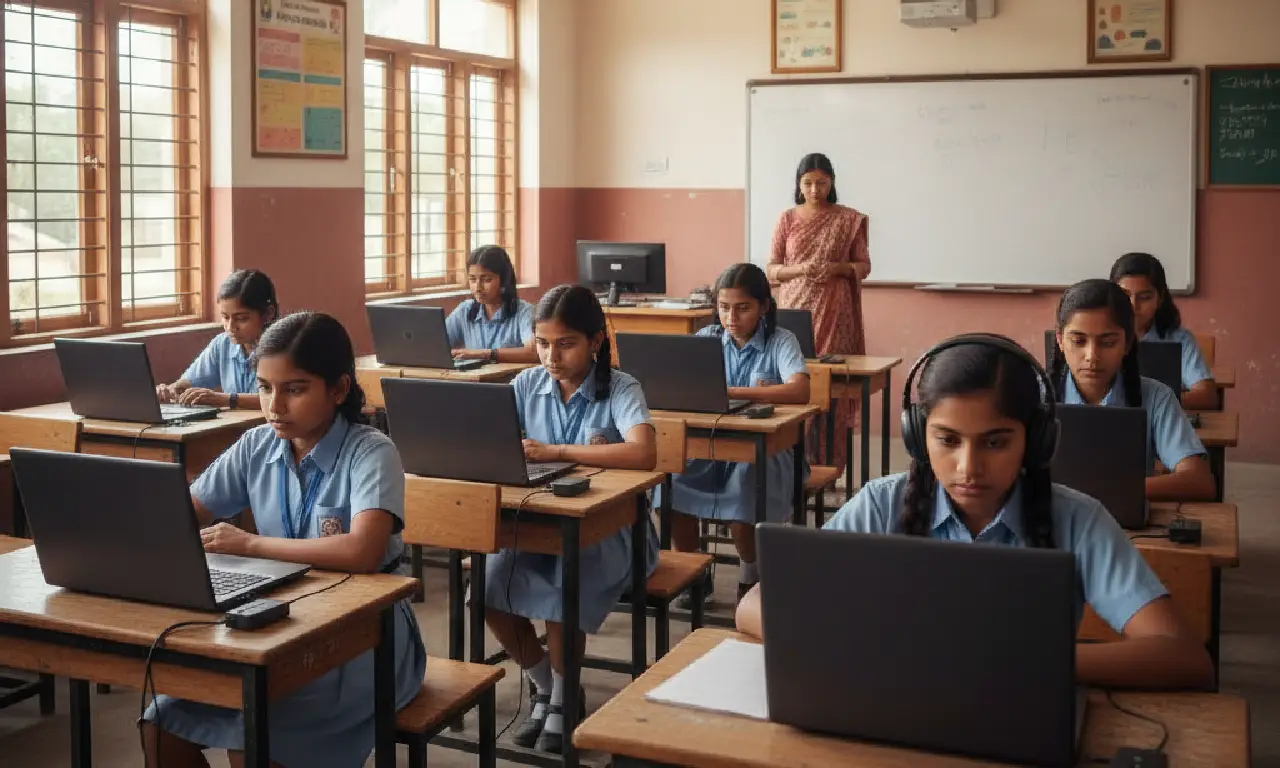
Artificial Intelligence is reshaping how schools evaluate students. In K-12 institutions across India, AI tools are automating essay scoring, analyzing answer sheets, and even adjusting test difficulty in real time. The promise is clear: faster grading, personalized insights, and data-driven fairness.
Yet, amid this progress lies a crucial question: can algorithms understand nuance, context, and emotion? While AI can evaluate grammar or accuracy, it can’t yet measure creativity, empathy, or intent. This is where the concept of “Humanising the Algorithm” comes in, designing AI systems where technology and teachers work together, balancing efficiency with empathy.
Why Schools Are Turning to AI-Assisted Evaluation
Indian schools face mounting challenges: large class sizes, mounting grading loads, and rising parental expectations for transparency. AI-assisted assessments promise to save faculty hours and reduce subjectivity in marking. Schools using automated scoring and adaptive testing have reduced grading time by 40–50%. However, the real appeal lies in precision and personalization. AI-based systems can:
- Identify common learning gaps across cohorts
- Generate individual student feedback instantly
- Detect inconsistencies in question difficulty
- Predict which students are at risk of underperforming
But speed alone isn’t enough. Without human review, AI systems risk overlooking the very qualities schools value most, i.e. fairness, empathy, and judgment.
Human-in-the-Loop: The New Standard for Fairness
The Human-in-the-Loop (HITL) model represents a hybrid approach: AI handles data-heavy tasks, but humans retain oversight and final decision-making. Globally, this framework is becoming a cornerstone of ethical AI use in education. Human-in-the-loop AI reduces bias in automated grading models by up to 70%. Teachers validate AI decisions, refine rubric design, and ensure alignment with curriculum context. For Indian schools, this approach protects against three common risks:
-
Bias in training data: AI may reflect pre-existing grading biases.
-
Loss of context: Algorithms can misinterpret creative or unconventional answers.
-
Trust deficit: Parents and students are less likely to accept fully automated scores.
Thus, schools adopting AI grading systems are learning that keeping teachers in the loop not only ensures accuracy but also strengthens institutional credibility.
Role of Teachers: From Evaluators to AI Supervisors
AI is not replacing teachers, it’s reshaping their roles. Educators are evolving from manual graders into AI supervisors, curators, and interpreters of machine insights. Teachers use AI to analyze student trends, validate anomalies, and focus on the higher-order aspects of feedback.
For instance, AI can grade 100 essays for grammar consistency, but only a teacher can recognize originality or emotional depth. By offloading repetitive tasks, educators regain time for mentoring and personalized instruction. Moreover, this partnership elevates teacher agency. When educators guide technology rather than resist it, they help shape systems that align with classroom realities, not just algorithms.
Case Study 1: Modern School, Delhi – Automating With Empathy
Modern School in Delhi piloted an AI-based essay scoring tool in 2025 to streamline its evaluation process. The AI provided immediate feedback on structure, grammar, and coherence, cutting grading time by nearly half.
However, teachers noticed that while the algorithm efficiently scored writing mechanics, it sometimes misjudged creativity or tone. To fix this, the school established a two-step process, the AI generated preliminary scores, and teachers reviewed borderline cases for final grading. This hybrid workflow resulted in:
- 40% faster grading turnaround
- More consistent rubrics across teachers
- Higher student trust due to teacher oversight
The pilot’s success proved one key insight: AI can optimize speed, but humans preserve meaning.
Case Study 2: Chennai’s AI Samrat – Seeing Beyond Right and Wrong
At Prasan Vidya Mandir in Chennai, the school deployed a system nicknamed “AI Samrat” to analyze exam papers. The tool once flagged a math question as ambiguous, not the student’s answer. The AI recognized that the question was poorly framed and credited the student for critical thinking.
This event changed how the school viewed AI: not as an evaluator, but as a collaborator. Teachers began using AI Samrat to identify design flaws in question papers, review grading consistency, and understand student thinking patterns. This reflects India’s growing consensus: AI can enhance assessment only when educators remain its conscience.
Policy Context: India’s Push Toward Ethical AI in Schools
The National Education Policy (NEP) 2020 and National Digital Education Architecture (NDEAR) encourage AI adoption with an emphasis on transparency, inclusivity, and teacher empowerment. Meanwhile, CBSE’s collaboration with IBM and Intel has already trained over 1,000 teachers in AI fundamentals and data ethics.
For school directors and trustees, aligning with these frameworks means:
- Adopting AI tools that comply with data privacy standards
- Ensuring transparency in AI decision-making
- Integrating teacher feedback loops into every digital assessment process
These policies reflect a national vision: AI should enhance human capacity, not replace it. By embedding teacher oversight, Indian schools can meet both ethical and operational benchmarks.
Building the Human-AI Partnership: A Leadership Playbook
School leaders looking to adopt AI responsibly can follow this roadmap:
-
Start with pilots: Introduce AI in one subject or grade before full deployment.
-
Invest in teacher training: Equip educators with AI literacy and feedback analysis skills.
-
Define roles: Clarify where AI’s judgment ends and human judgment begins.
-
Ensure data security: Follow national data-protection guidelines (NDEAR-compliant).
-
Communicate transparently: Share with parents how AI assists, not replaces, teachers.
These steps turn AI adoption from a tech upgrade into a cultural transformation, one that strengthens both teaching and trust.
Beyond Grades: The Emotional Intelligence Gap in AI
Even as algorithms advance, they remain tone-deaf to human emotion. AI cannot sense a child’s anxiety, effort, or learning struggles. Teachers can.
This is why emotional intelligence remains irreplaceable in assessment. Educators interpret not just performance data but emotional cues, an essential aspect of holistic learning. In hybrid AI workflows, teachers can use machine analytics to spot patterns (like consistent low confidence in certain topics) and intervene empathetically. AI can assess what a child knows; teachers understand why they learn the way they do. That distinction is the foundation of truly humanised education.
The Global Perspective: Lessons for Indian Schools
Globally, education systems are embracing the same ethos. In Finland, AI-powered grading is always moderated by teacher panels. In Singapore, national exams use adaptive algorithms, but every flagged outlier undergoes manual verification.
For Indian schools, this global alignment offers reassurance: the world’s most successful education systems view AI as a tool of amplification, not automation. As UNESCO MGIEP (2024) noted, “AI in education must evolve as a co-pilot for teachers, not an autopilot.”
Conclusion
India’s K-12 sector stands at the crossroads of automation and empathy. By designing assessments where AI and educators co-exist, schools can ensure fairness without sacrificing human insight.
The future belongs to schools that see AI not as a substitute, but as a symbiotic partner, a silent assistant that amplifies the teacher’s voice, not replaces it. As technology advances, the most powerful grading algorithm will remain the same: a teacher’s intuition, empathy, and understanding of every child’s story.
At GrowthJockey, we empower schools to adopt AI responsibly. From assessment automation through OttoScholar to analytics via Intellsys.ai, we design systems where human intelligence remains the core of digital transformation. Our mission is to help K-12 institutions scale with ethics, efficiency, and empathy.
FAQs
Q1. What is human-in-the-loop AI in school assessments?
Ans. It’s a model where AI automates scoring or analysis, but teachers review, interpret, and finalize results to ensure fairness and accuracy.
Q2. How does AI improve the quality of assessments?
Ans. AI speeds up grading, identifies patterns, and provides data insights, allowing teachers to focus on feedback and conceptual improvement.
Q3. Will AI replace teachers in Indian schools?
Ans. No. The NEP 2020 and global education frameworks emphasize augmentation, not replacement. Teachers remain central to all AI-driven processes.
Q4. What are the risks of fully automated grading?
Ans. Bias, lack of context, and reduced transparency. Human oversight ensures algorithms remain accountable and equitable.
Q5. How can schools start integrating AI into their assessments?
Ans. Begin with small pilots, train teachers in AI literacy, and adopt hybrid workflows where humans validate AI outputs.








Industries
Growth
Operations
Technology