
AI Lead Scoring in EV Dealerships: Why Hot-Lead Prioritisation Will Define 2025 Conversions
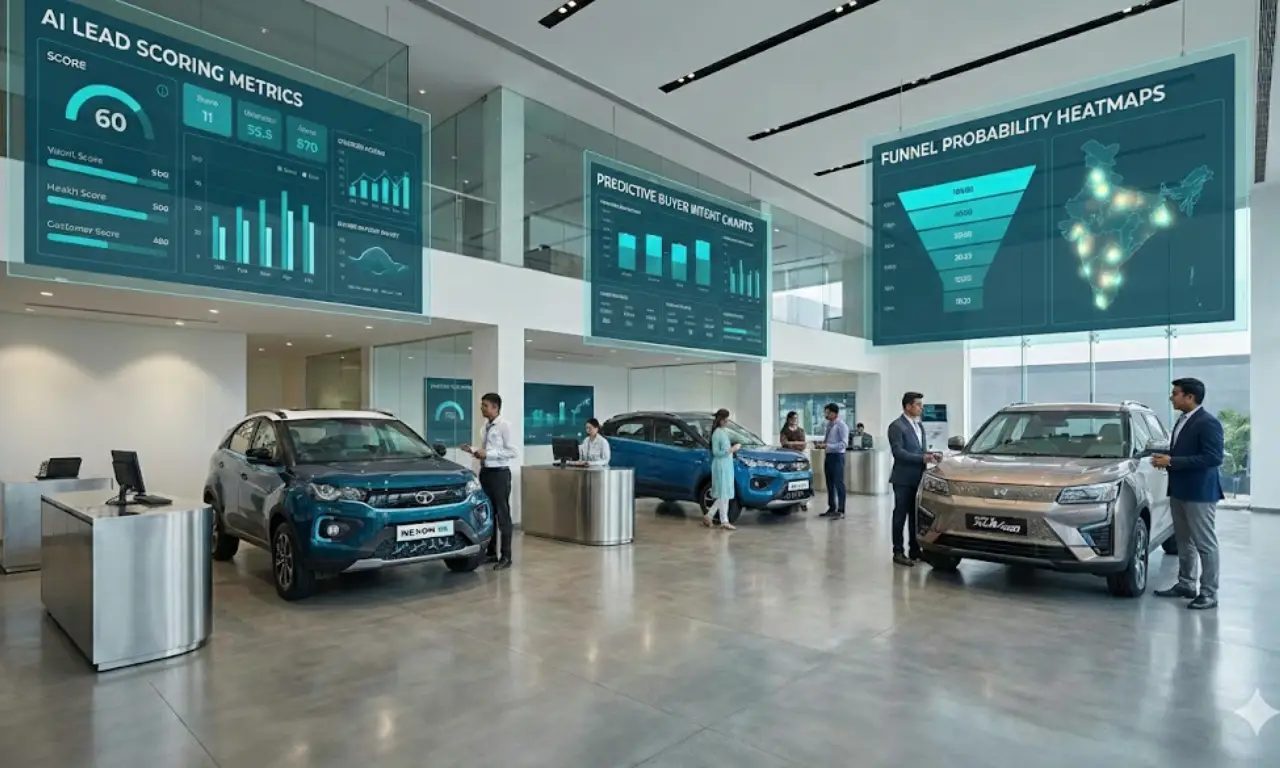
India’s EV retail ecosystem is now shaped by digital intent long before a customer enters a showroom. Buyers explore models, compare ranges, check EMI viability, and evaluate charging infrastructure months before they make contact. Yet, for most dealerships, every lead still arrives in the CRM as a uniform record. This creates a structural blind spot: sales teams must operate without clarity on who is ready to test ride, who needs nurturing, and who is unlikely to convert at all. AI lead scoring eliminates this ambiguity by assigning a predictive conversion probability to each buyer—transforming how dealerships prioritise outreach and enabling a more accurate, efficient and profitable sales pipeline.
The Digital Buyer Has Changed - Lead Management Has Not
EV buyers today display highly distinguishable online patterns, but dealerships continue to follow uniform contact cadences. As EV adoption accelerates, the share of digital-origin leads has grown significantly, and these leads carry rich behavioural signals: configurator depth, repeat visits, range comparison journeys, and finance-tool usage. However, conventional CRMs treat these as equal entries rather than hierarchies of purchase readiness.
This mismatch creates inconsistent funnel progression. High-intent prospects, capable of converting within days, often receive delayed follow-ups. Meanwhile, sales teams spend hours calling early-stage researchers who are months away from any decision. AI scoring resolves this mismatch by interpreting behavioural patterns and ranking leads according to their real purchase maturity. It shifts dealerships from reactive lead management to proactive revenue targeting.
The Technical Basis of AI Scoring in EV Dealerships
AI lead scoring models are built on behavioural clustering rather than simple demographic inputs. Instead of evaluating only “age, location, income,” the system analyses repeat browsing patterns, depth of comparison, responsiveness to communication, and progression across stages of digital evaluation.
These behavioural clusters form the foundation of scoring. A buyer exploring range anxiety FAQs behaves differently from someone evaluating variant-specific on-road pricing. AI interprets dozens of such micro-behaviours and combines them into a multidimensional readiness score. The more historical data a dealership accumulates, the more precise this scoring becomes, because the model learns which behaviours preceded actual bookings and which led to dead ends.
Unlike rule-based scoring, which requires manual threshold definition, AI models are self-improving. They continuously adjust signal weights to reflect emerging buyer patterns, changing EV price points, and new financing preferences. The system becomes more accurate with every cycle of wins and drop-offs recorded in the dealership funnel.
Why Hot-Lead Prioritisation Will Shape EV Conversions in 2025
The competition within India’s EV ecosystem is intensifying. With more OEMs, more product launches, and more digital channels influencing discovery, dealerships must operate with greater precision. Hot-lead prioritisation elevates conversion performance because it aligns sales bandwidth with revenue probability rather than sheer lead volume.
High-intent buyers move quickly. They respond faster, evaluate fewer alternatives, and convert at higher rates. These buyers expect immediate acknowledgement—delays often push them toward competing showrooms. When AI surfaces these buyers early, dealerships reduce time-to-contact, increase test-ride conversions, and accelerate revenue cycles. The impact is particularly visible in high-density EV clusters like Bengaluru, Hyderabad, Pune, Delhi NCR and Chennai, where lead volumes are high and response speed determines competitive advantage.
How AI Scoring Improves Test-Ride Efficiency
Test rides are still the strongest conversion lever in EV retail. However, they require operational orchestration: vehicle assignment, location coordination, and field executive allocation. Without clarity on buyer readiness, dealerships often deploy test rides to low-intent leads, which reduces test-ride-to-booking efficiency.
AI scoring addresses this by identifying leads at the “evaluation inflection point” where a test ride has the maximum impact. This includes buyers who have compared multiple variants, revisited performance specifications, or interacted with finance tools. When dealerships prioritise test rides for these profiles, utilisation increases and conversion ratios climb.
Sales teams also benefit from the predictability AI introduces. Instead of managing test rides on intuition, they follow a data-led framework: who should be contacted first, which leads should get immediate scheduling, and which buyers should be nurtured digitally before resource allocation. This makes test-ride operations more structured, efficient, and yield-driven.
The Data Engine Behind Accurate AI Lead Scoring
AI models derive strength from the depth and variety of signals they absorb. EV buying journeys include dozens of touchpoints, each representing behavioural insight. Scoring accuracy improves when dealerships capture these signals comprehensively.
Key data inputs include:
-
Revisit frequency across high-intent pages such as variants, charging options, and cost calculators
-
Interactions with WhatsApp or SMS callbacks
-
Drop-off timing and return cycles during model comparison
-
Time spent on range, battery, or maintenance-related content
-
Location proximity and feasibility of prompt test-ride execution
These signals help the AI differentiate casual browsers from active evaluators. Over time, the system identifies which signals correlate most strongly with bookings and adjusts scoring weights accordingly.
Scoring Categories That Optimise Sales Team Workflow
Most AI systems classify leads into hot, warm, and cold categories. Hot leads exhibit behavioural patterns that strongly correlate with imminent purchase consideration. Warm leads demonstrate active research but require contextual nurturing. Cold leads display sporadic, non-directional behaviour.
This categorisation allows dealerships to reorganise daily workflows. Sales advisors begin their day with a prioritised list of hot leads and time-sensitive follow-ups. Warm leads receive personalised nurturing across WhatsApp, SMS, and automated drip emails. Cold leads are routed to long-term remarketing pools without draining frontline bandwidth. The result is a more disciplined, structured, and high-yield sales cadence.
How AI Scoring Strengthens CRM Automation and Funnel Consistency
CRM automation becomes significantly more powerful when fuelled by accurate scoring. AI assigns the right communication at the right stage, eliminating generic follow-ups that dilute engagement quality. Once the system identifies a high-intent buyer, it triggers accelerated workflows: 15-minute call targets, prioritised test-ride offers, and immediate callback escalation.
Warm leads follow a different pattern. They receive value-driven nurture flows—charging cost comparisons, EMI breakdowns, ownership reviews, or product videos. Cold leads enter low-intensity automation loops that keep them in the ecosystem without over-communication. This segmentation ensures that each lead progresses with the appropriate amount of effort and context.
Better automation also improves the accuracy of downstream analytics. With cleaner scoring and structured progression, dealerships can analyse which behaviours correlate with higher booking ratios, which nurture messages accelerate movement, and which segment shows the highest lifetime value.
Implementation Roadmap for AI Scoring in EV Dealerships
Deploying AI lead scoring is less about technology complexity and more about data discipline. Dealerships require clean, structured digital journeys where user behaviour is tracked consistently. Integrations between the OEM website, CRM systems, WhatsApp business platforms, and lead-capture interfaces ensure that signals flow seamlessly into the scoring engine.
Once integrated, dealerships undergo a calibration phase where the AI model is trained on historical win-loss patterns. Over the first few weeks, the model evaluates behavioural clusters and produces preliminary scoring bands. As more test-ride outcomes and booking decisions are fed into the system, scoring accuracy improves. Within 60–90 days, dealerships typically achieve a stable scoring baseline that aligns strongly with real-world conversion patterns.
A critical success factor is internal alignment. Sales advisors must trust the scoring model and adjust workflows accordingly. When teams follow the prioritisation system consistently, dealerships observe measurable improvements in follow-up quality, lead velocity, and final bookings.
Impact on 2025 Conversion Economics
AI scoring will fundamentally reshape EV dealership economics in 2025. Higher scoring accuracy directly reduces lead wastage, improves contact-to-test-ride ratios, and accelerates booking cycles. Dealers operating in competitive catchments gain a clear advantage: they convert high-intent buyers faster than rivals.
OEMs are also beginning to recognise the strategic influence of scoring. As electric models diversify across price bands, understanding consumer evaluation patterns becomes crucial for product planning and channel strategy. AI scoring provides this intelligence directly from real buyer behaviour rather than opinion-based market reports.
Dealership networks that adopt scoring early will build cumulative knowledge advantages. Their models will mature faster, creating a widening performance gap relative to competitors who continue to operate with traditional, volume-heavy lead management approaches.
GrowthJockey enables enterprises to operationalise data-led revenue engines across digital and hybrid funnels. Through advanced analytics, intelligent automation, and platforms such as Intellsys and OttoScholar, GrowthJockey helps EV manufacturers and dealerships convert fragmented buyer signals into structured conversion systems. As EV adoption accelerates, GrowthJockey’s venture-building approach equips organisations with the tools, insights, and operating models required to scale efficiently and capture long-term market advantage.
FAQs
Q1. How does AI lead scoring improve EV dealership conversions?
AI improves conversions by analysing behavioural signals and identifying buyers who are closest to test-ride or booking readiness. This allows sales teams to prioritise high-value leads quickly.
Q2. Why are micro-creators more effective for building trust?
They possess higher engagement rates and closer audience connections, making their recommendations feel more genuine than celebrities.
Q3. How does social commerce benefit from creator partnerships?
Creators bridge discovery and purchase by demonstrating products in real-life contexts to drive direct sales.
Q4. What is community-driven brand storytelling?
It involves empowering users to share their own experiences, shifting the narrative control from the brand to the community.
Q5. How can brands measure the success of creator collaborations?
Success is measured by tracking engagement, conversion rates, and the quality of User Generated Content rather than just likes.









Industries
Growth
Operations
Technology