
Judges of Bharat Ke Super Founders, Hosted by Sunil Shetty
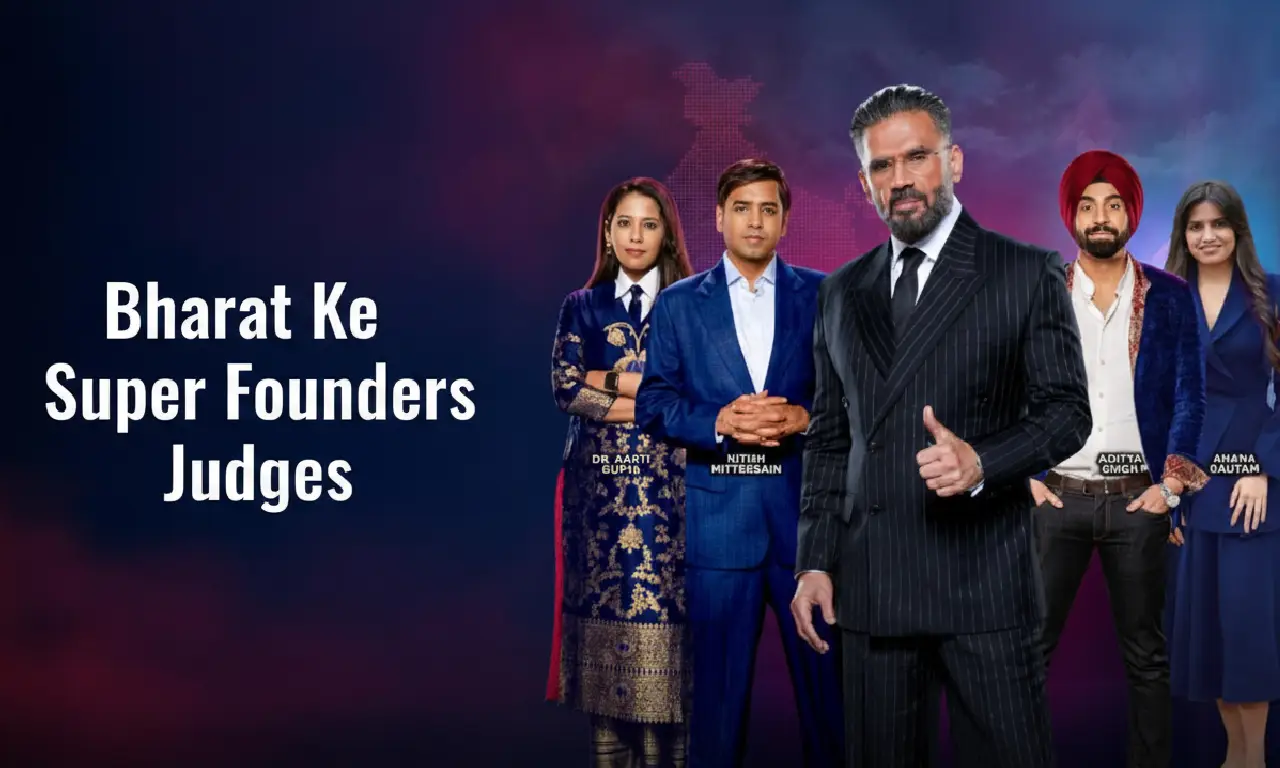
Bharat Ke Super Founders (BKSF) by Sunil Shetty is a reality series streaming on Amazon MX Player that serves as both an entertainment product and a financial vehicle. Unlike its predecessors, which largely focused on direct-to-consumer (D2C) brands and dramatic equity negotiations, BKSF positions itself as a platform for "nation-building" ideas, backed by a committed investment pool of ₹100 Crores. The show's distinct value proposition lies in its integration of diverse capital structures combining traditional equity, grants, and notably, venture debt through its partnership with Recur Club thereby mirroring the sophisticated financing stacks of mature enterprises.
This blog provides an exhaustive profile of the "Tycoons", the investor judges who adjudicate these deals. These individuals are not merely television personalities but architects of modern Indian industry. Their collective expertise spans diagnostics, digital gaming, family office wealth management, angel syndication, and venture debt. From the bootstrap legend Dr. A. Velumani, whose net worth exceeds ₹5,000 Crore following a historic exit to PharmEasy, to gaming mogul Nitish Mittersain, who steered Nazara Technologies to India's first gaming IPO, these figures represent the shift from "valuation" to "value".
The following analysis dissects Bharat Ke Super Founders Show's financial standing, professional pedagogies, and investment philosophies in granular detail. It is designed to serve as a definitive resource for understanding the "who, why, and how much" of the BKSF panel, addressing the growing public interest in their net worth and the strategic rationale behind their investments.
| Jduge/Panelist Name | Brand/Company | Est. Net Worth / AUM | Core Investment Thesis |
|---|---|---|---|
| Dr. A. Velumani | Thyrocare / PharmEasy | ~₹5,000 Cr (Net Worth) | High Margin, Frugality, Health-Logistics |
| Suniel Shetty | House of Shetty | ~₹125 Cr (Net Worth) | Brand Leverage, Supply Chain, Wellness |
| Nitish Mittersain | Nazara Tech | ~₹6,700 Cr (Co. Mkt Cap) | Digital Communities, E-Sports, Scalability |
| Dr. Aarti Gupta | Anikarth / Jagran | Family Office (Jagran Group) | Women Founders, Sustainable "Patient" Capital |
| Shanti Mohan | LetsVenture | $3 Billion+ (Portfolio Value) | Syndicate Deals, Cap Table Hygiene |
| Aditya Singh | All In Capital | ₹200 Cr (Target Fund) | Founder-Market Fit, Execution Capability |
| Ankur Mittal | IPV / Physis | ₹850 Cr+ (Deployed) | Valuation Discipline, Exit Engineering |
| Eklavya Gupta | Recur Club | ₹2,000 Cr (Disbursed) | Non-Dilutive Growth, Recurring Revenue |
This Table Shows a brief of all the BKSF panelists/Judges
The Host and Mentor: Suniel Shetty
While nominally the host, Suniel Shetty operates as the emotional and strategic anchor of the show. His role transcends that of a presenter; he is a bridge between the intimidating world of high finance and the aspirational "Super Founders."
Profile Snapshot
-
Name: Suniel Shetty
-
Role: Host, Mentor, Investor
-
Primary Entities: FTC Talent, House of Shetty
-
Estimated Net Worth: ₹125 Crore ($15 Million)
-
Investment Focus: Health-tech, Food-tech, Supply Chain
Wealth Analysis and Business Empire
Suniel Shetty's net worth, estimated conservatively at ₹125 Crore, is often understated because it is asset-heavy rather than valuation-driven. Unlike contemporary digital entrepreneurs whose wealth fluctuates with stock prices, Shetty's fortune is rooted in tangible assets accumulated over three decades.
Real Estate and Hospitality
Long before his cinematic debut, Shetty was a hotelier. His restaurant empire, which began with Mischief Dining Bar and Club H2O in Mumbai, established his cash flow early. His real estate portfolio is particularly robust, featuring high-value residential and commercial properties in Mumbai's exclusive Altamont Road and a sprawling luxury estate in Khandala. Some estimates value his real estate holdings alone in the range of ₹400 Crore, suggesting his total financial capacity exceeds the reported liquid net worth figures.
Strategic Startup Portfolio
In recent years, Shetty has pivoted from passive endorsements to active equity investing. His portfolio reflects a keen understanding of "Bharat's" logistical needs:
-
Proxgy: An industrial IoT startup known for its "Smart Hat" and drone delivery solutions. Shetty's investment here highlights his interest in deep-tech hardware that solves safety and efficiency problems in the unorganized labor sector.
-
Waayu: A zero-commission food delivery app. This investment positions him as a challenger to the duopoly of Zomato and Swiggy, appealing directly to the restaurant partners who struggle with high commissions a "Bharat" friendly stance.
-
Savesmart: A grocery delivery platform focusing on cost-efficiency, targeting the price-sensitive segments of the market.
-
Fittr (formerly SQUATS): A community-driven fitness platform. As a fitness icon, this investment leverages his personal brand equity to drive user acquisition, demonstrating his "Smart Capital" approach.
The Mentor Persona on BKSF
On Bharat Ke Super Founders, Shetty acts as the founder's advocate. When the Tycoons drill down into complex financial ratios, Shetty often intervenes to highlight the founder's grit ("Jazba"). He emphasizes "discipline," a core value from his own life as the primary predictor of success. His mentorship ensures that the show remains empathetic, validating the struggles of entrepreneurs who may lack polished pitch decks but possess immense operational stamina.
Dr. A. Velumani (The Bootstrapped Titan)
Dr. A. Velumani is arguably the most consequential figure on the panel. His presence shifts the gravity of the show from "venture capital" to "business building." His story is the ultimate validation of the "Bharat" dream.
Profile Snapshot
-
Name: Dr. A. Velumani
-
Designation: Creator, Thyrocare Technologies
-
Estimated Net Worth: ₹5,000 Crore+ ($600 Million+)
-
Origin: Landless farmer's son, Tamil Nadu
-
Key Exit: Sale of Thyrocare to PharmEasy for ₹4,546 Crore
-
Investment Style: Frugal, High-Margin, Zero-Debt, B2B Focus
The "Zero to Billions" Trajectory
Dr. Velumani's journey is a study in extreme resilience. Born in Appanaickenpatti Pudur, a small village in Tamil Nadu, he grew up in poverty. He began his career as a scientist at the Bhabha Atomic Research Centre (BARC) in Mumbai, where he worked for 14 years. This scientific background is crucial to understanding his business philosophy: he views business problems as mathematical equations to be solved.
In 1996, he resigned from his government job with a provident fund of just ₹1 Lakh to start Thyrocare. His insight was simple but revolutionary: thyroid testing was expensive because volumes were low and fragmented. By centralizing testing in a single, highly automated laboratory (the "hub") and collecting samples from across the country (the "spokes"), he could drive down costs dramatically. This "McDonald's of Pathology" model allowed Thyrocare to operate at EBITDA margins of 40%+, significantly higher than industry peers.
Wealth Analysis: The PharmEasy Deal
Dr. Velumani's wealth is not theoretical; it is realized. In June 2021, he executed one of the most significant transactions in Indian healthcare history by selling his 66.1% stake in Thyrocare to the digital pharmacy unicorn PharmEasy.
Deal Mechanics:
-
Transaction Value: The deal valued his stake at approximately ₹4,546 Crore.
-
Structure: Unlike many founders who cash out and leave, Velumani demonstrated his conviction in the sector by reinvesting approximately ₹1,500 Crore back into PharmEasy (Docon Technologies) for a ~5% stake.
-
Implication: This maneuver secured him ~₹3,000 Crore in liquid cash while retaining upside exposure to the consolidated digital health entity. This massive liquidity makes him one of the few "Super Angels" in India capable of writing institutional-sized checks personally.
Investment Thesis: The "Velumani Filter"
On BKSF, Dr. Velumani operates with a distinct set of heuristics that often clash with modern VC norms. He is the panel's "Profit Fundamentalist."
-
Frugality as a Moat: He believes that founders who spend money easily cannot build lasting businesses. He often probes founders on their personal spending habits and their "burn rate."
-
The "Delta" of Value: He looks for businesses that disrupt pricing. Just as Thyrocare made testing affordable for the masses, he favors startups that use technology to lower costs for the end consumer in "Bharat."
-
Stamina over Intelligence: He explicitly values "emotional quotient" (EQ) and the ability to handle pain over raw IQ or academic pedigree. He resonates with founders who have "skin in the game" and have bootstrapped their initial growth.
Nitish Mittersain (The Gaming Visionary)
Nitish Mittersain represents the digital future of Bharat. As the founder of India's first listed gaming company, he brings deep expertise in scaling digital products for a mass audience.
Profile Snapshot
-
Name: Nitish Mittersain
-
Designation: Founder & CEO, Nazara Technologies
-
Company Market Cap: ~₹6,700 Crore (Variable)
-
Personal Stake Value: ~₹225 Crore (Direct Equity) + Control Premium
-
Industry: Gaming, E-Sports, Ad-Tech
-
Investment Style: Network Effects, M&A-led Growth, Scalable Tech
The Nazara Odyssey: Survival to Dominance
Nitish Mittersain founded Nazara Technologies in 2000, right before the dot-com bubble burst. While thousands of internet companies vanished, Mittersain pivoted. He focused on the nascent mobile ecosystem, initially selling SMS-based content and ringtones (Value Added Services) before transitioning to smartphones and gaming. This 20-year journey of survival gives him a unique "long-term" perspective compared to founders who expect success in 2-3 years.
The "Friends of Nazara" Strategy:
Nazara is unique because it operates as a conglomerate. Mittersain's strategy has been to acquire majority stakes in winning gaming founders rather than building everything in-house. Key assets include:
-
Nodwin Gaming: The undisputed leader in Indian e-sports, organizing tournaments for titles like PUBG and Valorant.
-
Sportskeeda: A massive sports content platform with significant US traffic.
-
Kiddopia: A subscription-based edutainment app for kids, generating steady dollar revenues. This diversified portfolio generated revenues of ₹1,138 Crore in FY24, with a net profit of ₹89 Crore.
Wealth Analysis
Nitish Mittersain's net worth is inextricably linked to the performance of Nazara Technologies on the stock market. Public filings indicate his direct shareholding is valued at approximately ₹225 Crore. However, this figure likely underrepresents his total financial standing, which would include family holdings (the Mittersain family controls a larger block), dividends accumulated over two decades, and private investments. As the CEO of a publicly listed company, his investment decisions on BKSF are also scrutinized for potential strategic fits with the Nazara ecosystem.
Investment Thesis: The Digital Consumption Graph
On the show, Mittersain evaluates startups through the lens of digital adoption. He understands that the "Bharat" user is coming online primarily for entertainment and gaming.
-
Scalability: He prefers software businesses with near-zero marginal costs of replication.
-
Community: He looks for platforms that build engaged communities (like e-sports fans or learners).
-
Exit Strategy: As a founder who took his company public, he is keenly focused on the "end game." He pushes founders to articulate whether they are building for an IPO or an acquisition.
Dr. Aarti Gupta (The Family Office Steward)
Dr. Aarti Gupta represents a seismic shift in Indian capital markets: the professionalization of "Old Money." She brings the weight of one of India's most influential media families to the startup table.
Profile Snapshot
-
Name: Dr. Aarti Gupta
-
Designation: Chief Investment Officer (CIO), Anikarth Ventures (D.M. Gupta Family Office)
-
Family Entity: Jagran Group (Jagran Prakashan Ltd)
-
Group Market Cap: ~₹1,500 Crore (Promoter Holding ~69%)
-
Investment Focus: Women Entrepreneurs, Sustainable Tech, Defensive Moats
-
Style: Patient Capital, Values-Driven, Governance-Focused
The Jagran Legacy
The Jagran Group is a household name in the Hindi Heartland. Their flagship newspaper, Dainik Jagran, is one of the most widely read dailies in the world. The promoter family holds a commanding 69% stake in the listed entity, Jagran Prakashan Ltd. This media empire provides a steady stream of dividends and influence, which forms the corpus for Anikarth Ventures.
Anikarth Ventures: Modernizing Heritage Wealth
Dr. Gupta manages the D.M. Gupta Family Office through Anikarth Ventures. The name "Anikarth" is a portmanteau of "Anik" (Soldier) and "Arth" (Wealth/Meaning), symbolizing a disciplined approach to wealth creation. Unlike traditional VCs who are bound by 7-10 year fund cycles (forcing them to push for early exits), Family Offices like Anikarth offer "Patient Capital." They can hold investments for decades if the business fundamentals are sound. This aligns perfectly with the "Bharat" theme, where businesses may take longer to mature but offer robust longevity.
Investment Thesis: Inclusivity and Governance
Dr. Gupta distinguishes herself on the panel through her focus on inclusivity. As the National Head for FICCI FLO Startups, she is a vocal advocate for women entrepreneurs.
-
Gender Arbitrage: She recognizes that women founders are often undervalued by the market, presenting an investment opportunity.
-
Governance: Coming from a publicly listed family business, she places a premium on corporate governance. She scrutinizes the ethical foundations of the startups, ensuring they are built to last rather than built to flip.
Shanti Mohan (The Ecosystem Architect)
Shanti Mohan is the bridge builder of the Indian startup ecosystem. Her platform, LetsVenture, fundamentally changed how angel investing works in India.
Profile Snapshot
-
Name: Shanti Mohan
-
Designation: Founder & CEO, LetsVenture
-
Platform Stats: $3 Billion+ Portfolio Value; 900+ Startups Funded
-
Personal Net Worth (Est.): Founders' Net Worth ~₹89 Crore
-
Investment Focus: Early-stage Syndicates, Micro-VC
-
Style: Syndicate-Led, Diversified, High-Volume
The LetsVenture Revolution
Before 2013, angel investing in India was a closed club of ultra-wealthy individuals. Shanti Mohan democratized this by building LetsVenture, an online marketplace connecting startups with accredited investors. The platform has facilitated over ₹1,400 Crore in investments. Crucially, she recently launched Trica, a platform for cap table management and secondary shares, catering to growth-stage startups. This gives her visibility into the entire lifecycle of a company, from seed funding to exit.
Wealth Context
It is vital to distinguish between the assets on her platform ($3 Billion) and her personal wealth. Regulatory filings suggest the net worth of the LetsVenture founders is around ₹89 Crore. However, her "Influence Capital" is immense. A "Yes" from Shanti Mohan on BKSF signals to thousands of investors on her platform that the startup is vetted and investible.
Investment Thesis: The Syndicate Model
On BKSF, Shanti Mohan evaluates startups for their "syndicatability." Is the story simple and compelling enough to aggregate small checks from hundreds of angels? She focuses on:
-
Clean Cap Tables: Ensuring the founder hasn't given away too much equity to advisors or family.
-
Regulatory Compliance: Given the SEBI scrutiny on Alternative Investment Funds (AIFs), she is meticulous about structure.
-
Network Effects: She looks for founders who can leverage the LetsVenture network for more than just money for mentorship and customer access.
Aditya Singh (The Operator-VC)
Aditya Singh brings the "founder empathy" to the panel. As a successful entrepreneur turned investor, he speaks the language of the trenches.
Profile Snapshot
-
Name: Aditya Singh
-
Designation: Co-Founder, All In Capital
-
Fund Size: Targeting ₹200-300 Crore (Fund II)
-
Background: Founder, Bookmyforex.com (Acquired by MakeMyTrip)
-
Focus: Pre-Series A, Founder-First
-
Style: High Conviction, Operational Support
The Operator Journey
Aditya Singh founded Bookmyforex.com, India's first online marketplace for foreign exchange. Fintech in India is a regulatory minefield, and navigating this to a successful exit (acquisition by MakeMyTrip) proved his operational mettle. This "been there, done that" background allows him to see through polished pitches to the operational reality beneath.
All In Capital: The Thesis
His fund, All In Capital, is a micro-VC firm. The name reflects his philosophy: he backs founders who are "all in", fully committed with no Plan B.
-
Selection Criteria: He looks for "founder-market fit." Why is this person the best person to solve this problem?
-
Stage: He typically invests early (Seed to Pre-Series A), where the risk is highest but the potential returns (multiples) are greatest.
-
Role on BKSF: He acts as the operational stress-tester, asking specific questions about customer acquisition costs (CAC), hiring challenges, and tech stack scalability.
Ankur Mittal (The Metrics Analyst)
Ankur Mittal represents the institutionalization of angel investing. He brings data rigor to the chaotic early-stage market.
Profile Snapshot
-
Name: Ankur Mittal
-
Designation: Co-Founder, Inflection Point Ventures (IPV) & Physis Capital
-
Capital Deployed: ₹650 Crore+ (IPV); ₹200 Crore+ (Physis)
-
Track Record: 61% IRR (Internal Rate of Return)
-
Focus: Due Diligence, Metrics, Exit Engineering
Structuring the Chaos: IPV and Physis
Mittal co-founded Inflection Point Ventures (IPV) to solve the "lack of diligence" problem in angel investing. IPV runs a rigorous evaluation process involving 30-40 parameters before presenting a deal to its members. This discipline has resulted in a spectacular 61% IRR across 14 exits, a number that commands respect in the industry. To support his winning portfolio companies in later stages, he launched Physis Capital, a growth-stage fund with a corpus of $50 Million.
Investment Thesis: The Math of Success
On the show, Ankur Mittal is the "Human Calculator."
-
Valuation Logic: He relentlessly challenges arbitrary valuations. If a founder asks for ₹10 Crores valuation on ₹10 Lakh revenue, Mittal will dismantle the ask using revenue multiples and industry benchmarks.
-
Exit Visibility: He invests with the exit in mind. He wants to know who will buy this company in 5 years a strategic acquirer or the public markets?
-
The "Scorecard": His decision-making is less emotional and more scorecard-based, focusing on Team, Tam (Total Addressable Market), and Traction.
The Financial Engine: Recur Club & Eklavya Gupta
A unique structural differentiator of Bharat Ke Super Founders is the formal integration of Recur Club, represented by Eklavya Gupta. This introduces a financial instrument that is critical for the "Bharat" ecosystem: Non-Dilutive Capital.
Profile Snapshot
-
Name: Eklavya Gupta
-
Designation: Co-Founder & Co-CEO, Recur Club
-
Platform Scale: ₹2,000 Crore+ Capital Disbursed
-
Funding: Raised $50 Million (Series A + Debt)
-
Background: Private Equity (Nomura, Kotak, CDPQ)
The Debt Revolution: Revenue Based Financing (RBF)
In traditional VC (like Shark Tank), the only currency is equity founders must sell a piece of their company to get cash. This is expensive, especially for early-stage founders with low valuations.
Recur Club changes the game by treating future revenue as an asset. If a startup has predictable monthly revenue (e.g., subscriptions), Recur Club provides upfront cash in exchange for a small percentage of that future revenue.
-
Mechanism: A startup with ₹10 Lakh monthly revenue can get ₹50 Lakh upfront to spend on marketing. They repay it as a % of revenue over 6-12 months.
-
Advantage: The founder suffers zero dilution. They keep their shares.
Role on BKSF
Eklavya Gupta appears on the show not just as an investor but as a "Capital Architect."
-
The "Reality Check": He often advises founders against taking equity investment if they don't need it.
-
Hybrid Deals: He structures deals where a founder might take ₹50 Lakh in Equity from Dr. Velumani (for mentorship) and ₹50 Lakh in Debt from Recur Club (for working capital). This optimizes the founder's cost of capital.
-
Impact: This education is vital for "Bharat" founders who often view debt as a "loan shark" instrument rather than a strategic growth tool.
Comparative Analysis: BKSF vs. Shark Tank India
To truly understand the market positioning of these judges, a direct comparison with the incumbent Shark Tank India Judges is necessary.
| Primary Focus | D2C Brands (Consumer Goods), Viral Products | "Bharat" Solutions, Agritech, Deep Tech, Industrial |
|---|---|---|
| Judge Profile | Founders of Consumer Brands (Boat, Sugar, Lenskart) | Institutional Builders (Diagnostics, Gaming, Family Office) |
| Net Worth Scale | High (₹300 - ₹4,000 Cr range) | Massive Variance (Velumani @ ₹5,000 Cr+ vs. Micro VCs) |
| Capital Type | Predominantly Equity | Hybrid: Equity + Venture Debt (Recur Club) + Grants |
| Tone | Dramatized, Negotiation-Heavy, Personality-Led | Mentorship-Driven, Discipline-Focused, Educational |
| Key Metric | "Marketing Spend" & "Brand Recall" | "Unit Economics" & "Profitability" |
Insight: BKSF is not trying to be a "better" Shark Tank; it is trying to be the "serious" alternative. It appeals to the founder who is building a logistics company in Bihar rather than a lipstick brand in Mumbai. The presence of Dr. Velumani anchors the show in the reality of hard business that requires physical infrastructure, logistics, and patience, not just Instagram ads.
Conclusion: Where GrowthJockey Fits In
Bharat Ke Super Founders signals a shift in Indian entrepreneurship from hype-driven funding to disciplined, value-led venture building. The panel reflects a mature ecosystem where capital is no longer the constraint; clarity and execution are.
That gap is where GrowthJockey comes in.
As a venture architect, GrowthJockey helps founders design businesses the way BKSF tycoons evaluate them with strong unit economics, the right capital mix (equity vs debt), and scalable operating systems. We focus on building ventures that survive beyond funding rounds, not just pitch decks.
If BKSF shows what great looks like, GrowthJockey helps you build towards it - from idea to enduring enterprise.
Note: Financial figures are based on publicly available data, regulatory filings, and market capitalizations as of early 2026. Net worth estimates for private individuals (like VC fund managers) often reflect "Carry" (potential profit share) and personal holdings, whereas figures for public company founders (Velumani, Nitish) are more precise based on shareholding disclosures.
FAQs
Q1. Who are the judges of Bharat Ke Super Founders? The judges include Dr. A. Velumani, Nitish Mittersain, Dr. Aarti Gupta, Shanti Mohan, Aditya Singh, Ankur Mittal, and Eklavya Gupta. The show is hosted by Sunil Shetty.
Q2. Is Sunil Shetty a judge or the host of Bharat Ke Super Founders? Sunil Shetty is the host and mentor, not a core equity judge. He guides founders and anchors discussions while investments are led by the panel.
Q3. How is Bharat Ke Super Founders different from Shark Tank India? BKSF focuses on Bharat-first businesses, profitability, and capital discipline, using a mix of equity, venture debt, and patient capital instead of only equity deals.
Q4. Where can you watch Bharat Ke Super Founders? Bharat Ke Super Founders is streaming on Amazon MX Player.









Industries
Growth
Operations
Technology