
From BNPL to EVs: How Embedded Finance Is Changing Vehicle Lending
Over the past decade, a quiet revolution has been reshaping how consumers access credit. From “Buy Now, Pay Later” (BNPL) at online checkouts to instant EMIs for mobile phones and furniture, embedded finance has transformed credit from a back-end process into an invisible feature of everyday purchases. As India accelerates toward electric mobility, these same principles hold the power to unlock adoption by making customer financing frictionless, inclusive, and data-driven.
This article explores how the BNPL playbook perfected by e-commerce and fintech can guide the evolution of EV lending. It highlights the key parallels, underlying technologies, and lessons that can help OEMs, banks, and NBFCs design next-generation POS financing models for electric vehicles.
Understanding Embedded Finance and Its Rise
What is embedded finance?
At its core, embedded finance refers to the seamless integration of financial services lending, payments, insurance, or investments within non-financial platforms. Instead of visiting a bank or filling lengthy forms, consumers access credit directly within the purchase journey.
In e-commerce, BNPL and instant EMI options are classic cases. Shoppers buying phones on Flipkart or Amazon can opt for credit instantly through fintech partners like ZestMoney, Simpl, or LazyPay. This is not traditional consumer finance; it is credit designed to feel invisible.
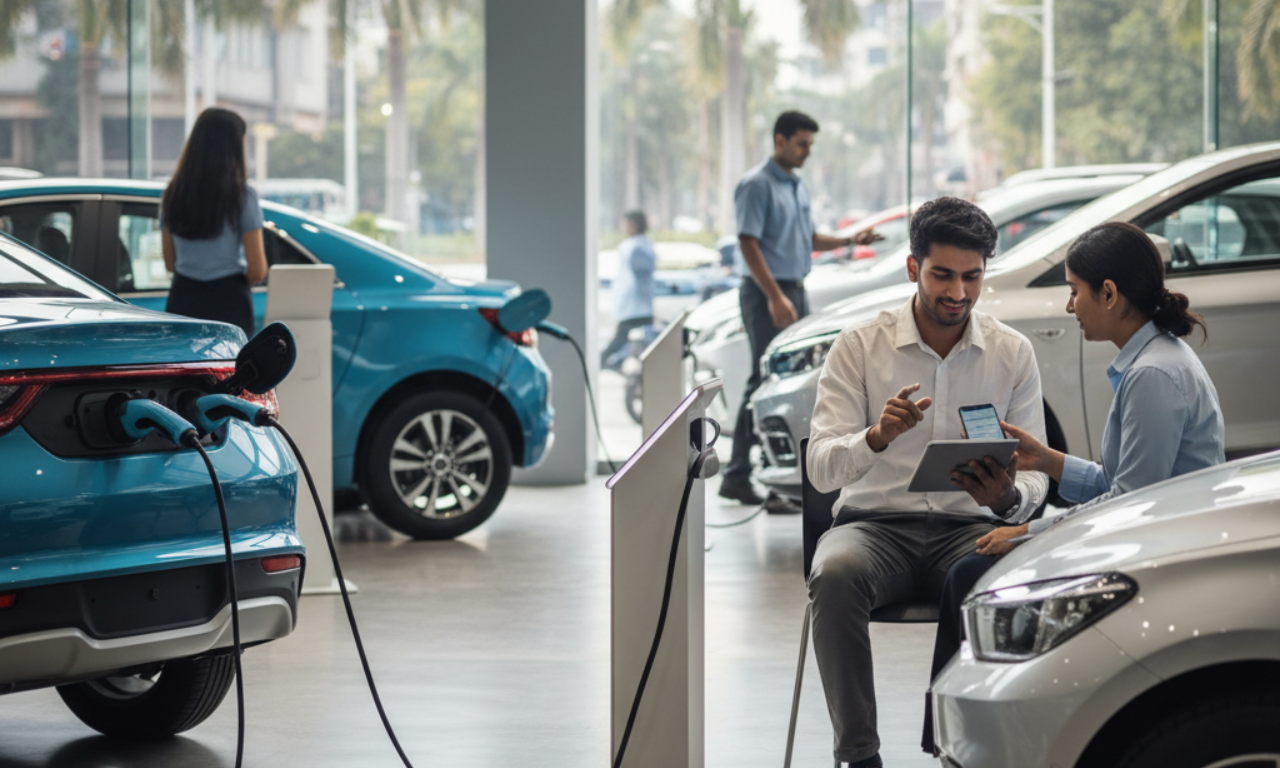
The same principle can power EV adoption. Instead of arranging financing separately, buyers could access pre-approved customer financing while booking a scooter or car digitally, instantly, and personalized to their profile.
The BNPL explosion
India’s BNPL sector has grown from less than $3 billion in 2019 to nearly $12 billion in 2025, driven by younger, thin-file customers and fintech innovation. It offers critical insights for EV lenders:
-
Speed matters: Instant credit decisioning at checkout drives conversion.
-
Data intelligence: Real-time behavioral data builds more accurate credit models.
-
Affordability: Flexible tenures and small-ticket EMIs boost participation.
-
Trust through transparency: Simple repayment schedules and digital reminders reduce defaults.
These mechanisms have proven that most automobile financing is provided by institutions that can effectively blend risk management with user experience. Translating this to EVs means replicating the same emotional and operational ease in a higher-value purchase.
The EV Financing Challenge
Structural credit gaps
Despite India’s EV sales surpassing 2 million units in FY25, financing remains constrained. For many lenders, EV loans still appear riskier due to uncertain resale values, lack of long-term data, and higher upfront costs.
Traditional loan journeys rely heavily on bureau scores, paper KYC, and manual underwriting, which elongate approval times. This friction leads to drop-offs at dealerships and delays sales. AI-driven POS financing and digital transformation in finance industry processes can compress this timeline from days to minutes.
Comparing EV loans with BNPL logic
BNPL thrives because it is designed around simplicity and trust. When a user clicks “Buy with EMI,” the system leverages digital footprints to instantly evaluate risk. EV lenders can adopt the same architecture:
-
Use alternative data (UPI transactions, telematics, utility payments) to feed AI in banking and finance models.
-
Offer pre-approved limits at the point of sale via dealer tablets or mobile apps.
-
Convert approvals into consumer finance loan offers embedded in the booking flow.
This experience removes psychological and procedural friction, improving conversion exactly what BNPL achieved in retail.
Cross-Industry Case Studies: Lessons for EV Financing
E-commerce and BNPL In e-commerce, companies like Flipkart and Amazon India pioneered embedded finance through collaborations with fintechs and banks. During Flipkart’s “Big Billion Days” 2024 sale, 70 % of transactions involved some form of EMI or pay-later option.
These partnerships demonstrated how consumer finance integrated within purchase flows increases both sales and customer stickiness. For EVs, similar “Festival Financing Drives” could offer instant credit during model launches, leveraging customer financing ecosystems built jointly by OEMs and lenders.
Consumer durables and lifestyle finance
The consumer durables sector from electronics to education has mastered small-ticket lending. Platforms like Bajaj Finserv and HDFC Bank’s Smart EMI rely on artificial intelligence in banking ppt-style credit models that score applicants instantly. Over 60 % of Bajaj Finserv’s retail loans now originate digitally, illustrating innovation in banking sector practices.
The insight for EVs: digital retail asset products can work even for higher-value goods, provided risk is balanced by data-rich underwriting.
Mobility and fleet finance
Ride-hailing companies like Ola and Uber use driver data earnings, trip volumes, repayment history to enable AI-based credit. Ola Financial Services offers customer financing and POS in loan features directly within its driver app, reducing processing time to minutes.
These embedded models show that use of AI in finance can deliver not only convenience but also portfolio quality improvements. Applying similar designs to EV OEMs could accelerate two- and three-wheeler adoption in Tier-2 markets.
The Mechanics of Embedded EV Finance
Integrating credit at the point of sale
In an ideal setup, the EV purchase journey should merge selection, credit, and insurance into one interface. Dealerships can use AI-powered APIs to instantly evaluate eligibility, execute KYC remediation, and generate consumer finance types customized for the buyer.
This process converts the dealership from a sales outlet into a financial hub, turning most automobile financing into a seamless retail experience.
Instant decisioning and AI-driven underwriting
BNPL models demonstrate the power of instant gratification. Similarly, AI-based underwriting for EVs can assess thousands of data points within seconds. It can use telematics data, mobility patterns, or charging behavior to evaluate repayment capacity expanding credit to previously underserved borrowers.
Such automation ensures inclusivity and highlights the advantages of underwriting through data-driven precision.
Automation of KYC and documentation
AI tools, OCR, and biometrics have made digital transformation in finance industry a reality. EV lenders can integrate paperless onboarding, e-sign, and kyc for high risk customers checks within a unified system. This reduces manual overheads, speeds up approvals, and strengthens compliance.
Linking insurance and maintenance finance
A mature embedded finance ecosystem includes not just credit but also insurance distribution channels. Integrating insurance aggregators into EV purchase flows helps manage asset risk and customer trust. For example, bundled warranties or battery insurance can reduce default probability by lowering perceived risk.
Strategic Framework: Adapting BNPL Lessons for EV Lenders
OEMs: make finance part of the product
EV manufacturers must treat credit as integral to their offering. Embedding customer financing tools into dealer tablets and apps can transform sales outcomes. Mahindra, Tata, and Ather already integrate instant loan offers into their purchase journeys.
Adding future of credit cards-style flexibility such as deferred payments or cashback on timely EMIs can enhance appeal among younger consumers.
Lenders: embrace new data and partnerships
Banks and NBFCs should invest in fintech software solutions that enable artificial intelligence in banking sector in India. Partnerships with OEMs can create hybrid partial underwriting systems, leveraging real-time telematics and transactional data.
For instance, examples of small finance banks such as Equitas or AU SFB could collaborate with EV startups to design low-ticket consumer finance loan products, blending physical presence with digital analytics.
Regulators: facilitate innovation with oversight
The Reserve Bank of India (RBI) and NITI Aayog have both emphasized responsible AI in banking and finance adoption. Regulatory sandboxes should encourage pilot programs that test embedded finance models safely. Mandatory importance of underwriting protocols can ensure risk discipline even as automation scales.
Consumers: building trust and literacy
BNPL succeeded because consumers understood its simplicity. EV finance must communicate the same clarity transparent EMIs, total cost of ownership, and advantages of retail banking options. Consumer literacy campaigns can strengthen trust and ensure sustainable adoption.
Quantifying the Opportunity
A recent NITI Aayog report estimates India’s EV financing demand will touch ₹3.7 trillion by 2030, requiring deep private-public collaboration . Within this, digital credit could constitute nearly 60 % of new disbursals.
The impact of technology on banking industry is evident: paperless and AI-based journeys reduce processing costs by up to 70 % and improve loan-to-approval ratios by 25 % .
Globally, the embedded finance market is projected to surpass $7 trillion in value by 2030 . If even a fraction of this architecture applies to EVs, India could see exponential adoption driven by affordability and speed.
Risks and Guardrails
Despite the promise, caution is essential.
-
Over-extension: Easy credit can lead to over-borrowing.
-
Data privacy: Cross-industry data use must comply with India’s Digital Personal Data Protection Act 2023.
-
Model drift: Constant monitoring is needed to prevent algorithmic bias or inaccurate risk assessment.
-
Systemic risk: Excessive unsecured lending, as seen in early BNPL phases, must be checked through importance of underwriting standards.
Clear governance, transparency, and consumer protection will define whether embedded finance becomes a sustainable lever or a risk multiplier.
The Road Ahead: Convergence of Credit and Commerce
From BNPL checkouts to EV showrooms, one principle remains constant credit works best when it is invisible. The next leap in recent trends in banking is not about new products but new experiences: frictionless, inclusive, and personalized.
By blending AI in banking and finance, customer financing, and embedded finance, India can design an EV ecosystem that mirrors the accessibility of online shopping. The lessons from BNPL speed, simplicity, and smart data are the bridge between aspiration and adoption.
The future of India’s electric mobility may not be built only in factories but also in algorithms where every battery, rider, and repayment becomes part of an intelligent, self-learning consumer finance network.
In that sense, the road from “Buy Now, Pay Later” to “Drive Now, Pay Later” has already begun.
FAQs
Q1. What is embedded finance?
Ans. Embedded finance integrates credit or payments directly into the purchase flow.
It lets consumers access loans seamlessly without visiting banks.
Q2. How can BNPL lessons help EV financing?
Ans. BNPL principles like speed and simplicity enable instant EV loan approvals.
POS financing reduces friction and improves adoption rates.
Q3. What role does AI play?
Ans. AI analyzes alternative data to assess creditworthiness quickly and inclusively.
It enables dynamic limits, real-time monitoring, and smarter underwriting.
Q4. What are the risks?
Ans. Risks include over-borrowing, data privacy concerns, and algorithmic bias.
Strong governance, transparency, and monitoring are essential for safety







Industries
Growth
Operations
Technology