
Charging the Hinterland: How Rural Infra Will Shape India’s EV Future
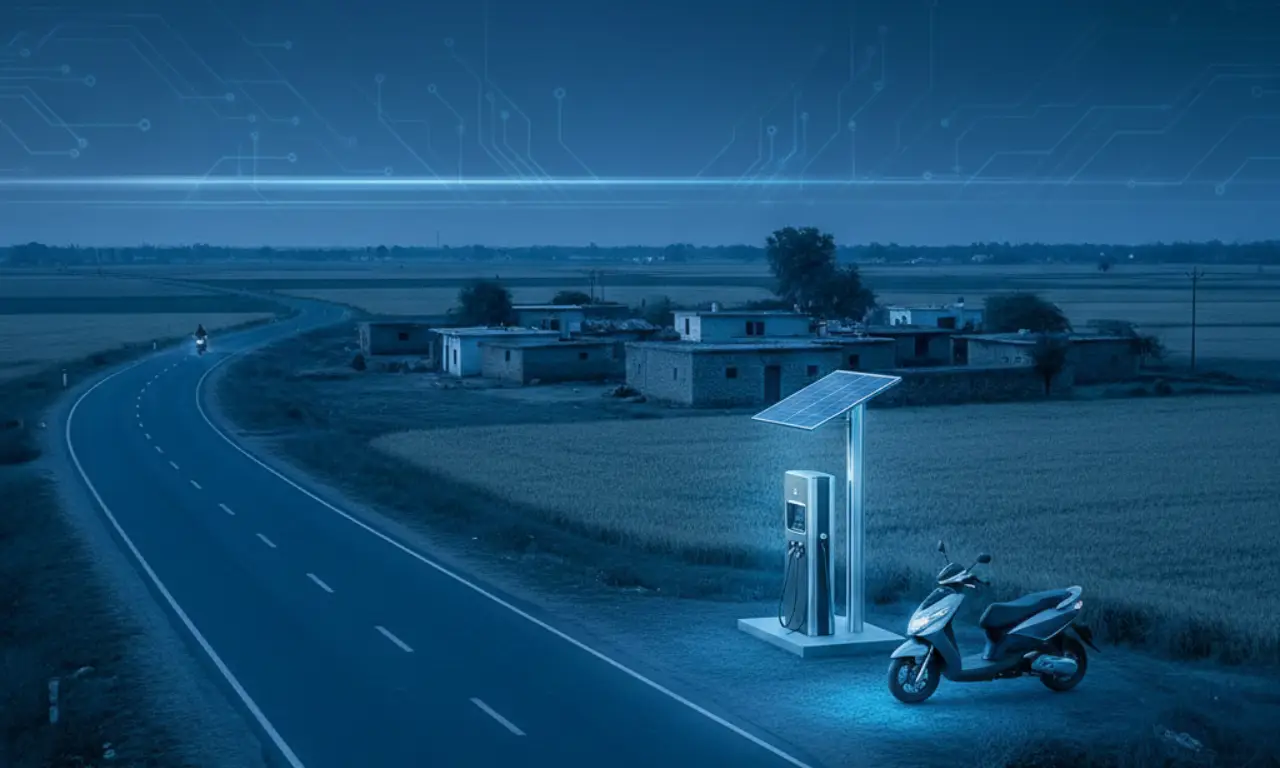
India’s electric mobility transition is often framed around urban adoption, premium scooters, and fast-charging corridors. Yet the true inflection point lies far from cities in India’s villages, small towns, and agrarian belts where mobility is a daily lifeline. This article examines how rural India is emerging as the decisive battleground for EV growth, why charging infrastructure is the catalytic layer, and how solar microgrids, battery swapping, rural entrepreneurship, telematics, and OEM operations will collectively define the next decade.
A Quiet Revolution Beyond India’s Cities
Night falls differently in rural India. In villages where evenings arrive early and roads fade into long stretches of darkness, mobility is not convenience it is possibility. It enables a delivery worker to reach home safely, a farmer to transport produce before spoilage, a pregnant woman to reach a clinic twenty kilometres away, a student to attend coaching classes across districts, or a technician to travel for essential repairs.
For decades, petrol-driven two-wheelers and motorcycles stitched this social and economic fabric together. But something is changing. A faint electric hum along dusty lanes, a small EV scooter parked beside a kirana store, a solar pump operator charging two scooters next to his shed, and panchayats experimenting with community charging booths these are not sporadic events. They are early indicators of a structural transition.
The future of EVs in India will not be shaped in Bengaluru or Pune.
It will be shaped in Bharat, where mobility is a necessity, not a lifestyle choice.
And the catalyst for this transformation is not the vehicle it is charging infrastructure.
Why Rural India Matters More Than Ever
Rural India is not a secondary market. It is the demographic and economic backbone of national mobility.
Population Gravity
Over 65% of India’s population resides outside Tier-1 metropolitan zones. Any national-scale electrification strategy must centre rural mobility.
Mobility as Daily Survival
Rural transportation needs are purposeful and frequent:
-
Agriculture and farm logistics
-
Commuting to work
-
Access to healthcare
-
Micro-entrepreneurship
-
Local goods movement
-
Women-led mobility for household and livelihood needs
-
Education and coaching commutes
EVs naturally align with these patterns owing to their predictability, low running cost, and mechanical simplicity.
Rural Travel Patterns Fit EV Capabilities
The average rural commuter travels 8–25 km per day perfectly suited for even the most affordable electric scooters. Unlike cities, where range anxiety dominates, rural usage often involves predictable, shorter routes with known endpoints.
High Cost Sensitivity
A daily petrol expense of ₹100–200 weighs heavily on rural households. EVs reduce this to ₹5–15 per day and near-zero when powered by solar. This economic delta has transformative potential.
Women as Early EV Champions
Women in rural India increasingly prefer EVs due to:
-
Lightweight and easy handling
-
Quiet operation
-
Low maintenance
-
Safety and predictability
-
Reduced dependency on petrol pumps
This demographic shift amplifies household-level adoption.
The Core Barrier: Charging Accessibility
When rural consumers hesitate to buy EVs, the concern is consistent:
-
“Where will we charge?”
-
“Is electricity reliable?”
-
“What if the vehicle stops midway?”
These are not objections—they are infrastructural reflections. Rural EV demand exists; what lags is charging accessibility, not interest or affordability. Fortunately, this gap is closing through bottom-up, entrepreneurial, and decentralized innovations.
Six Big Shifts Shaping Rural EV Charging in India
Affordable, Decentralized Charging Infrastructure
Urban charging relies heavily on expensive DC fast chargers costing ₹3–12 lakh. Rural India does not need this. What it needs are ultra-low-cost, low-voltage solutions:
-
3.3 kW AC chargers
-
Shared socket charging
-
Wall-mounted low-voltage chargers
-
Portable chargers
-
Battery swapping kiosks
-
Small solar micro-charging units
These solutions cost 80–90% less, fit village power capacities, and work seamlessly with two-wheelers and e-rickshaws. Overnight charging aligns with rural work cycles, making slow charging not a compromise - but an advantage.
Decentralized models allow installations in kirana stores, panchayat halls, schools, farms, petrol pumps, and even homes. Charging thereby becomes local, community-owned, and infinitely scalable.
Solar-Powered Charging: The Rural Superpower
Rural India leads the country in per-capita solar usage, already powering irrigation pumps, schools, community halls, and rooftops. EV charging is an organic extension of this ecosystem.
Solar benefits include:
-
Zero dependence on unstable grids
-
Extremely low operating costs (₹2–₹3 per charge)
-
Daytime charging compatibility for fleets
-
Night charging via stored solar energy
-
High scalability and resilience
By 2035, rural India may well operate on a “Sun-to-Scooter” model a renewable, circular mobility loop, with solar microgrids as its backbone.
Battery Swapping: The Rural Gamechanger
If charging is slow, swapping is instant. For rural India, swapping is particularly suited because:
-
No wait time
-
No need for home charging setups
-
No reliance on inconsistent electricity supply
-
Lower vehicle cost through battery-as-a-service
-
Ideal for fleets and shared mobility
-
Operates even on weak electrical grids
Small 5’×5’ kiosks, solar-powered swap lockers, and community-run swap cabins will define mobility in thousands of villages.
Rural Entrepreneurship: The Real Scaling Engine
Rural India adopts new technology fastest when it becomes a source of income as seen with mobile recharge shops, Common Service Centres (CSCs), UPI merchants, and solar pump operators.
EV charging will follow the same path. A single charging point can be operated by:
-
Kirana stores
-
Tea shops
-
Mechanic workshops
-
Women-led SHGs
-
Panchayat-run businesses
-
Mobile repair shops
-
Tuition centres
This creates hyper-local charging networks that grow not by government mandate but by rural entrepreneurship. Charging becomes a livelihood, not a utility.
OEM Strategy: Rural India Will Decide Market Leadership
OEMs focused solely on urban customers risk losing the largest EV market segment. To win rural India, they must redesign product, service, software, and distribution from the ground up.
Rural-focused EV design requires:
-
Higher suspension travel
-
Dust and water protection
-
Stronger chassis
-
Mid-speed, durable motors
-
Stable battery chemistries
Service must include:
-
Simplified diagnostics
-
Doorstep repair
-
Remote updates
-
Low-cost spares
Software must offer:
-
Vernacular apps
-
Simple UIs
-
Offline functionality
-
Essential, not excessive, telematics
Distribution must shift to:
-
Rural micro-dealers
-
Service-on-wheels vans
-
Mobile technicians
-
Local partnerships
This complex transformation requires operational rigor.
Here, platforms like ottopilot play a pivotal role. ottopilot allows OEMs to:
-
Manage large rural dealer networks
-
Track real-time sales and service SLAs
-
Integrate spare-parts supply
-
Optimize technician deployment
-
Standardize operations
-
Monitor KPIs at scale
Without such a unified operating system, rural expansion becomes chaotic.
Telematics + AI: Creating Rural Reliability
In rural India, breakdowns are not an inconvenience they are lost income and increased risk. Telematics and AI help eliminate this uncertainty.
Through platforms such as Intellsys.ai, OEMs can monitor:
-
Battery temperature and cell health
-
Rural terrain stress
-
Voltage drops
-
Riding patterns
-
Charging cycles
-
Early-warning failure signals
AI-driven clustering reveals insights such as:
-
High-stress geographies
-
Vehicle health variations by distance
-
Predictive servicing needs
-
Dealer-level performance gaps
This transforms servicing from reactive → to predictive → to preventive.
The result is simple but powerful: trust.
Rural Charging in 2030–2035: A Future in Formation
Within a decade, rural India’s charging ecosystem will look remarkably different. Early prototypes already exist across Karnataka, Tamil Nadu, Uttar Pradesh, and Maharashtra.
1. Solar-Powered Panchayat Charging Plazas
Equipped with slow AC chargers, swap kiosks, digital meters, seating, and lighting.
2. Kirana Store Chargers Every 1–2 km
Just like UPI acceptance, charging will become a low-friction retail service.
3. Battery Swap Cubicles in Village Squares
Simple, modular, lockable cabins offering instant mobility.
4. Mobile Charging Rickshaws
Serving remote settlements and agricultural belts.
5. Dairy Cooperative Charging Networks
Leveraging the existing collection-centre network.
6. EV-Ready Rural Bus Stands
Powered by solar microgrids, supporting inter-town mobility.
7. Village Mobility Hubs
Combining charging, swapping, repair, parking, and rentals in one ecosystem.
The future isn't distant it is unfolding through scattered pilots that will soon become nationwide templates.
Economics: Why Rural EV Adoption Will Outpace Urban Adoption
Urban EV adoption is driven by convenience and aspiration. Rural adoption is driven by financial necessity.
Monthly Cost Comparison:
-
Petrol scooter: ₹3,000–₹4,200
-
EV scooter: ₹150–₹500 (solar charging approaches zero)
This savings of 85–95% is life-changing for rural households. It accelerates adoption faster than any subsidy or advertisement. Once a village trusts EVs, word-of-mouth creates network effects that cities cannot replicate.
Policy Momentum: A Bias Toward Rural Electrification
The next phase of EV policy in India will shift decisively toward rural infrastructure. Key focus areas include:
-
Rural charging networks
-
Solar pairing
-
Microfinance-enabled EV purchasing
-
Women-led fleets
-
Agricultural EVs
-
Rural battery waste management
-
Rural technician training
-
Inter-village EV corridors
Existing schemes like PM-KUSUM, rooftop solar initiatives, and state EV policies already lay the foundation.
OEM Playbook to Win Rural India
Product Adaptation
-
Higher IP ratings
-
Dust and water protection
-
Mid-speed motors
-
Easy plug-and-play batteries
-
Durable plastic parts
Rural Charging Ecosystem Partnerships
OEMs must build charging partnerships with panchayats, SHGs, rural entrepreneurs, kirana networks, and local cooperatives.
Distribution & Service Strategy
-
Rural micro-dealers
-
Doorstep service vans
-
Mobile technicians
-
Vernacular onboarding
Operational Discipline with ottopilot
ottopilot enables OEMs to orchestrate rural scale through:
-
500+ dealer network visibility
-
Real-time SLA tracking
-
Automated technician routing
-
Spare-part integration
-
KPI-driven operations
Intelligence Layer via Intellsys.ai
-
Heatmap analytics
-
Predictive maintenance
-
Rural performance clusters
-
Early failure detection
Rural Financing Architecture
-
Micro-loans
-
EMIs under ₹2,000
-
Battery subscription models
-
SHG financing
-
Co-op bank tie-ups
This comprehensive stack creates rural-ready EV operations that can scale predictably.
Why Rural India Will Shape India’s EV Future
Cities adopt trends. Villages create movements.
When an EV proves itself in rural India, adoption is collective:
-
families adopt together
-
villages adopt together
-
entire belts electrify together
The EV revolution is no longer technological it is social and economic.
It is Bharat-first.
India cannot become an EV nation without electrifying its hinterlands.
And that journey begins with charging infrastructure.
GrowthJockey Positioning
GrowthJockey is enabling India’s EV industry to build scalable, predictable, and rural-ready mobility ecosystems through two core platforms:
Intellsys.ai Intelligence Layer
Enables OEMs to unlock:
-
Real-time customer insights
-
Predictive service models
-
Dealer performance visualization
-
Rural mobility behavior mapping
-
Retail funnel analytics
Ottopilot Execution Layer
A business operating solution ensuring:
-
Rural dealer network orchestration
-
Field-team coordination
-
Service tracking & escalation
-
Operational consistency
-
KPI-backed rural scale
Together, they form the backbone of a rural-first EV expansion strategy.
FAQs
Q1. Can rural India support EVs without massive grid upgrades?
Ans. Yes. Solar charging + low-voltage AC chargers + battery swapping make deployments feasible.
Q2. Which vehicles will dominate rural EV adoption?
Ans. E-scooters, e-rickshaws, small commercial EVs, and low-cost loaders.
Q3. How fast can rural India electrify mobility?
Ans. With proper infra, rural adoption can outpace metros by 2030.
Q4. Will charging stations be profitable in villages?
Ans. Yes , small kiosks can earn ₹20,000–₹40,000 per month.
Q5. What will drive trust in rural EVs?
Ans. Durability, service availability, telematics reliability, and community-driven adoption.









Industries
Growth
Operations
Technology