
Technical Education in East Africa: Building Skills That Matter

As Africa’s youth population continues to surge, the need for skilled labor in key sectors such as ICT, healthcare, green energy, and manufacturing is more urgent than ever. In Kenya and across East Africa, Technical and Vocational Education and Training (TVET) institutions are enrolling more students, but many programs remain disconnected from labor market needs.
The solution lies in aligning TVET curricula with labor-market demand. By optimizing TVET portfolios to focus on high-demand sectors, educational leaders can bridge the gap between training and employment, improve completion rates, and enhance graduate employability. Building capabilities that matter is not just a strategic advantage; it is essential for creating a workforce that drives economic growth and productivity.
Current Realities: The Mismatch Problem
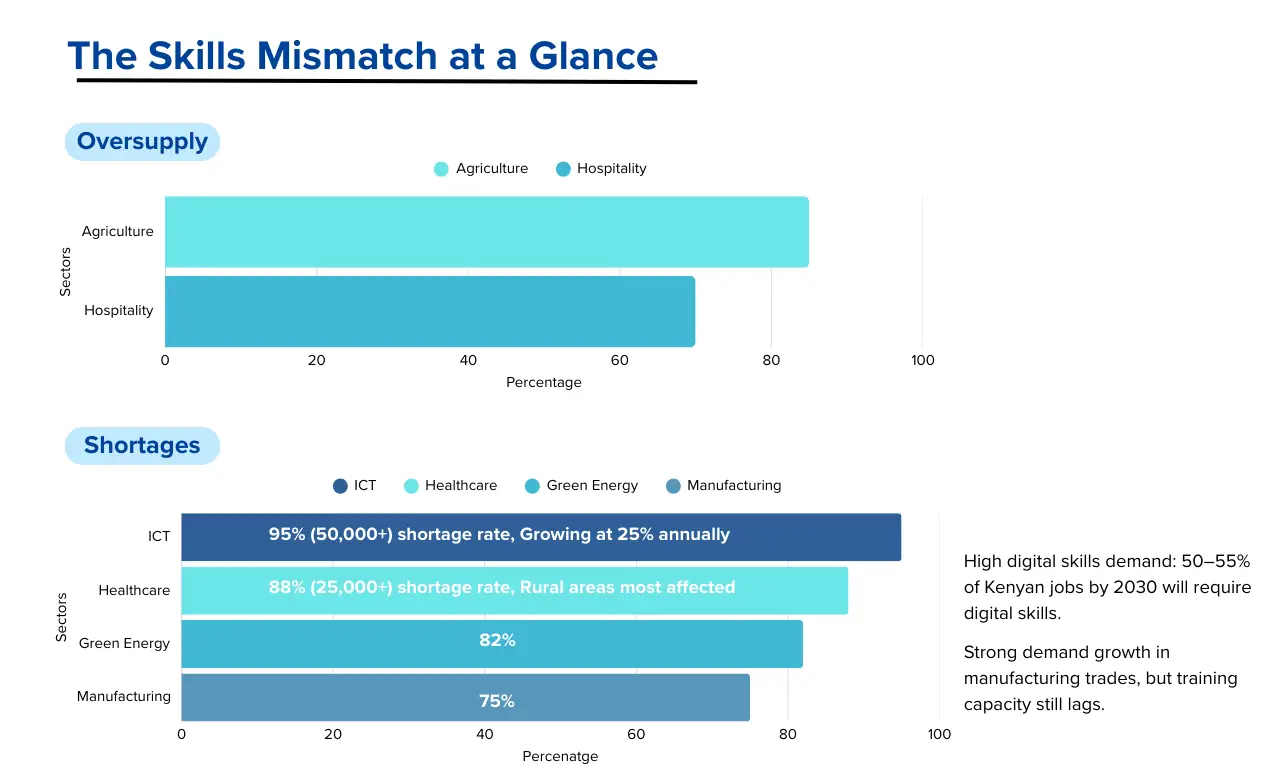
TVET enrollment has increased in Kenya and East Africa, but the mismatch between programs and industry needs persists. According to the ILO (2023), this gap is widening:
-
High demand sectors such as ICT, healthcare, and green energy face significant skills shortages, while traditional fields such as agriculture and hospitality remain oversaturated.
-
Underemployment among TVET graduates is widespread, with nearly 30 percent of graduates unable to secure work in their trained fields.
-
Many students leave TVET institutions without the industry-specific skills employers require, leaving them underprepared for the job market.
Why Aligning with Labor-Market Demand Matters
TVET programs must align closely with labor-market needs to remain relevant and produce employable graduates. Here are some of the key reasons why this alignment is critical:
1. Meeting Employer Demand
Employers in fast-growing sectors such as ICT, renewable energy, and healthcare cannot find enough qualified workers. In Kenya, for instance, there are over 100,000 unfilled tech jobs, and ICT firms report that nearly 40% of their hires lack the necessary practical skills. Aligning TVET curricula with these sectors will ensure a pipeline of skilled workers ready to meet market demand.
2. Boosting Graduate Employability
Well-aligned curricula ensure that graduates leave with industry-recognized skills that are directly linked to employment opportunities. Rwanda’s Workforce Development Authority (WDA) reported a 20 percent increase in employment outcomes for students trained in green energy fields after targeted curriculum reforms.
3. Driving Economic Impact
The economic return is significant. Every additional 100,000 TVET graduates who enter shortage sectors contribute an estimated USD 150 to 200 million in annual productivity. By aligning portfolios with high demand industries, institutions not only serve students but also stimulate national and regional growth.
Strategic Levers for Alignment
To ensure TVET curricula are aligned with labor-market needs, leaders can leverage several strategic levers. These include:
1. Demand Sensing and Market Intelligence
Understanding current and future labor-market needs is essential for effective curriculum planning. TVET institutions must harness market intelligence tools to track real-time industry trends.
-
Job-posting analytics: Tools that analyze job postings across sectors to understand which skills are most in demand.
-
Employer councils: Engaging with employer councils in sectors like ICT, healthcare, and energy to align curricula with the latest workforce needs.
-
Sector roadmaps: Developing sector-specific roadmaps (e.g., for ICT or green energy) that provide clear guidance on necessary skills and qualifications for the future workforce.
This data enables TVET leaders to stay ahead of market trends and ensure that their programs are producing graduates with the skills employers need.
2. Competency Frameworks and Outcomes
Competency frameworks provide the foundation for aligning learning outcomes with labor-market needs.
-
Occupational standards and skills taxonomies: Defining clear occupational standards and skill sets for various industries ensures that TVET programs are industry-recognized and meet employer expectations.
-
Learning outcomes tied to roles and wages: Ensuring that learning outcomes are closely linked to real job roles and market wages helps institutions provide tangible value to students and employers.
3. Modular and Stackable Programs
The future of vocational education lies in flexible, stackable credentials that allow students to build skills over time.
-
Micro-credentials: Offering short-term courses that build specific skills, such as coding, renewable energy installation, or health services, and allow students to earn credits toward a larger qualification.
-
Recognition of Prior Learning (RPL): Allowing students to get credit for skills they’ve already acquired through informal work or training makes it easier to upskill and re-skill the workforce quickly.
-
Short-cycle upskilling programs: Offering short, intensive courses for working adults or career changers helps address immediate skills gaps in growing sectors.
4. Labs and Practical Readiness
TVET programs need to ensure that students are not just learning theory, but are also workplace-ready.
-
Simulation/virtual labs: These allow students to practice real-world tasks in a controlled, digital environment, gaining hands-on experience in areas like healthcare simulation, coding environments, or machinery operation.
-
Capstones and assessment rubrics: Real-world projects and assignments that are industry-aligned ensure that students graduate with the skills they will use in the workforce.
-
Equipment planning and ROI: Institutions must carefully plan for the cost of training tools and infrastructure and ensure these investments yield strong returns in terms of graduate success and employer satisfaction.
5. Work-Integrated Learning at Scale
One of the most effective ways to align TVET with labor-market needs is through work-integrated learning.
-
Dual training models: Work-based learning should be a core component of TVET curricula, where students split their time between classroom instruction and on-the-job training.
-
Apprenticeship brokerage: TVET institutions should work with employers to create apprenticeship opportunities that allow students to gain hands-on experience while earning a stipend or wage.
-
Employer co-design of curricula: Collaboration with employers ensures that training is always aligned with current industry needs and offers real-world feedback on skills requirements.
6. Capacity, Quality, and Accreditation
The quality of TVET education is critical to ensuring that graduates meet employer expectations.
-
Faculty upskilling: Educators must stay up to date with both industry trends and digital pedagogy to provide relevant, high-quality instruction.
-
Internal quality audits: Regular, internal assessments of programs, teaching methods, and employer satisfaction ensure that TVET institutions maintain their credibility and relevance.
-
Accreditation readiness: TVET institutions must pursue accreditation from national and international bodies, ensuring that their qualifications are recognized across borders and sectors.
From Curriculum to Capability
TVET cannot be about filling classrooms; it must be about building capabilities that drive employment. By aligning programs with market demand, institutions in Kenya and East Africa can transform into hubs of innovation while producing graduates employers are eager to hire.
Path Forward for TVET Leaders
The path to alignment is clear:
-
Invest in labor-market intelligence and embed it into every aspect of curriculum planning.
-
Build modular, stackable, and industry-aligned programs that provide real-time employability.
-
Collaborate with employers to co-design curricula and provide work-integrated learning.
-
Use data-driven decision-making to measure and improve the admissions and outcomes pipeline.
By aligning TVET education with labor-market demand, institutions will not only strengthen the employability of their graduates but also contribute to a more competitive, future-ready workforce.
Frequently Asked Questions (FAQs)
Q1. Why do TVET programs need alignment with labor-market demand?
Ans. To ensure that graduates possess the skills employers need, improving both placement rates and employability.
Q2. Which sectors have the highest skills demand in East Africa?
Ans. Sectors like ICT, healthcare, green energy, and manufacturing are experiencing the most acute skills shortages.
Q3. How can employers support TVET curriculum development?
Ans. Employers can co-design curricula, offer internships or apprenticeships, and provide feedback on required competencies.
Q5. What KPIs should TVET leaders track to measure alignment?
Ans. Key metrics include completion rates, time-to-hire, placement rates, and graduate earnings.









Industries
Growth
Operations
Technology