
How to Start an FMCG Business in 2026
The FMCG sector is booming in 2026, offering huge opportunities for new entrepreneurs. India’s FMCG market alone is projected to reach $220 billion by 2025, driven by rising incomes and digital channels. Starting an FMCG business today means tapping into a fast-growing consumer base with evolving needs. It’s a chance to innovate in everyday products and capitalize on new distribution models.
Launching an FMCG (Fast-Moving Consumer Goods) business can be highly rewarding - these are essential products with constant demand. However, success requires meticulous planning and execution. This step-by-step guide will break down the process into simple parts, from researching your market to scaling up operations. We’ll also highlight key trends (like D2C brands, hyperlocal marketing in FMCG, and quick commerce) reshaping the industry so you can stay ahead of the curve.
The FMCG opportunity: FMCG is one of the largest industries[1], encompassing food, beverages, personal care, home care, and more. It provides employment to millions and contributes significantly to the economy. With over 13 million retail outlets in India (mostly small kirana shops) selling FMCG products, distribution networks are vast. Consumer habits are changing rapidly – online channels and 10-minute delivery apps are redefining convenience. For a founder, this means new ways to reach customers and differentiate your brand.
Below, we’ll walk through the foundational steps to start an FMCG company and answer common questions. Whether you want to start with no money by beginning small, or you plan a large launch, these insights will help you navigate the journey.
Step 1: Market Research and Finding Your Niche
Every successful FMCG venture starts with deep market research. Begin by analyzing current trends and gaps in the market:
-
Identify Consumer Needs: Look at everyday problems or desires. For example, is there demand for healthier snacks, eco-friendly packaging, or affordable grooming products? In 2025, consumers are more health-conscious and eco-aware than ever. Trends show rising demand for natural ingredients and sustainable packaging.
-
Study the Competition: Research existing brands in your category. What products do big FMCG companies offer, and where are the gaps? Perhaps the market lacks a certain flavor of beverage, or an affordable alternative in a premium category. Finding an underserved niche – maybe a regional taste or a specialized personal care product – can give you a foothold.
-
Analyze Market Size and Growth: Understand how big your segment is and whether it’s growing. For instance, the healthy snacks market is projected at ₹20,000 crore by 2030, indicating a huge opportunity if you’re considering food products. Use reports from sources like IBEF, IMARC, or NielsenIQ to gather data on volumes and growth rates. This will also help convince investors or partners later.
Tip: Focus on a specific category rather than launching too many products at once. It’s easier to build a brand when you specialize. You could start with one product line – say, an organic soap or a new spice mix – and become known for it. Many new food startups begin by excelling in a single niche (e.g. a unique protein drink or a millet snack) before expanding. Specialization helps you streamline operations and marketing in the early stages.
Step 2: Create a Solid FMCG Business Plan and Model
With your research in hand, the next step is to draft a business plan. This is your roadmap that defines how you will operate and make money. Key components include:
-
Business Model: Decide the model that fits you best. Will you manufacture your own products, distribute existing brands, or build a direct-to-consumer (D2C) brand? Each has advantages: Manufacturing your product allows control over quality and branding, while a distribution business may require less product development (you earn by selling others’ products). You could also explore a hybrid model – for example, start as a distributor to generate cash flow, then launch your own label. If capital is tight, beginning as an FMCG distributor or wholesaler can be easier than setting up a factory. (Many ask “how to start an FMCG business with no money” – the answer is to start small, use existing manufacturers, or act as a local distributor to build funds.)
-
Product Selection: Within your niche, outline the product or products you will offer initially. Detail what makes them unique. Is it a new flavor, better quality, local sourcing, or pricing? Your USP (unique selling proposition) should be clear. For example, you might offer personalized nutrition snacks or a cleaning product using natural enzymes. This differentiation is crucial in FMCG because consumers often stick to familiar brands unless you give them a reason to switch.
-
Target Market and Sales Channels: Define your target customers (age, location, income) and how you will reach them. FMCG can be sold through traditional retail distribution (distributors -> retailers), modern trade (supermarket chains), online marketplaces, or direct channels. Many new brands today start with online D2C to test the market, then expand to retail. Think about whether you will focus on urban cities, rural areas, or both. Rural markets are growing fast (rural India now accounts for ~38% of FMCG sales) and often respond to different strategies than urban areas
-
Financial Projections: Estimate your costs (production, marketing, overhead) and how long before you break even. FMCG typically works on volume with thin margins, so efficiency is key. Include pricing strategy – what will you charge, and what profit margin does that give after accounting for retailer/distributor cuts? (Remember that retailers and distributors take a share; in FMCG, distributor margins might range around 3-10% and retailer margins around 8-40% depending on the product. Run scenarios for best-case and worst-case sales. This financial plan will help determine how much investment you need initially.
A strong business plan not only guides you but is also essential if you seek bank loans or investors. It demonstrates you’ve thought through the venture. Founders and marketers reading this should ensure the plan covers both growth strategy and risk mitigation. For instance, include a SWOT analysis (Strengths, Weaknesses, Opportunities, Threats) to show awareness of challenges like competition or supply chain issues.
Step 3: Registering the Business and Legal Requirements
Setting up the legal framework of your FMCG company is a critical early step. Compliance isn’t optional – missing a required license can halt your operations. Key legal tasks include:
-
Business Registration: Choose a suitable business structure. In India, common options are Sole Proprietorship (simplest for one-person businesses), Partnership or LLP, and Private Limited Company (preferred if you plan to scale or raise equity). Register your company name and get a PAN card for the business. If you’re aiming to attract investors, a Private Limited structure offers credibility and easier fundraising.
-
GST Registration: FMCG products fall under India’s GST tax system, so you must obtain a GST number. This allows you to collect taxes on sales and claim input tax credits on your purchases. It’s mandatory once your turnover crosses a threshold (₹40 lakh for goods in many states, often lower for special category states). Most serious businesses get GST registered from the start for transparency.
-
FSSAI License (for Food/Cosmetics): If you deal with any food or edible products, an FSSAI license is non-negotiable. The Food Safety and Standards Authority of India issues this license to ensure your product meets safety standards. Similarly, for cosmetics or ayurvedic products, check if you need approvals from agencies like CDSCO or AYUSH. Always comply with industry-specific regulations – for example, packaged foods need proper labeling of ingredients, nutritional info, and best-before dates per FSSAI guidelines.
-
Trade Licenses and Local Permits: Depending on your operations, you might need local licenses. If you set up a manufacturing facility, you may require a Factory License from the local authority and a fire safety clearance. If you’re only trading/distributing, ensure you have a Shop & Establishment registration for your office or warehouse. Also, apply for a Trademark on your brand name and logo to protect your brand legally.
-
Quality Certifications: While not legally mandatory, obtaining certifications can build trust. For example, ISO 9001 for quality management or ISO 22000 for food safety can signal that your processes meet international standards. These are more important once you scale or plan to export, but worth keeping in mind.
Getting these legal aspects sorted might seem tedious, but it forms the foundation of a credible business. Customers and retailers will take you more seriously when you operate formally. Moreover, many modern trade outlets and online platforms will require your GST and FSSAI details to onboard you as a seller.
Step 4: Product Development and Branding
With paperwork underway, you should work in parallel on developing your product and crafting your brand identity. In FMCG, product and brand are king – they directly influence consumer choice.
-
Formulation and Sourcing: If you’re manufacturing, invest time in R&D to get your product right. This could involve working with food technologists for a new food recipe, or chemists for a cosmetic formula. Ensure the product meets quality and safety standards (and tastes good or works effectively, as applicable!). Identify reliable suppliers for raw materials. Consistency is crucial: if you’re making soap, for example, source quality oils/fragrances that you can procure steadily. You don’t want to reformulate frequently due to supply issues.
-
Prototype and Testing: Create small batches or prototypes of your product and test them. Gather feedback from a focus group or potential customers. For instance, if you’re launching an energy drink, do people like the flavor? If you’re introducing an organic cleaner, does it clean well compared to competitors? Use this feedback to refine the product before mass production. It’s much cheaper to fix issues at this stage than after you’ve shipped thousands of units.
-
Brand Name and Packaging: Choose a memorable brand name that resonates with your target audience. FMCG brands often go for simple, catchy names (think Coca-Cola, Dove, Maggi) – easy to pronounce and recall. Design a logo and packaging that stand out on shelves. Good packaging can significantly influence purchase decisions in FMCG, since shoppers make quick choices. Make sure to include all required label information (ingredients, net weight, MRP, manufacturer details, customer care number, etc.) as per regulations.
-
USP and Storytelling: Clearly communicate your product’s USP on its packaging and marketing materials. Does it solve a problem or offer something unique? For example: “100% natural ingredients”, “Sugar-free with added protein”, “Ayurvedic recipe from Himalayan herbs”, or “Eco-friendly packaging”. Consumers should see at a glance what sets your product apart. In addition, craft a brand story that connects emotionally – perhaps your inspiration came from a family recipe or a local tradition. Storytelling builds brand loyalty in a crowded FMCG market.
-
Testing for Compliance: Before rolling out, if it’s an ingestible or cosmetic, consider stability testing (to ensure the product stays good through its shelf life under various conditions). Get nutritional testing done for foods to print accurate information. If making health claims (vitamin-rich, etc.), ensure they are truthful and ideally backed by lab tests.
Remember, your brand is not just a logo — it’s the overall perception and trust you build with consumers. In an FMCG business, repeat purchases are vital, so customers must consistently have a positive experience with your product quality. This is where a clear brand growth strategy becomes critical, as it shapes how consumers perceive and stay loyal to your offering over time.
Many founders underestimate this and rush to launch; but product issues can kill goodwill fast. Take the time to make your product great. As a new business, this quality-led approach is how you’ll compete against established FMCG giants.
Step 5: Setting Up Manufacturing or Sourcing Production
Turning your idea into a tangible product requires a production plan. There are two main paths: set up your own manufacturing, or outsource production to third parties. The right choice depends on your product type, budget, and expertise:
-
In-House Manufacturing: If you have the capital and expect production at scale, you might set up your own manufacturing unit. This involves securing a facility (a small factory or commercial kitchen), buying machinery, and hiring skilled staff. For example, starting a small snacks manufacturing might require mixers, ovens, fryers, and packaging machines. Ensure the facility layout meets hygienic standards (important for food and cosmetics). You will need to implement quality control processes from day one. While in-house production is investment-heavy, it gives you full control over quality and scheduling. You can also implement efficiency practices like lean manufacturing to optimize operations – companies using lean methods see 25–30% productivity gains and 20–50% cost reductions, which can greatly improve profitability.
-
Third-Party Manufacturing (OEM/Private Label): Many FMCG startups choose to outsource manufacturing to established producers, especially in the beginning. This is often faster and cheaper. You can find contract manufacturers who will produce your product under your brand (often called private labeling). For instance, there are factories that can produce biscuits, sauces, detergents, etc. to your specification. You provide them the formula (or choose from their base formula), your packaging design, and they handle the production. This model requires less upfront capital – you pay per batch produced. However, you must do due diligence to pick a reliable manufacturer. Ensure they have necessary certifications and can maintain consistent quality. The upside is you can focus on branding and sales while leveraging their production capacity.
-
Quality and Scalability: Whether in-house or outsourced, put in place strict quality checks. For food items, this means batch testing for taste and microbiology; for cosmetics, checking for stability and safety; for any product, ensuring packaging seals properly, etc. Early on, it’s wise to personally supervise production or hire a quality control consultant, because one bad batch can damage your reputation. Also, plan for scalability – if your product takes off, can production ramp up quickly? If you outsource, discuss capacity limits with your partner. If it’s in-house, ensure you have space and a plan to add more equipment or shifts as needed.
-
Supply of Raw Materials: Build relationships with suppliers for your raw materials or ingredients. Having at least two suppliers for key inputs is a good risk mitigation (so you’re not completely dependent on one source). Negotiate prices and purchase in bulk when advantageous, but be mindful of storage and shelf-life. Efficient sourcing will protect your margins, since raw material costs directly affect profit. Many FMCG businesses face margin pressure when input costs rise (e.g. sugar, oil, packaging materials) – larger companies hedge these, but as a startup, you need to be agile with vendors and maybe lock prices short-term or find substitutes if prices spike.
In summary, this step is about bringing your product to life in a consistent, cost-effective way. If you are a founder with limited funds, starting via third-party manufacturers can be a smart move - it’s how many brands launch quickly. If you have a novel process or recipe, you might invest in your own small-scale setup for more control. Either way, prioritize efficiency and quality. The most brilliant marketing cannot save a business if the product is frequently out of stock or of poor quality. Operations excellence is a backbone of FMCG success (think of how giants like HUL or P&G built robust supply chains over decades).
Step 6: Starting An FMCG Distribution Network
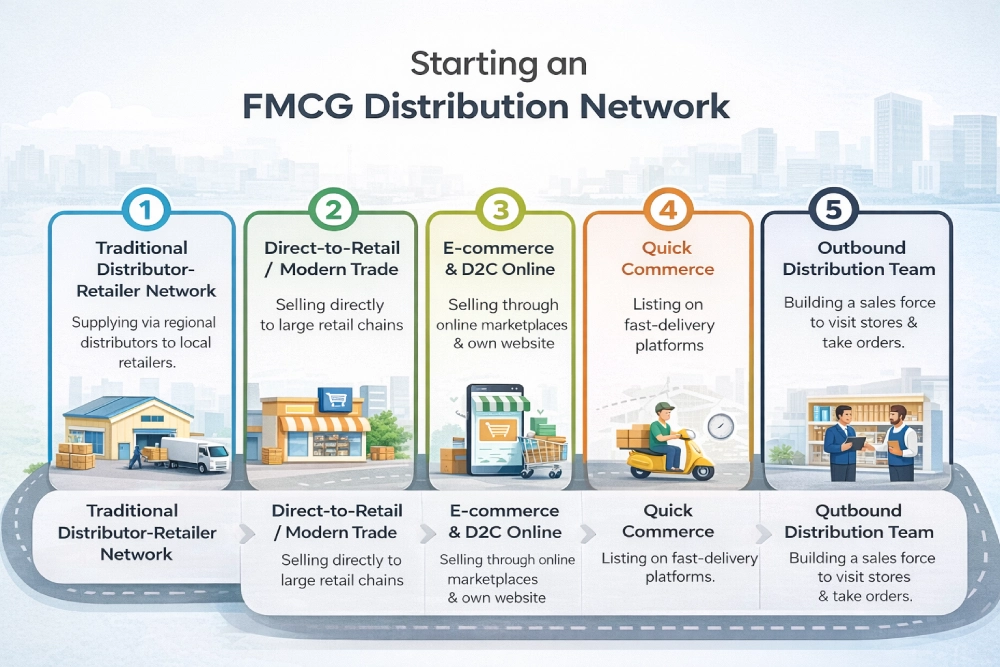
Distribution is the lifeblood of an FMCG business. Even the best product needs to reach customers through the right channels, in the right quantities, at the right time. There are multiple distribution strategies you can employ, and often a mix works best:
-
Traditional Distributor-Retailer Network: This is the classic FMCG route. You (as the manufacturer/brand) supply products to regional distributors or stockists, who then supply local wholesalers or retailers (kirana stores, supermarkets, pharmacies, etc.). It’s a multi-tier system, but it can achieve massive reach. To start, you might focus on one city or region: appoint a distributor there who has connections with many retail outlets. They will buy stock from you (often on credit) and push it into stores. Typically, you give distributors margins (maybe around 5-10%) and they in turn give retailers margin (~10-20% depending on category). This model requires you to produce enough stock and provide marketing support, but it leverages the distributor’s network. Keep in mind the cost of distribution in your pricing – you must leave enough margin for everyone to profit, which is why FMCG manufacturer margins can be slim until volume grows.
-
Direct-to-Retail/Modern Trade: Some brands skip middle distributors and sell directly to big retail chains or supermarkets (modern trade). For example, you could approach a chain like Reliance Retail, Big Bazaar, or D-Mart to carry your product. Modern trade often negotiates hard on margins and payment terms, but gives you shelf space in high-traffic stores. You might initially get into a few local outlets or smaller supermarket chains to build a track record. Ensure you can meet their supply requirements consistently. Another direct approach is selling to institutional buyers (hotels, offices, schools) if relevant – this works if you have, say, a bulk food product or hygiene product that institutions buy in quantity.
-
E-commerce and D2C Online: In 2025, online channels are indispensable. E-commerce accounted for about 8% of FMCG sales in 2023 and is expected to reach 15% by 2025[2]. You should plan to list your product on major online marketplaces like Amazon, Flipkart, BigBasket, etc. These platforms expose your brand to a nationwide customer base. Be ready to handle the logistics of shipping (either yourself or via their fulfillment programs). Additionally, consider a Direct-to-Consumer (D2C) approach through your own website. Many new FMCG brands thrive by selling on Instagram, Facebook, or their own sites, using targeted digital marketing to attract buyers. This gives higher margins (no retailer cut), but you’ll spend on marketing and need to manage deliveries. The digital route also provides rich consumer data and feedback.
-
Quick Commerce and Hyperlocal Delivery: A big trend now is quick commerce – apps like Blinkit, Zepto, and Swiggy Instamart promise delivery in 10-30 minutes. These platforms have exploded in urban areas, already making up 35% of FMCG e-commerce sales in cities. Getting your products listed on quick commerce apps can rapidly boost sales velocity. They often prefer fast-moving products and might ask for discounts or advertising support within the app. If you can manage the logistics (supplying to their dark stores or warehouses), this channel can be a game-changer for an FMCG startup. Many brands use it to launch new products in a limited area, get instant feedback, and then expand. Speed matters: consumers now expect instant availability, and quick commerce giants (Blinkit, Zepto, etc.) are competing fiercely on assortment and service. Partnering with them can amplify your reach, especially for food and daily essentials.
-
Outbound Distribution Team: As you grow, consider building a sales team that can visit stores and promote your product (often called feet-on-the-street). They can take orders from retailers directly or ensure that your distributors are stocking and pushing your product. In early stages, founders often do this themselves – visiting local shops to place the product. This grassroot approach is crucial to gain shelf presence. Remember, in a shop, your product may be alongside well-known brands; having a relationship with the store owner (or incentives for them) can help keep your product visible and recommended.
Efficient distribution is about availability - your product should be easily available wherever your target customer shops. It’s also about logistics – ensuring smooth flow from factory to consumer. Track your supply chain metrics: fill rates (no stockouts), delivery times, and return rates. Using software like distributor & consumer management systems or even simple tools can help track orders and inventory in various locations. As a new business, you might start manually, but as volumes increase, invest in tech for supply-chain visibility.
Lastly, consider starting region-wise and then expanding. It’s often better to have deep penetration in one city/state than thin presence in many. Positive word-of-mouth in a concentrated market can create a case study and revenue base to fund expansion.
Step 7: Marketing and Growth Strategy
Now that your product is ready and distribution channels identified, you need to drive consumer awareness and demand. Marketing for FMCG combines traditional branding with innovative tactics:
-
Brand Positioning: Clearly define what your brand stands for. Are you a budget-friendly value brand, a premium quality brand, or an eco-conscious brand? This positioning will guide your marketing voice and design. For instance, a premium personal care startup will focus on aspirational imagery and maybe influencer tie-ups, while a mass-market snack might focus on family, fun, and price offers.
-
Advertising & Promotions: Leverage a mix of marketing channels. As a startup, you may not afford mass TV ads (which big FMCGs use), but you can effectively use social media marketing strategies, local media, and smart campaigns. Platforms like Instagram, Facebook, and YouTube are powerful for FMCG – you can run targeted ads showing your product in action to the relevant demographic. Collaborate with micro-influencers or bloggers who review products in your niche. For example, a food vlogger trying your organic spice mix can introduce it to thousands of viewers. Allocate some budget for promotional offers – e.g., introductory discounts, bundle deals, or free samples. Many new brands strike deals with retailers to do in-store sampling (especially for food/beverage) so customers can taste or try the product.
-
Hyperlocal Marketing: Don’t ignore grassroots marketing, especially if targeting specific local markets. Engage in hyperlocal marketing in FMCG by tailoring campaigns to a community or region[2]. This could mean using local language ads, participating in community events, or partnering with neighborhood shops for visibility. In India, rural and tier-2 markets respond well to on-ground activations – like demonstration vans, melas (fairs), and community influencer endorsements. Even in cities, you can do things like sponsor local events (e.g. a marathon or a festival celebration) to get your brand out there.
-
Digital Presence and E-commerce Optimization: Ensure your brand has a professional online presence. This includes a well-designed website and active social media profiles. Share engaging content – recipes if it’s a food item, tips if it’s a personal care product, etc. Content marketing builds trust and keeps your audience interested beyond just sales pitches. Additionally, on e-commerce platforms, optimize your product listings with good images, descriptions, and keywords. Encourage satisfied customers to leave reviews – positive reviews significantly boost conversions for FMCG products online. Monitor your online sales data to learn which geographies or customer segments are buying, and refine your marketing accordingly.
-
Leverage Data and AI: Big companies use advanced analytics to refine marketing – and you can too at a smaller scale. Track sales by region and product to identify which SKUs are doing well. Use tools (even Excel or simple CRM at first) to capture customer feedback. As you grow, consider using AI forecasting in FMCG to predict demand surges or optimal inventory (some modern platforms offer this). For marketing, AI tools like intellsys AdGPT can help with personalized email campaigns or targeting ads more precisely. The idea is to make your marketing spend as efficient as possible, which is vital for a startup.
-
Promotions in Modern Trade & Quick Commerce: If you are present in supermarkets or apps, participate in their promotional schemes. For example, supermarkets often have themed weeks or end-cap displays you can pay for to highlight your product. Quick commerce apps allow brands to buy banner space or search priority – these can be costly, but even occasional bursts (say during a festival or season) can dramatically lift sales. Data from GrowthJockey indicates brands partnering on quick commerce saw 25–50% YoY growth due to higher visibility and instant delivery appeal. While those are usually bigger FMCG brands, a startup can piggyback on the trend by aligning with these channels early.
-
Customer Feedback Loop: Finally, treat your early customers like gold. Solicit customer feedback and respond quickly to any complaints. If someone tweets that they loved your product, engage and thank them (maybe send a coupon for their next purchase). If a customer had an issue (say, damaged packaging or something), address it publicly to show responsiveness. This not only converts one unhappy customer to a loyal one, it shows others that your brand cares. Building a community – perhaps via a WhatsApp group or Instagram page for product enthusiasts – can create loyal advocates who will spread the word.
Marketing is often what decides if an FMCG brand breaks through the clutter. Even with a limited budget, creativity can compensate. Think of guerrilla marketing tactics (flash mobs, quirky stunts, etc.) if it suits your brand. The key is to connect with your target audience where they are, and give them a compelling reason to try your product. After that, if your product delivers on its promise, they’ll buy again and tell others. In FMCG, that repeat purchase and word-of-mouth is the true victory.
Step 8: Key Success Factors and Scaling Up
Launching is just the beginning. To truly succeed and grow your FMCG business, keep these success factors in mind:
-
Consistency and Quality: Ensure every batch of your product is consistent. Inconsistency can break trust quickly. Develop SOPs (standard operating procedures) for production and distribution. Regularly audit product quality and retail presence (are products in good condition on shelves, within expiry dates, etc.?). A consistent product builds brand trust, leading to loyal customers who stick with you for years.
-
Efficient Operations: As volume grows, inefficiencies can creep in. Keep a close eye on unit economics – your cost per unit should ideally go down with scale (due to bulk purchasing, better overhead absorption). Continue to optimize the supply chain. Techniques like lean manufacturing and just-in-time inventory can help reduce waste and costs. This is especially important in FMCG where margins are often single-digit percentages. Efficient operations directly improve profitability and give you room to price competitively or invest in marketing.
-
Innovate and Expand Thoughtfully: Plan your product line expansion wisely. It’s tempting to launch new flavors or variants quickly – and indeed innovation is important (consumers love variety in FMCG). But make sure any new SKU (stock-keeping unit) is backed by market research and does not overly complicate your production or confuse customers. A rule of thumb: a new product should either bring a new customer segment or increase share of wallet of existing customers. Also watch for market feedback – if customers suggest improvements or a new related product, weigh those ideas. Some of the most successful FMCG startups constantly iterate (like adjusting taste based on feedback, or introducing a complementary product that customers ask for).
-
Cash Flow Management: Growth in FMCG can strain cash flow because you need to invest in inventory and give credit to distributors, while marketing spends also rise. Monitor your cash cycle closely. Try to negotiate favorable credit terms with suppliers (e.g., pay in 30 days instead of upfront) while incentivizing distributors/retailers for faster payments (maybe small discounts for early payment). Avoid stockpiling too much inventory; it ties up cash and risks expiry for perishable goods. A healthy cash flow ensures you can seize growth opportunities (like a bulk order or a new marketing slot) when they come. Many small businesses are profitable on paper but run out of cash – don’t let that happen. Keep some emergency funds or a line of credit for backup.
-
Adaptability and Market Feedback: The FMCG market can change rapidly – new competitors emerge, input costs fluctuate, consumer preferences shift (for example, sudden craze for keto-friendly snacks or a new personal care trend). Stay updated with industry news and consumer insights. Be ready to pivot strategies – if one distribution channel underperforms, explore another; if a marketing message isn’t resonating, tweak it.
GrowthJockey research shows that agility is a key trait of successful ventures. Always be in a learning mode. Even large FMCG firms like HUL are continually experimenting with new digital strategies or product tweaks; as a startup, you have the advantage of being more nimble.
By focusing on these areas, you’ll set a strong foundation for scaling. As sales increase, invest back into the business wisely: perhaps in better automation equipment, in hiring skilled managers, or in expanding to new regions. Scaling an FMCG business often means replicating your model in new geographies – use the learnings from your initial market to guide expansions rather than starting from scratch each time.
Finally, success in FMCG is a marathon, not a sprint. It may take time to breakeven and build brand recognition. But the upside is huge: you’re operating in a massive market where a single product hit can turn into a household name. Remain persistent, keep improving, and stay customer-focused. With the right mix of quality, availability, and marketing, your product could become the next staple in people’s daily lives.
GrowthJockey: Your Partner in Scaling FMCG Ventures
Before we wrap up, it’s worth noting that building and scaling an FMCG business can be accelerated with the right support. GrowthJockey – Full Stack Venture Builder – specializes in helping companies validate, build, and scale new businesses using an AI-driven venture architecture. In the context of FMCG, GrowthJockey can assist founders with data-driven market validation, rapid prototyping, and go-to-market strategy.
Our venture architects bring playbooks for lean startup execution, AI forecasting for demand, and growth hacking that can give your FMCG startup an extra edge. In short, GrowthJockey acts as a co-pilot, ensuring that innovation is paired with strategic execution. This kind of partnership can be a game-changer, especially when navigating a competitive sector like FMCG where speed and intelligence are critical. With GrowthJockey’s support, entrepreneurs can focus on their product and customers while leveraging a proven system to build and scale faster.
FAQs on Starting an FMCG Business
Q1: What are 5 FMCG products?
Five common FMCG categories include beverages, packaged food and snacks, personal care products, home care items, and processed foods or staples.
Q2: What is the minimum investment for FMCG?
You can start with ₹3–5 lakhs as a small distributor or reseller, while launching your own FMCG product may require ₹10–50 lakhs depending on scale.
Q3: What is the profit margin in FMCG?
Net profit margins are typically under 10% for most FMCG brands, with higher margins possible in premium or niche categories.
Q4: Which FMCG product is most profitable?
Premium products like skincare, cosmetics, nutraceuticals, and value-added foods tend to have higher margins than basic staples.
Q5: How can I start an FMCG business from home?
You can start from home by producing small batches, launching an online-only brand, or reselling FMCG products to local retailers.








Industries
Growth
Operations
Technology