
Top Digital Marketing Trends 2026: AI, Video, Search & Growth

The digital marketing landscape is evolving at warp speed. In 2025, trends like generative AI, privacy regulations, and short-form video reshaped how brands engage audiences. Consumers began favoring authenticity and useful content over flashy gimmicks. AI matured quickly, powering smarter personalization and analytics, while even long-form video regained popularity thanks to improved discovery on platforms.
And as AI-powered search (like Google's Overviews) spread, brands learned that value-packed content and expertise were the new currency. In short, 2025 taught marketers that authentic, customer-first content matters more than ever.
What Changed in Marketing Over the Last Year (2025 → 2026)
-
AI shifted from experimentation to core infrastructure
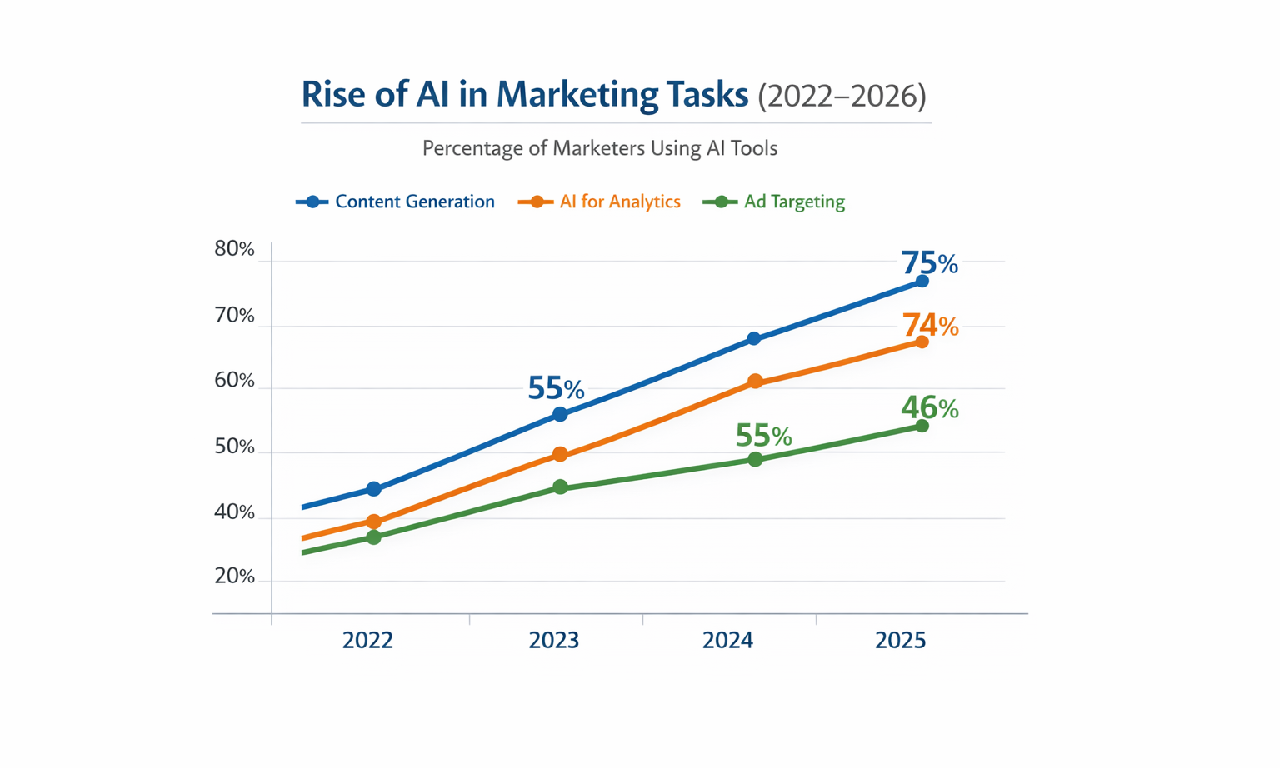
In 2025, generative AI stopped being a side tool and became embedded in the marketing workflow itself. What began as copy assistance and creative generation evolved into AI-led media buying, audience segmentation, analytics, and reporting. Marketers stopped debating whether to use AI and instead focused on defining where human judgment was still essential. This shift fundamentally changed operating models across teams. As a result, 2026 marketing strategies are built on AI as an underlying system, not a feature. -
Search lost its monopoly over discovery
Last year marked a decisive shift in how people find information online. Users increasingly relied on AI assistants, social platforms, and communities instead of traditional search engines. Zero-click results, AI summaries, and conversational responses meant people consumed answers without visiting websites. Brands learned that ranking alone no longer guaranteed traffic or visibility. This behavior reset expectations and paved the way for conversational search optimization and answer-first content in 2026. -
Performance marketing faced a measurement reality check
In 2025, attribution models began breaking at scale. With cookies disappearing and privacy regulations tightening, marketers could no longer rely on platform-reported metrics alone. ROAS and last-click attribution increasingly failed to reflect true business impact. This forced teams to revisit incrementality, experiment design, and long-term value metrics. The outcome is a 2026 focus on marketing mix modeling, experimentation, and business-aligned KPIs. -
Content quality became a survival filter
The explosion of AI-generated content in 2025 flooded the internet with volume but not value. Audiences quickly tuned out generic, over-optimized, or clearly automated content. Platforms responded by rewarding experience-driven, expert-led, and genuinely useful content. Marketers learned that publishing more was no longer enough — relevance and depth became essential. This reset explains why 2026 prioritizes authenticity, community-driven content, and human-led storytelling. -
Commerce and media fully converged
2025 erased the line between “marketing” and “selling.” Video became transactional, social feeds turned into storefronts, and retailers evolved into full-scale media companies. The traditional funnel collapsed into real-time moments of intent and purchase. Consumers grew comfortable discovering, evaluating, and buying within the same interface. This shift laid the foundation for video commerce, retail media dominance, and omnichannel buying experiences in 2026. -
Trust and privacy became competitive differentiators
As privacy regulations tightened and tracking declined, trust emerged as a core marketing asset in 2025. Brands that were transparent about data usage and offered clear value in exchange for information gained an edge. First-party and zero-party data replaced third-party tracking as the backbone of personalization. This shift forced marketers to rethink consent, communication, and customer relationships. In 2026, privacy-first marketing is no longer compliance-driven - it’s growth-driven. -
Marketing teams were forced to reskill and reorganize
The pace of change in 2025 exposed a major skills gap across marketing teams. While AI adoption surged, very few organizations felt prepared to manage it effectively. Marketers had to rapidly build fluency in data, automation, and AI tools while preserving creativity and strategic thinking. Cross-functional collaboration became non-negotiable. This cultural shift explains why 2026 places such emphasis on upskilling, hybrid talent, and agile team structures.
Top Trends That Will Dominate Digital Marketing in 2026
Today, successful marketing balances cutting-edge technology with human creativity. Below we rreveal the top trends set to dominate 2026.
1. Conversational Search & AI-Powered Discovery
Search is becoming conversational and AI-driven. Google, Bing, ChatGPT and other AI assistants now answer queries directly. Many searches yield AI-generated "Overviews" or instant answers instead of clicking to websites. In fact, Google's AI Overviews appear on over half of queries. This shift means SEO must focus on delivering clear, concise answers and structured data up front. Content strategy should be optimized for Answer Engine Optimization (AEO) – with succinct summaries, bullet-point lists, and tables of key facts that AI can easily parse.
Voice search and local queries are surging too: users often ask, "Where's the best local coffee shop?" or "What's the weather in [city] right now?" expecting instant, conversational responses. Meeting these needs requires writing in a natural Q&A style. For example, adding FAQ sections or step-by-step guides can satisfy both human readers and AI assistants. Likewise, using rich schema markup (like FAQPage or QAPage schemas) and descriptive alt-text for images makes content more discoverable to AI tools.
Rather than focusing solely on keywords, emphasize intent and completeness. A comprehensive article that fully answers a question will perform better than one stuffed with keywords. Ensure pages load quickly and are mobile-friendly (many voice searches come from phones). Track engagement metrics (scroll depth, time-on-page, sign-ups) instead of just clicks. A robust content strategy should align topics with real user queries and needs.
Key action: Rewrite or extend your content to directly address real user questions. Add Q&A sections, bullet lists, and data visualizations. Use analytics to align topics with how customers ask questions. Test your content with voice assistants or AI-preview tools to ensure it reads naturally. By speaking your searchers' language and structuring information clearly, your brand becomes the answer, not just a search result link.
2. The Video-Commerce and Short-Form Video Boom
Video is now commerce. Short-form and live videos aren't just for brand awareness – they directly drive sales. Social platforms have transformed views into transactions: TikTok, Instagram, and YouTube support in-stream shopping, live shopping events, and shoppable posts. In 2025, over 86% of advertisers used (or planned to use) generative AI for video ads[1], and roughly 40% of video ads are expected to be AI-generated by 2026. This means marketers can iterate video content at scale and test variations efficiently.
Consumers have responded. For instance, 96% of marketers say video increased brand awareness. Short clips (15–60 seconds) now grab attention immediately, and viewers are accustomed to shopping within apps. Best practices include repurposing content: break a longer product demo or tutorial into multiple short clips for each platform. Interactive features (poll stickers, swipe-ups, live comments) turn passive viewing into active engagement. Even B2B firms are embracing video: many now host webinars or LinkedIn Lives to generate leads.
Key action: Treat every video as a mini storefront. Embed product links or tags in your videos, and use platform features like TikTok's Shop or Instagram Checkout. Host live streams for product launches and flash promotions. Repurpose long-form content (webinars, guides) into bite-sized snippets for TikTok, Reels, Shorts, etc. Track video engagement metrics (view rate, adds-to-cart, purchases) to identify winning formats. Over time, prioritize the video styles (like fast-paced demos or user-generated snippets) that deliver the highest ROI.
3. Privacy-First Marketing & First-Party Data
Privacy regulations and browser changes have made first-party data the new currency. Marketers can no longer rely on third-party tracking – for example, Google plans to phase out all cookies by 2026. This means that marketers now need to pivot towards cookieless marketing strategies. Instead, trust and transparency become competitive advantages. Brands must capture user consent and build rich Customer Data Platforms (CDPs) fed by opt-in channels like email signups, loyalty programs, and interactive content (quizzes, surveys). By owning this data, companies create a robust profile of each customer. In fact, one report finds 93% of marketers consider first-party data critical for future success, and 85% say voluntarily-shared (zero-party) data is essential for personalization[2].
Email itself is evolving into a trust channel. With Gmail and Outlook using AI to filter mail, generic blasts won't cut it. In fact, 42% of consumers expect personalized promotions in their inbox. Brands must "earn" this channel by delivering clear value (exclusive content, loyalty rewards, advance notices). Otherwise, messages may never be seen.
Key action: Audit your data strategy now. Enhance opt-in points: newsletter sign-ups, gated content, loyalty programs, and user preferences forms. Adopt cookieless tactics like contextual advertising and CRM-based targeting. Invest in CDPs or customer data clean rooms to unify online and offline data securely. Always use data transparently and update privacy policies so customers see how sharing data improves their experience. The brands that master this "privacy-first" approach will maintain personalization and trust in the post-cookie world.
4. Retail Media Networks and Omnichannel Commerce
Retail Media Networks (RMNs) – the ad platforms of retailers like Amazon, Walmart, and Target – are now mainstream. These networks let brands advertise directly at the point of purchase. Spend is skyrocketing: forecasts expect RMN budgets to reach about $62 billion in 2025 (nearly 18% of all digital ad spend)[3], rising above 20% by 2026. Brands use RMNs like search engines – for example, bidding on Amazon's "Sponsored Products" or Walmart's on-site display ads.
This concept is expanding beyond retail. Any company with customer data can launch a "commerce media" channel. Experian notes that industries like automotive, travel, finance and others are creating their own ad networks. In fact, over half of marketers plan to advertise on these new networks. For example, a car manufacturer might offer ads on its dealer network's apps, or a hotel chain on its booking site.
Key action: Develop a retail media strategy today. Integrate your product catalog into major marketplaces via data feeds or APIs. Align promotions with retailer ads – if you're running a sale, make sure it appears in those ads too. Allocate part of your ad budget to RMNs on platforms where your products are sold. Use analytics or custom marketing dashboards to track how each retailer's ads drive sales. Early adopters of RMNs will capture in-market shoppers and outpace competitors in 2026.
5. The Creator Economy Evolves: Co-Creation & Micro-Influencers
Influencer marketing has matured. By 2026 we expect a shift from one-off sponsorships to deep co-creation. Brands will partner with creators and micro-influencers as collaborators in products and campaigns. These creators become niche experts, not just amplifiers. For example, a beauty brand might invite a makeup influencer to co-design a new palette, launching it under both names. Lego and Nike run open contests inviting fans to submit design ideas, effectively co-creating their next product line.
Micro-influencers (those with smaller, passionate audiences) will have outsized impact. Their authenticity often drives higher engagement. Instead of just paying for a post, brands can give them creative control or profit-sharing. This breeds more genuine promotion. For instance, a sneaker brand could let a local influencer design a custom shoe model and share revenue from its sales.
Key action: Shift from transactional influencer deals to collaborative partnerships. Identify creators who truly love your brand's ethos. Involve them early – ask for feedback on new concepts or co-produce content (podcasts, videos, designs). Encourage user-generated content (UGC) by running challenges or contests that spotlight customers' creativity. Track metrics like engagement lift, brand sentiment and reach. Co-created campaigns strengthen authenticity and often drive higher conversions than standard ads.
6. Community Building & Authenticity as a Competitive Moat
Audiences crave community and authenticity. In 2026, people want to belong to something real. Brands that cultivate user communities (forums, social media groups, membership apps) and amplify internal voices (employees, founders, advocates) will stand out. Authenticity matters now more than ever: one analysis found audiences "stopped engaging with content that felt too polished, too automated, or too distant". Real customer stories, employee highlights, and behind-the-scenes content outperform staged ads.
Successful companies will invest in owned communities. For example, a software firm might host a user forum for peer support, or a sports brand might create a members-only app with exclusive training tips and chat rooms. Employee advocacy programs will grow as well – employees sharing genuine insights on LinkedIn or TikTok can humanize the brand. And user-generated content (UGC) is gold: fans trust peer photos and reviews more than polished ads, so spotlighting UGC (with permission) builds credibility.
Key action: Activate and reward your community. Encourage customers to share experiences (via hashtags, contests or loyalty perks) and feature them in your marketing. Train and empower employees to post expertise and stories on their social channels. Foster conversation: reply to comments, host live Q&As, and create loyalty programs with community benefits (early access, special events). For social media fundamentals, see our guide to social media marketing. A vibrant, engaged community becomes a powerful moat – trusted community members drive referrals and long-term loyalty.
7. AI as the Marketing Operating System
Generative AI is evolving from novelty to core infrastructure. In 2026, we'll treat AI like the operating system behind marketing – powering strategy execution, creative generation, media buying, and personalization. Platforms like Google Ads and Meta already use AI to optimize bids and targeting. For example, Meta aims to fully automate ad campaigns by late 2026. AI chatbots trained on your data can answer customer questions and generate draft content, while predictive models can forecast trends and segment audiences.
However, humans remain central. Marketers must set goals, guide strategy, and ensure outputs are on brand. AI handles scale (churning out dozens of ad variants, preliminary designs, or data analyses), while people curate and refine. Ethical oversight is crucial: always review AI-generated copy for factual accuracy and brand tone. Many organizations now have AI governance guidelines or oversight teams.
Key action: Build your AI ecosystem. Train your team on current AI tools (from creative generators to analytics platforms) and encourage experimentation. Use AI for efficiency – e.g., automate segmentation, personalization, or reporting – so humans can focus on strategy and storytelling. Invest in data quality and proprietary datasets to feed your AI. For content specifically, see GrowthJockey's insights on AI in content marketing for examples of blending AI tools with human creativity. By treating AI as an integrated, well-governed system, marketers can scale up without losing control.
8. Data & Measurement: New Metrics, Dashboards & Mix Modeling
As third-party tracking fades, traditional attribution models collapse. Marketers are returning to Marketing Mix Modeling (MMM) and holistic measurement to link spend to real outcomes. MMM uses aggregated sales and media data to estimate how each channel contributes to results, even when cookies are gone. For example, brands might use MMM to determine how shifts in TV, social, and search budgets affect overall sales lift.
This requires an integrated analytics stack. Combine your CRM, e-commerce data, and web analytics into one view. Use unified dashboards (or data warehouses) to compare online and offline metrics. Some teams run geo-experiments or holdout tests (e.g. pausing ads in one city) to measure incremental lift. Tools like Google Analytics 4 now use modeling for missing data, but savvy marketers will validate with MMM or controlled experiments.
Key action: Redefine your KPIs and processes. Focus on meaningful metrics like customer lifetime value, retention rates, and incremental revenue. Build a centralized dashboard that links digital and offline data. Conduct regular mix-model or lift studies to see what spend actually drove sales. For example:
- Audit your analytics and set new KPIs (e.g. cost per acquisition, retention rate, LTV).
- Integrate all data into unified dashboards (link ad platforms, CRM, sales data).
- Run MMM or controlled experiments to measure true impact of channels.
- Adjust your media mix based on incremental ROI from each channel.
By shifting from platform-centric metrics to business outcomes, you can prove marketing's value and optimize budgets for growth.
9. Immersive Experiences & Gamification
Marketing is becoming an experience. Static ads are giving way to interactive, immersive formats. Augmented Reality (AR) and Virtual Reality (VR) will grow significantly. For example, a furniture retailer might offer an AR app to virtually place a sofa in your home, or a fashion brand might host a live VR runway event. These formats create memorable engagement and can drive intent (e.g. capturing sign-ups or social shares).
Gamification adds fun and reward. Brands may launch interactive quizzes, scavenger hunts, or social media challenges tied to products. Deloitte notes platforms are moving from passive scrolling to active participation. A campaign could, for instance, incorporate an AR filter that gives users points for trying products or solve a branded puzzle for discounts.
Key action: Allocate part of your budget to creative experiments. Pilot one immersive campaign (AR filter, VR demo, gamified quiz) and measure engagement (time spent, shares) as well as conversion (sign-ups, downloads, purchases). Link each experience to a clear call-to-action (like an in-app coupon). Iterate on the formats that resonate most. Over time, these unique experiences can set your brand apart and keep audiences engaged in the crowded digital feed.
10. The Human Edge: Skills, Culture & Upskilling
Technology shifts fast; people and culture must keep pace. In 2026, marketers who win are those who invest in talent. Surveys show 92% of companies plan more AI adoption, but only 1% feel fully ready with the right skills and change management[4]. Closing this gap is crucial.
Key skills for marketing teams include:
- Data literacy & analytics: Interpreting MMM models, marketing dashboards, and customer data to guide decisions.
- AI fluency: Comfort using AI tools (e.g. prompt engineering, refining AI outputs) and understanding their capabilities.
- Creativity & storytelling: Crafting compelling content (especially video and immersive) that emotionally connects with audiences.
- Adaptability & collaboration: Working in agile, cross-functional teams and pivoting based on insights.
Companies must foster a culture of learning and experimentation. Offer training in AI and analytics, and encourage "aha!" sessions where teams share findings. Blend your teams (e.g. data scientists working with creatives) so perspectives mix. Hire or develop "T-shaped" talent who understand both tech and content. By valuing continuous learning and diversity of skills, you ensure your people keep up with innovation.
Key action: Audit and upskill your team. Provide workshops on new tools and data analysis. Form agile squads for rapid testing. Empower employees to innovate (hackathons, idea platforms). Remember, tools can automate processes, but human judgment and creativity drive strategy. GrowthJockey's approach is that talent and culture are as important as technology – we help clients build teams that innovate continuously while keeping the customer at the center.
Conclusion
The trends for 2026 all point toward integration: combining AI with human creativity, data with storytelling, and media with commerce. Marketers must move beyond silos and craft unified experiences. To thrive, adopt an always-on, test-and-learn mindset and focus on what drives customer value.
At GrowthJockey, we live these principles every day. We help brands build data-driven content strategies, set up integrated marketing dashboards, and navigate the cookieless world with privacy-first approaches. Whether you need to innovate your social programs, implement AI-assisted content, or optimize your entire marketing funnel (see our funnel marketing automation guide), GrowthJockey has you covered.
Ready to put these trends into action? Partner with GrowthJockey for a 360° digital marketing strategy. Whether you're a growing startup or an enterprise, we provide the insights and execution to make growth inevitable. Check out our Digital Marketing for Startups blog for tips on low-budget growth, or contact us to build your 2026 marketing playbook and outpace the competition.
FAQs
Q1. What are some great content ideas for 2026?
Prioritize interactive and personalized content. Short-form videos (Reels, Shorts, TikToks), quizzes, polls, and user-generated content will perform best. Podcasts and live Q&As are also strong formats when guided by audience data and AI-driven insights.
Q2. What are the top digital marketing trends right now?
Key trends include AI-driven marketing, conversational and zero-click search, video commerce, privacy-first data strategies, creator and community marketing, immersive experiences (AR/VR), retail media networks, and true omnichannel personalization.
Q3. How can I prepare my business for these 2026 trends?
Audit your current strategy, strengthen first-party data channels, and optimize content for conversational search. Invest in video and social commerce, upskill your team on AI and analytics, and adopt integrated measurement to track real business impact.
Q4. What skills will marketing teams need in 2026?
Marketing teams need strong data literacy, AI fluency, and creativity. The ability to collaborate cross-functionally, adapt quickly, and continuously learn new tools and platforms will be just as important as technical skills.
- In 2025, over 86% of advertisers used (or planned to use) generative AI for video ads - Link ↑
- In fact, one report finds 93% of marketers consider first-party data critical for future success, and 85% say voluntarily-shared (zero-party) data is essential for personalization - Link ↑
- Spend is skyrocketing: forecasts expect RMN budgets to reach about $62 billion in 2025 (nearly 18% of all digital ad spend) - Link ↑
- Surveys show 92% of companies plan more AI adoption, but only 1% feel fully ready with the right skills and change management - Link ↑








Industries
Growth
Operations
Technology