
Fulfillment by Amazon (FBA) India: Business Model & Cost Breakdown
Fulfillment by Amazon (FBA) is a service where Amazon handles storage, packing, shipping, and customer service for sellers' products. In simpler terms, Amazon FBA lets sellers store their inventory in Amazon's fulfillment centers, and once orders come in, Amazon takes care of delivering the products to customers and even manages returns and inquiries.
The term FBA literally stands for "Fulfillment by Amazon". This program is extremely popular – in fact, about 86% of third-party sellers on Amazon use FBA to leverage Amazon's vast logistics network. By using FBA, sellers can focus on growing their business (finding products, marketing, etc.) while Amazon handles the heavy lifting of fulfillment.
Understanding Fulfillment by Amazon (FBA)
At its core, Amazon FBA (Fulfillment by Amazon) is an order-fulfillment service. Sellers send products in bulk to Amazon’s fulfillment centers, where Amazon stores the inventory until a customer places an order. Once an order is received, Amazon picks the item, packs it, ships it to the customer, and handles customer support and returns on the seller’s behalf
Because Amazon manages fulfillment, FBA listings are automatically eligible for Amazon Prime, giving them the Prime badge and access to fast one-day or two-day delivery. This significantly improves visibility and conversion rates, as many Prime members filter exclusively for Prime-eligible products.
Beyond speed, FBA also transfers Amazon’s trust and service standards to your brand. Customers expect reliable delivery, easy returns, and responsive support - all handled by Amazon. In effect, FBA allows even small or home-based sellers to offer the same logistics experience as Amazon itself, creating a major competitive advantage without building their own fulfillment infrastructure.
What Is Amazon FBA? How does Amazon FBA Work?
Let's break down the FBA process step by step:
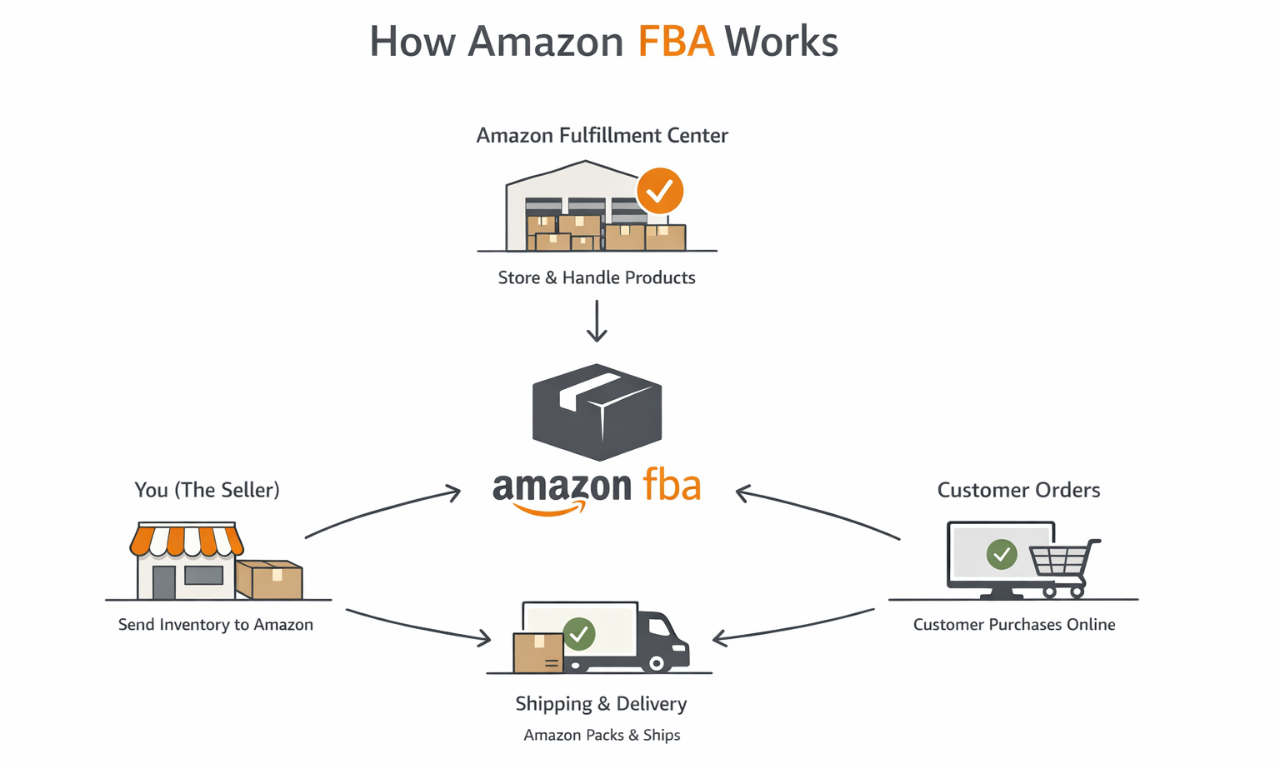
1. Ship Inventory to Amazon
You first send your products to an Amazon fulfillment center. Amazon has warehouses (fulfillment centers) across many regions, including a robust network of over 100 fulfillment centers in India by 2025 to service sellers nationwide. You'll use Amazon's Seller Central platform to create a shipping plan, label your products, and send the stock. (If you're new to selling, be sure to complete the steps to registering a business on Amazon first, so you have a seller account set up.)
2. Amazon Stores Your Products
When the inventory arrives, Amazon scans and stores your units in their fulfillment center shelves. Your products are now officially "in FBA stock." Amazon's facilities have 24/7 security and organized storage systems to keep your items safe. You can monitor your stock levels through inventory management tools on Seller Central.
3. Customer Places an Order
A shopper finds your product on Amazon and clicks the "Buy" button. Amazon's system instantly recognizes that the item is in an FBA warehouse.
4. Amazon Picks, Packs, and Ships
Amazon's fulfillment center staff (or robots) retrieve the item (pick it from the shelf), pack it into an Amazon-branded box with proper packaging, and ship it to the customer's address. They handle choosing an appropriate shipping method to meet the delivery promise (Prime one-day/two-day shipping, etc.).
5. Amazon Handles Customer Service
After delivery, if the customer has questions, needs to return the item, or claims a refund, Amazon's customer service team takes care of those queries on your behalf. If a return is requested, Amazon will process the return and, if the item is still sellable, put it back into your inventory for resale. This relieves you of a huge administrative burden.
Throughout this process, you can focus on other aspects of your business – e.g. sourcing new products or marketing your listings – while Amazon ensures customers get their orders quickly. It's important to note that you maintain ownership of your inventory; Amazon is just handling it for you. You are charged fees for this service (covered in the Costs section below), but many sellers find the trade-off worthwhile. In fact, using FBA for shipping can be more cost-effective on a per-unit basis due to Amazon's economies of scale – Amazon estimates FBA shipping costs about 32% less per unit on average compared to alternative fulfillment methods[1].
Tip: Even though Amazon will do the order fulfillment, you're still responsible for driving traffic to your products. Successful FBA sellers invest in optimizing their product listings and advertising. Leveraging Amazon's advertising platform (formerly known as the Amazon AMS platform) is a smart move to generate more visibility. Sponsored Product ads (Amazon Pay-Per-Click) and Amazon display advertising can significantly boost your FBA sales by putting your listings in front of the right shoppers. FBA ensures fast delivery, but you'll want to ensure customers find your products in the first place through SEO and ads (for example, thorough keyword optimization – see our guide on keyword research for Amazon SEO – and strategic Amazon pay-per-click tutorial campaigns).
Benefits of Amazon FBA for Sellers
Using Amazon FBA gives sellers access to Prime customers, operational scale, and Amazon’s logistics muscle-without having to build everything in-house.
-
Prime Eligibility & Boosted Sales
FBA listings automatically get the Prime badge, which significantly improves click-through rates and conversion. Prime members strongly prefer fast, free delivery, leading to higher sales velocity, better Buy Box ownership, and improved organic rankings. Over time, this momentum can even help products earn badges like Best Seller on competitive listings. -
Hands-Off Logistics
Amazon manages storage, picking, packing, and shipping once your inventory reaches their fulfillment centers. This removes the need for warehouses, shipping staff, or courier coordination. Sellers can scale order volumes without operational stress and focus more on growth activities like sourcing and marketing. -
Customer Service and Returns Handling
Amazon handles buyer queries, refunds, and returns on your behalf. Returned products that meet quality checks are automatically restocked, reducing manual effort. This improves customer satisfaction while protecting your seller metrics—without you managing support tickets or return logistics. -
Lower Shipping Rates
Amazon’s bulk shipping contracts and optimized fulfillment network often reduce per-unit shipping costs, especially for small and lightweight products. Sellers also benefit from discounted partnered carrier rates when sending inventory to Amazon warehouses, lowering inbound logistics costs. -
Multi-Channel Fulfillment
FBA inventory can also fulfill orders from non-Amazon channels like your own website or other marketplaces through Multi-Channel Fulfillment. This allows Amazon’s warehouses to act as a centralized logistics hub for your broader e-commerce operations. -
Access to Amazon’s Tools & Programs
FBA sellers get access to tools like the FBA Revenue Calculator, detailed inventory reports, and eligibility for programs such as Prime Day deals and Lightning Deals. FBA listings also tend to perform better in Buy Box competition compared to FBM offers. -
Drawbacks or Downsides
FBA comes with costs-fulfillment, storage, and long-term inventory fees can add up, especially for bulky or low-margin products. Inventory limits, aging stock penalties, and higher return rates due to Prime convenience are additional factors sellers must plan for. Despite this, many sellers find the time saved and sales uplift justify the trade-off.
Costs and Fees of Amazon FBA
Using FBA involves multiple fee layers, and understanding them upfront is critical because they directly impact your margins.
Amazon Fulfillment Pricing
This is a per-unit fee Amazon charges for picking, packing, shipping, and customer service. It depends on product size and weight, with tiered pricing.
- Small, lightweight items → lower fees
- Large or oversized items → higher fees
Indicative range:
- US: ~$3 for small standard items, $10+ for large items
- India: Charged in INR with marketplace-specific slabs
This is the core FBA “service charge” and often forms the largest cost component, commonly ~30% or more of the sale price for many products.
Monthly Storage Fee
Amazon charges storage fees based on the volume your inventory occupies, billed monthly.
- Fees are higher in Q4 (Oct–Dec) due to peak demand
- Slow-moving or bulky inventory increases costs quickly
Example (US):
- Off-season: ~$0.75 per cubic foot
- Q4: ~$2.40 per cubic foot
Amazon India uses cubic meter–based pricing. Long-stored inventory may also attract long-term storage fees or removal actions, so inventory planning is essential.
Referral Fee
This applies to all Amazon sales, whether FBA or FBM.
- Typically ~15% of the sale price (varies by category)
- Paid for Amazon’s marketplace access and customer acquisition
Your total Amazon cost is usually:
Referral fee + FBA fees
In many cases, this means ~30–35% of your selling price goes to Amazon.
Other Possible FBA Fees
These don’t apply to every seller but are important to know:
- Return processing fees (common in apparel categories)
- Removal or disposal fees for unsold inventory
- Unplanned service fees if shipments aren’t prepped correctly
- FBA Export fees (if cross-border fulfillment is enabled)
All of these are visible in your Seller Central fee reports.
Calculating Profit (Before You Ship)
Always estimate fees before sending inventory to FBA using Amazon’s FBA Calculator or third-party tools.
Example (India):
Selling price: ₹1,000
- Referral fee (~15%): ₹150
- FBA fulfillment fee: ₹100–150
- Storage (fast-selling item): minimal
Total Amazon fees: ₹250–300 Net before ads & product cost: ₹700–750
From this, subtract manufacturing cost + ad spend to check real profitability.
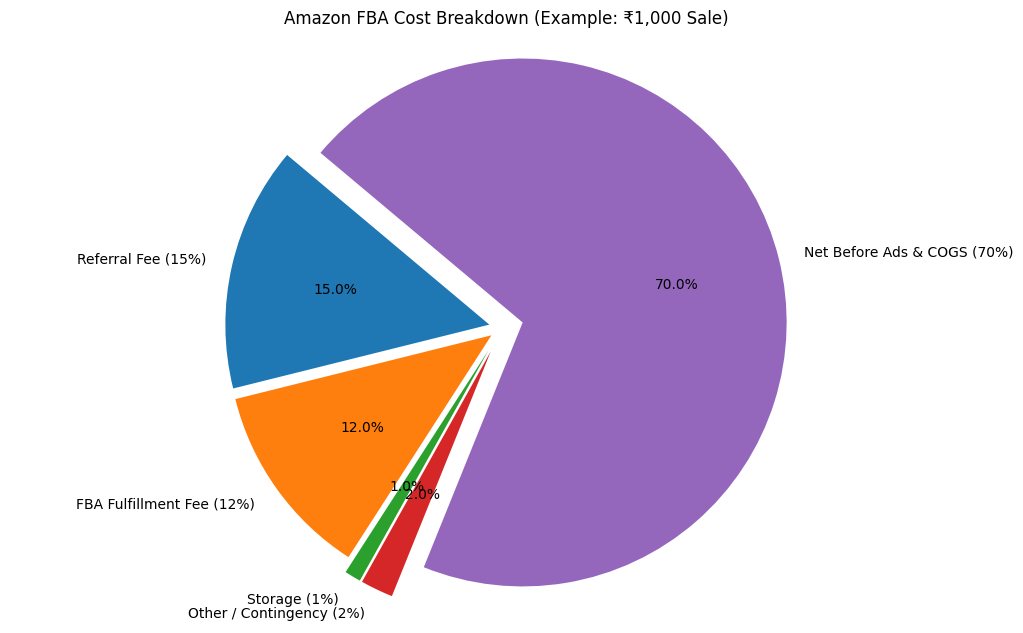
Example: Total Amazon FBA Cost Breakdown
| Cost Component | Approx. Amount (₹) | % of Selling Price |
|---|---|---|
| Referral Fee (15%) | 150 | 15% |
| FBA Fulfillment Fee | 120 | 12% |
| Storage (monthly avg.) | 10 | 1% |
| Other / Contingency Fees | 20 | 2% |
| Total Amazon Fees | 300 | 30% |
| Net Before Ads & COGS | 700 | 70% |
Final Takeaway
FBA simplifies logistics and customer experience, but pricing blindly can kill margins. Fees change periodically, so always check the latest Amazon India or regional fee schedules before scaling.
If you’re new, start small - send a few units, monitor actual fees, and refine your pricing before going all in.
Amazon FBA in India – An Overview
If you are an Amazon seller in India, FBA can be a game-changer for scaling your business. Amazon India operates dozens of fulfillment centers across the country, allowing you to store inventory closer to customers in different regions. As of 2025, Amazon's logistics network in India spans 100+ fulfillment centers covering 15 states[2], and they continue to invest in expansion. This vast network means faster deliveries even to tier-2 and tier-3 cities as Amazon keeps improving Prime delivery coverage (they even launched initiatives like Amazon Air in India for air cargo, and a network of smaller local fulfillment hubs).
For Indian sellers, there are a couple of ways to utilize FBA:
Domestic FBA (Fulfillment by Amazon within India)
You send stock to Amazon's FCs in India, and Amazon delivers to customers who buy on Amazon.in. This will give your products the Prime badge on Amazon.in (making them more appealing to the growing base of Indian Prime members). It's especially useful if you're selling in high volumes or want to offer Prime on heavy items like appliances which customers expect fast delivery for. Amazon.in's customer expectations are rising, and using FBA can help meet the demands for quick, reliable shipping.
Global Selling with FBA
Amazon India encourages exporters to take their products global. Through the Amazon Global Selling program, you can list products on Amazon marketplaces abroad (US, UK, etc.) and use FBA in those countries to fulfill international orders.
For example, an Indian handicraft seller can send bulk inventory to an Amazon US fulfillment center and when US customers order, it's fulfilled via FBA locally in the US. This removes the complexity of international shipping on a per-order basis. Amazon has even introduced services like Amazon SEND to help Indian sellers ship internationally with ease. By using FBA internationally, Indian sellers have managed to scale export businesses without setting up local warehouses overseas.
It's a powerful model – you focus on product and manufacturing, and Amazon handles international logistics. (Do note, selling internationally requires complying with export regulations, Amazon policies for each country, and understanding currency/payment conversion, but many thousands of Indian sellers are already succeeding at this.)
Flipkart's Equivalent
In India, the other e-commerce giant is Flipkart. Flipkart offers a similar service called Flipkart Fulfillment (and a program Flipkart Advantage). As a seller, you might wonder how Amazon FBA vs Flipkart's fulfillment compare. Both aim to provide fast shipping and ease for sellers, but Amazon's network and Prime program are more extensive globally.
If you are selling on multiple marketplaces, you might use both (Amazon FBA for Amazon.in and Flipkart's fulfillment for Flipkart). For a broader comparison of selling on these platforms, you can read our analysis on Amazon vs Flipkart for sellers. In general, Amazon FBA is a key part of Amazon's appeal to sellers, and it's a major reason Amazon often leads in attracting larger seller volumes, especially for those aiming for pan-India reach.
One thing to keep in mind for India: cash on delivery (COD) is still a popular option among customers. Amazon's FBA does support COD orders (Amazon will collect payment on your behalf), so you don't miss out on those buyers. FBA fees in India are charged in INR, and you receive payouts from Amazon (after they deduct fees) to your bank. Ensure you carefully read Amazon India's fulfillment fee and storage fee charts which are slightly different from other countries.
FBA Business Models: Private Label, Wholesale, and More
Amazon FBA is not a "business model" by itself but rather a fulfillment method that can be applied to various Amazon selling business models. Two common models among sellers utilizing FBA are private label and wholesale:
Amazon FBA Private Label
This refers to sellers who create or source their own branded products to sell on Amazon, often finding a manufacturer (locally or in China, etc.), putting their own brand/logo on the product, and importing it in bulk to Amazon's fulfillment centers.
FBA is extremely popular for private label sellers because it enables a small brand to offer prime shipping and nationwide reach from day one. If you've invented a new product or built your own brand (let's say a new kitchen gadget under your brand name), you can manufacture a batch of it and send, for example, 500 units into FBA. Then your product gets listed on Amazon with Prime eligible delivery. Private label sellers love FBA because it handles the operational side while they focus on marketing their brand. Success in private label often involves keyword optimization and SEO on Amazon (to get your product seen for relevant searches), as well as running ads. Doing thorough keyword research for Amazon is a critical step in launching a private label product, ensuring your product listing targets the terms customers actually search for.
Amazon FBA Wholesale
This model is when you purchase products from established brands or manufacturers at wholesale prices and resell them on Amazon (typically you'd try to sell items that already have demand). As a wholesale seller, you might, for instance, buy 100 units of a popular branded toy or electronic item from a distributor, then list that item on Amazon.
Often, you'll be one of several sellers on the same product listing (if it's a well-known product with an existing Amazon listing). Using FBA for wholesale means you send those 100 units to Amazon's warehouse, and Amazon will handle each order as they come. Wholesale FBA sellers benefit from the Buy Box rotation – if you're competitively priced and using FBA, you have a strong chance to win the Buy Box (the "Add to Cart" default seller) when customers view that product page. Essentially, FBA can give wholesale sellers a competitive edge over merchants who ship themselves, because Amazon tends to favor FBA offers for Buy Box due to reliability. Wholesale can be lower margin per unit (since you're selling known products with set prices), so you must really watch the fees and source at a good price.
Other models include retail arbitrage (buying products from retail stores on clearance and reselling on Amazon), online arbitrage, and handmade goods – all of which can leverage FBA for fulfillment. No matter the model, FBA's promise is the same: streamlined fulfillment and Prime eligibility. Your focus should be on sourcing or creating great products; FBA will help deliver them efficiently.
Scaling Your Amazon Business
Many sellers start with one model (say, private label FBA) and then expand. For growth, aside from managing fulfillment, you'll need to think about marketing and strategy. We at GrowthJockey have observed that the most successful Amazon businesses take a holistic approach: great products, smart pricing, and aggressive marketing.
For instance, using Amazon FBA alongside an advertising strategy (Sponsored Products, Sponsored Brands, etc.) can significantly amplify sales. Sellers in India should also stay informed on the latest Amazon e-commerce growth strategies and insights in India to stay competitive in a fast-evolving market. Keep an eye on tools Amazon offers – from new ad types to reports – and consider even exploring off-Amazon promotions (like driving traffic from social media or Google Ads). In fact, understanding the science of keywords in Google Ads can help you run external campaigns that bring more buyers to your Amazon listings – a tactic some advanced sellers use to boost ranking and sales. Combining FBA's fast fulfillment with strong marketing is a recipe for success on the platform.
How To Start FBA On Amazon?
Getting started with FBA is relatively straightforward:
1. Create an Amazon Seller Account
If you haven't already, sign up as an Amazon seller. In India, you'd register through sellercentral.amazon.in. You'll need some business details, tax information (GST), etc. to get approved. (Refer to our blog on the steps to registering a business on Amazon for a detailed walkthrough of setting up your seller account properly.)
2. List Your Products on Amazon
Once your seller account is active, create product listings for the items you want to sell. This includes writing titles, descriptions, setting price, etc. Ensure you mark them as "Fulfilled by Amazon" (you can change a listing from FBM to FBA by updating fulfillment settings or during shipment creation).
3. Enroll in FBA & Send Inventory
Navigate to Amazon's FBA onboarding (within Seller Central, there's an option to "Send/Replenish Inventory"). Amazon will walk you through converting your products to FBA if not already. You'll create a shipping plan, which means specifying how many units of each product you want to send, to which warehouse, and printing Amazon's provided labels.
You'll need to label each unit with an Amazon barcode (FNSKU) unless your product is eligible for stickerless commingled inventory. Then, prepare cartons and ship your products to the assigned Amazon fulfillment center. Amazon's partner carriers (like UPS in many countries) offer discounted rates for this inbound shipment. For Indian sellers, you'll send to the Amazon FC that the system assigns (which could be in another state, depending on where demand is or where Amazon needs stock).
4. Amazon Receives Inventory
After you ship, within a week or two (domestically) or a few weeks (if exporting abroad), Amazon will receive and check in your stock. The status in Seller Central will update, and your listings will show as "In Stock" with fulfillment by Amazon. Now customers can start ordering.
5. Monitor and Maintain
With stock in FBA, you should keep an eye on inventory levels (replenish in time so you don't stock out), and monitor your sales. You'll also need to handle things like advertising, price changes, and customer messages that Amazon may forward (for example, some buyers might still message you for product-specific questions that Amazon doesn't handle). Amazon deposits your sales revenue (minus fees) to your bank account on a regular cycle (every 2 weeks typically).
The good news is any seller is eligible to use FBA – whether you're on an Individual plan (pay-as-you-go) or a Professional seller plan, you can participate in FBA. There's no special requirement or quota; even a brand new seller can send inventory to FBA. Just ensure your products comply with Amazon's FBA product guidelines (some items are restricted or require additional prep – e.g. liquids need secure packaging, expiry-based products need labels, etc., which Amazon's help pages detail).
If you ever decide FBA isn't right for a product, you can switch a listing back to self-fulfillment (FBM) or use Amazon's removal service to get your inventory back. FBA is quite flexible and scalable, which is why it's used by everyone from solo entrepreneurs to large brands.
GrowthJockey: Your Partner in Scaling Amazon Success
Entering the world of Amazon FBA is a big step toward scaling your e-commerce venture. But succeeding on Amazon involves more than just logistics – it requires a solid strategy for visibility, conversion, and growth. This is where GrowthJockey can help. We are a venture builder and growth partner that works closely with companies to accelerate their e-commerce success. Not only do we guide businesses in setting up robust Amazon operations (like optimizing for FBA, improving listings, etc.), we also specialize in running high-performance ad campaigns to drive traffic and conversions.
At GrowthJockey, we run AI-optimized campaigns on Amazon and Flipkart to augment a company's growth. Our team leverages Amazon's advertising platform and data-driven insights to ensure your FBA products don't just sit in a warehouse, but actually fly off the shelves.
We can manage your Amazon Pay-Per-Click, display ads, and even advise on expanding to new marketplaces or your own website. Think of us as an extension of your team – we combine expertise in Amazon's ecosystem with broader digital marketing know-how to execute a comprehensive growth strategy. Whether you need help with campaign optimization on Amazon, or refining your overall approach (we even integrate cross-platform strategies, since success on Amazon can be amplified with off-platform efforts too), our goal is to help you maximize sales and profits.
Ready to take your Amazon FBA business to the next level? Contact GrowthJockey for a consultation and let's discuss how we can propel your growth. We've helped brands navigate Amazon's complexities, from compliance to increasing sales on Amazon through smart marketing. With FBA handling fulfillment and GrowthJockey handling optimization and marketing, you'll be well on your way to building a thriving e-commerce business.
FAQs
Q1. How does Amazon FBA work?
Amazon FBA works by having Amazon handle the storage, packaging, and shipping of your products. You send inventory to Amazon's fulfillment centers, and when orders come in, Amazon picks, packs, and ships products to customers while managing customer service and returns.
Q2. Can I make $1000 a month selling on Amazon?
Yes, it's possible – about 40% of Amazon sellers generate $1,000-$25,000 in sales per month. However, sales aren't the same as profit. Your actual profit depends on product costs, Amazon fees, and advertising expenses, but with the right strategy, $1,000+ monthly is achievable.
Q3. What is FBA eligibility?
FBA eligibility refers to whether a product or seller can use Fulfillment by Amazon. Most sellers with active accounts can use FBA from day one with no minimum sales required. However, certain products (hazardous materials, temperature-sensitive goods) may have restrictions or require special compliance.
Q4. What is Amazon FBA Meaning ?
"FBA" stands for Fulfillment by Amazon. It's Amazon's service where they handle storage, shipping, and customer service for third-party sellers. When you use FBA, Amazon becomes your warehouse and shipper, allowing you to focus on other aspects of your business.
- In fact, using FBA for shipping can be more cost-effective on a per-unit basis due to Amazon's economies of scale – Amazon estimates FBA shipping costs about 32% less per unit on average compared to alternative fulfillment methods - Link ↑
- Amazon India operates dozens of fulfillment centers across the country, allowing you to store inventory closer to customers in different regions. As of 2025, Amazon's logistics network in India spans 100+ fulfillment centers covering 15 states - Link ↑









Industries
Growth
Operations
Technology