
India’s EV Revolution: Policies Fueling Affordable Mobility
State-led reforms and fiscal incentives are redefining India’s EV economics-turning affordability from a manufacturer challenge into a policy-driven outcome.
 By Akshatha G.Updated on 31 October 20254 min read
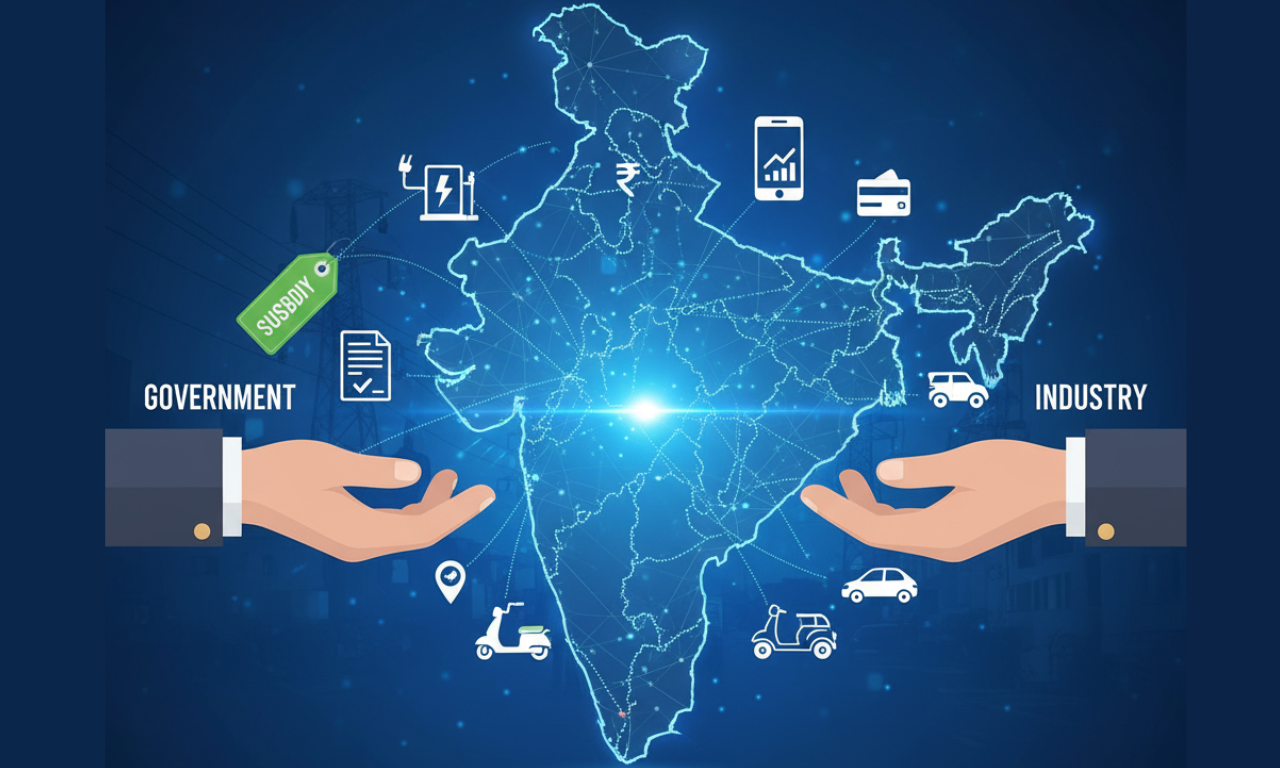
October 2025 marked a decisive moment in India’s electric-mobility journey. Delhi unveiled its second EV policy with a clear mandate-make electric vehicles financially accessible for every citizen and commercial operator. On the same month, Uttar Pradesh amended its rules to reward local manufacturing with 100 percent rebates on road tax and registration fees. Together, these actions signalled a shift from isolated incentives to systemic affordability architecture.
Financing-once treated as a private-sector function-has entered the policy mainstream. The state now acts as a catalyst, not just a regulator.
The Affordability Equation
An EV’s high upfront price stems from battery cost, import duty, and finance charges. By targeting these three variables simultaneously, new policies are re-engineering the math of ownership:
1. Battery Cost Relief: Support for battery-as-a-service models and battery-only loans lowers entry price by 30–40 percent.
2. Fiscal Incentives: Rebates on road tax and registration directly reduce transaction value.
3. Interest-Rate Support: Government-backed green loans channel liquidity to NBFCs at lower cost of funds.
This policy triad converts EV financing from a premium proposition into a mainstream consumer credit segment.
Delhi EV Policy 2.0: Blueprint for Urban Electrification
The Delhi policy extends its focus beyond four-wheelers to two-wheelers and gig-economy fleets -the segments driving volume growth. Key features include:
-
Doubled per-kWh subsidies for two-wheelers.
-
Low-interest financing through designated NBFCs and banks.
-
Scrappage and retrofit benefits to accelerate fleet renewal.
-
Charging infrastructure mandates for housing societies and parking facilities.
For CXOs and fleet operators, these measures translate into direct cost savings and improved asset utilisation. Policy becomes a profit lever, not a compliance burden.
Uttar Pradesh’s Localisation Rule: Policy as Industrial Design
Uttar Pradesh’s decision to link tax benefits with local assembly creates a multi-layered impact:
-
Encourages OEMs to set up assembly and battery plants within state borders.
-
Reduces logistics and import dependency costs.
-
Aligns EV production with employment and MSME growth goals.
By tying policy to production, the state positions affordability as a function of ecosystem self-reliance.
National Momentum and FAME Continuity
While FAME III was not announced in October 2025, the continuation of FAME II benefits and PLI schemes kept OEMs and lenders aligned. Key elements include incentives for battery chemistry innovation and domestic cell production. The result is a gradual shift from import-led subsidy dependence to local value creation.
Financing Integration Across Policies
Perhaps the most defining change is how policy now interfaces with finance technology. RBI’s digital-lending framework and state EV policies are converging through API-linked subsidy disbursals and loan validation systems.
For lenders and OEMs, this means real-time eligibility checks, paperless documentation, and direct benefit transfer of incentives. It creates transparency and reduces processing time from weeks to hours-an efficiency gain that directly boosts adoption.
The Policy Impact on Tier-2/3 Markets
In semi-urban India, policy driven affordability has unlocked latent demand. Low-cost financing, battery subsidies, and dealer-level incentives combine to make EVs viable for delivery riders, fleet operators, and first-time owners. October 2025 data showed a notable spike in two-wheeler registrations across Tier-3 districts-an indicator of how well policy penetrates grassroots markets when paired with embedded finance.
Relevancy: For Policy Makers and CXOs
For industry leaders, these developments offer clear direction:
1. Policy is becoming predictable: Stable five-year frameworks allow long-term financial planning.
2. Affordability is a shared responsibility: Public funding meets private execution through co-lending and PPP models.
3. Digital compliance is mandatory: APIs and account-aggregator systems will govern future subsidy flows.
For CXOs, the message is simple: align go-to-market and pricing strategies with the policy calendar to capture first-mover advantages.
Investment and Capital Flows
Impact investors and green-bond funds are responding to policy clarity with renewed interest. Mirova’s US $15 million injection into Revfin and NIIF’s ₹500 crore commitment to EKA Mobility highlight confidence in regulated, policy-aligned lending vehicles. As capital moves from general ESG themes to specific policy-compliant assets, affordability receives direct financial reinforcement.
Policy to Practice: Execution Challenges
Despite progress, gaps remain: uneven state-level implementation, limited battery-recycling infrastructure, and fragmented digital registries. For the next wave of EV adoption, policymakers must shift from announcing incentives to standardising execution. Uniform API frameworks for loan tracking and subsidy release will be critical.
Conclusion: Policy as the New Pricing Mechanism
EV affordability is no longer solely a function of battery innovation or OEM efficiency. It is increasingly a derivative of policy architecture. States and regulators are acting as market designers-calibrating subsidies, interest rates, and incentives to shape consumer behaviour.
For industry leaders, the imperative is to embed policy literacy into business strategy. Those who build systems aligned with real-time regulatory shifts will own the next phase of EV growth. The future belongs to those who treat policy not as an announcement, but as infrastructure.
At GrowthJockey, we believe India’s EV story will only reach full maturity when financial innovation catches up with technological progress. As venture architects, we help enterprises bridge that gap designing and scaling digital-first ecosystems that drive both adoption and profitability.
Our venture tools, including Intellsys.ai , Ottopilot and Ottoscholar, enable organizations to turn insights into action transforming finance, data, and experience into one connected growth engine.
FAQs
Q1. What is the Delhi EV Policy 2.0?
Ans. Delhi EV Policy 2.0 introduced in October 2025 enhances two-wheeler and fleet subsidies, adds scrappage benefits, and provides low-interest financing to accelerate urban electrification.
Q2. How does Uttar Pradesh’s localisation rule impact affordability?
Ans. By linking tax rebates to local assembly, it reduces vehicle cost and encourages domestic production, making EVs more affordable and supply chains self-reliant.
Q3. What are the key financing benefits under new state policies?
Ans. Low-interest green loans, 100 percent road-tax and registration rebates, and API-based subsidy disbursals that speed loan approvals and lower EMIs.
Q4. How can OEMs and lenders align with policy frameworks?
Ans. By integrating digital loan systems with government APIs for eligibility and subsidy validation, ensuring fast, transparent financing and higher adoption.
DISCLAIMER: The information in this article is general in nature and does not constitute financial or investment advice. Readers are solely responsible for their decisions, and we disclaim all liability for any losses or damages arising from reliance on this content.
Read next
Captive Finance Arms: Why OEMs Are Building Their Own Banks
As India’s EV market matures, OEM-led finance arms are emerging as strategic growth engines-turning credit into a competitive moat and redefining customer ownership.
Battery-Only Financing: The Next Frontier in EV Affordability
As India’s EV adoption accelerates, a new lending model is redefining ownership-battery-only financing is lowering entry barriers and reshaping affordability across two- and three-wheeler markets
Leveraging Technology in Captive Finance: The Role of AI and Data in EV Loan Approvals
Learn how AI and data analytics are transforming EV loan approvals, enabling OEMs to offer personalized financing solutions and accelerate EV adoption.
Navigating the Complexities of Building a Captive Finance Company in the EV Market
Learn how OEMs can build a successful captive finance company for EVs, covering business models, legal steps, partnerships, and technology requirements.
Most Read
Popular
For sponsors building at scale.
We work on a small number of large mandates. If you are weighing a new business, or the scale of one you already have, we would be glad to hear from you.