
Types of Amazon Ads: Sponsored Products, Brands, Display & DSP

Amazon is now the starting point for product searches, with over 50% of online shoppers beginning on Amazon. This shift has pushed brands to increase ad spend, with Sponsored Products spend up 165%, thanks to strong conversion performance. The challenge is choosing the right Amazon ad types without inflating ACoS.
This guide explains the major Amazon ad formats, from Sponsored Products and Sponsored Brands to Sponsored Display and Amazon DSP, and shows how performance marketers can use them strategically to drive efficient growth.
(Pro tip: If you're new to selling on Amazon, ensure you have a Professional Seller account and enroll in Brand Registry to access all ad features. Not started yet? Check our guide on steps to registering your business on Amazon to lay the groundwork.)
Main Types of Amazon Ads (PPC Advertising Overview)
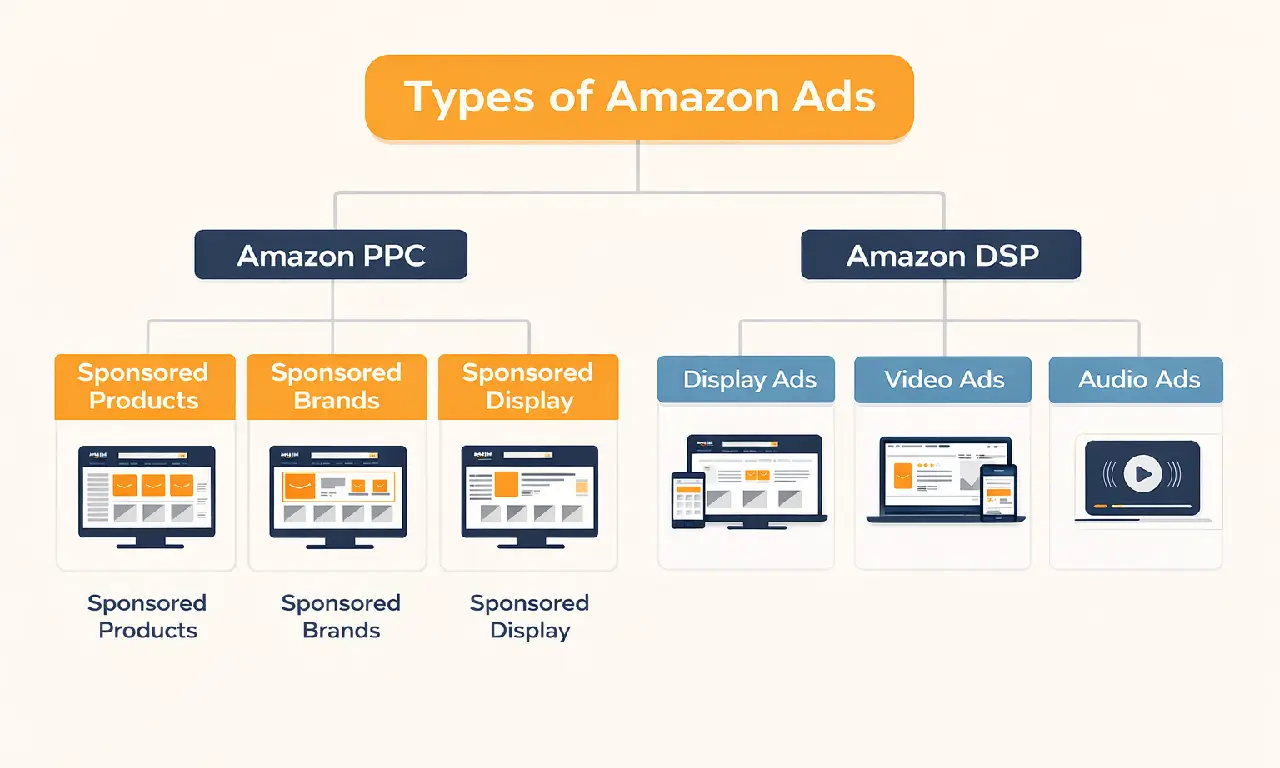
When we talk about "types of Amazon ads," we primarily refer to Amazon's Sponsored Ads – the self-service, pay-per-click ad formats available through the Amazon Advertising console (formerly Amazon Marketing Services, or AMS). These are the ads most sellers use to promote products within Amazon's marketplace. There are three core Amazon PPC ad types:
• Sponsored Products – Promotes individual product listings in search results and product pages.
• Sponsored Brands – Promotes a brand with a custom headline, logo, and multiple products (includes formats like banner ads and videos).
• Sponsored Display – A display ad format that retargets or interests shoppers on Amazon and across the web with product-centric ads.
Amazon also offers programmatic advertising through its Demand-Side Platform (DSP), which is a more advanced channel for running display, video, and audio ads both on and off Amazon. We'll cover DSP separately, since it differs from the core PPC ads above.
Before diving into each ad type, it’s important to understand why Amazon ads matter. They appear natively within the shopping experience, reaching customers at the point of purchase intent, unlike Google Ads (general search) or Facebook Ads (passive interest). For performance marketers, Amazon ad formats work best as funnel components: Sponsored Products capture high-intent searches, Sponsored Brands build awareness and brand recall, and Sponsored Display re-engages shoppers through retargeting.
Amazon's own data shows that using multiple ad types in tandem can significantly boost results (e.g. advertisers running Sponsored Products and Display ads together saw a 22% increase in new-to-brand customers on average[1].
Let's explore each Amazon ad type in detail, including how they work and best practices to get the most out of them.
1. Sponsored Products
Sponsored Products are Amazon’s core PPC ad format, used to promote individual product listings. They work like search ads within Amazon: you select a product, target keywords or products, and pay only when a shopper clicks. Because they directly drive sales, Sponsored Products are usually the starting point for Amazon advertising.
Where Sponsored Products appear
Sponsored Products appear natively across Amazon, including top, middle, and bottom of search results and on product detail pages (for example, “Sponsored products related to this item”). These placements blend into the shopping experience on both desktop and mobile, often resulting in strong click-through rates.
Who can use Sponsored Products
Sponsored Products are available to Professional Sellers, vendors, and KDP authors across all Amazon marketplaces, including India. Brand Registry is recommended but not mandatory. Products must be in eligible categories, new condition, and Buy Box eligible. There’s no minimum spend, making this format accessible for sellers of all sizes.
Targeting and bidding options
Sponsored Products support two targeting methods:
-
Keyword targeting: Bid on shopper search terms using broad, phrase, or exact match. Automatic campaigns can be used to discover converting keywords, while manual campaigns offer tighter control.
-
Product targeting: Target specific ASINs or categories, including competitor listings or complementary products.
This flexibility lets you capture both search-driven and browse-driven intent.
Why use Sponsored Products
Sponsored Products drive immediate visibility and sales, making them ideal for product launches, scaling winners, and defending high-value keywords. Increased ad-driven sales often improve organic rankings, creating a compounding growth effect. Among all Amazon ad types, Sponsored Products typically deliver the highest conversion rates due to strong purchase intent.
Optimization tips
To maximise results, ensure your listings are fully optimised and Buy Box competitive. Use negative keywords to control wasted spend, and regularly adjust bids based on performance. Track both ACoS and TACoS to measure true efficiency. For deeper guidance, see our breakdown of TACoS vs ACoS.
2. Sponsored Brands
Sponsored Brands (formerly Headline Search Ads) are designed to promote your brand, not just a single product. These ads feature your brand logo, a custom headline, and multiple products, and appear in premium search placements, most notably at the top of Amazon search results.
Unlike Sponsored Products, Sponsored Brands can drive traffic to your Amazon Store or a curated landing page, making them ideal for brand discovery, launches, and portfolio promotion.
Formats and features
Sponsored Brands support multiple formats:
-
Product Collection (Banner): Displays your logo, headline, and 2–3 products. Clicking the headline or logo leads to your Store, while product clicks go to individual detail pages.
-
Sponsored Brands Video: Short, auto-playing videos (no sound) that appear within search results. These typically deliver higher engagement due to strong visual impact.
Both formats run on a CPC auction model, similar to Sponsored Products.
Where Sponsored Brands appear
Sponsored Brands appear within Amazon search results on both desktop and mobile. Key placements include above the search results, inline while scrolling, and at the bottom of search pages. Sponsored Brands Video usually occupies a single mid-search slot, making it competitive but highly effective.
These placements make Sponsored Brands well-suited for top-of-funnel visibility and brand recall.
Who can use Sponsored Brands
Sponsored Brands are available to Brand Registered sellers, vendors, and agencies. Sellers must be enrolled in Amazon Brand Registry to access these ads, as they are brand-led formats tied to Store pages and branded assets.
There’s no fixed minimum spend, but competition for top placements can drive higher CPCs compared to Sponsored Products.
Why use Sponsored Brands
Sponsored Brands are primarily about brand building and strategic visibility:
-
Premium visibility: Appear at the top of search results for high-impact brand exposure.
-
Showcase multiple products: Promote a product range instead of a single ASIN.
-
Drive Store traffic: Funnel shoppers into a controlled brand environment.
-
Creative flexibility: Use headlines, logos, and video to differentiate beyond standard listings.
In practice, Sponsored Brands complement Sponsored Products well. Sponsored Brands build awareness and defend brand keywords, while Sponsored Products capture conversion-ready shoppers. Many performance marketers run both together to improve overall conversion rates and new-to-brand sales.
Tip: Sponsored Brands Video often delivers strong ROI. Keep videos short, sound-off friendly, and focused on the first 2 seconds to capture attention quickly.
3. Sponsored Display
Sponsored Display is Amazon’s self-serve display ad format that lets sellers reach shoppers on and off Amazon without using DSP. It evolved from the old Product Display Ads and is available directly through Seller Central or the Ads console.
Unlike search ads, Amazon Sponsored Display ads doesn’t use keywords. It targets audiences or products based on shopping behavior, enabling retargeting and interest-based reach. These ads appear on product pages, near search results, and across third-party sites, helping re-engage shoppers and attract new customers.
Where Sponsored Display ads appear
On Amazon, Sponsored Display ads appear on product detail pages, sidebars, or between search results, helping capture shoppers as they compare products. Off Amazon, they show across websites and apps in Amazon’s network. For example, someone who viewed your product may later see your ad on a news or weather app. You choose the targeting, and Amazon handles placements automatically, extending reach beyond Amazon using its shopper data, similar to display retargeting on Google or Meta.
Targeting options
Sponsored Display offers two main targeting approaches:
-
Product targeting (contextual): Product targeting lets you choose specific ASINs or categories to show your ads on. This works well for competitor conquesting or promoting complementary products. You can target competitor product pages to win shoppers, or advertise on your own listings to defend against rival ads. It supports both offensive and defensive strategies within Amazon.
-
Audience targeting: This targets shoppers based on behavior and interests. Amazon offers audiences like views remarketing, purchases remarketing, and interest-based segments. Views remarketing is especially powerful, letting you re-engage shoppers who viewed your product but didn’t buy. Amazon can also reach users who viewed similar products, all without any external tracking or setup
Sponsored Display simplifies what used to require the Amazon DSP: even if you're not spending huge budgets, you can still do dynamic product ads and retargeting. It's cost-per-click or cost-per-impression (you can choose a vCPM bidding model to optimize for impressions if your goal is reach). Notably, Sponsored Display has no minimum spend, unlike Amazon DSP which often requires thousands of dollars.
Why use Sponsored Display:
This ad type fills a crucial gap in the Amazon advertising funnel – it lets you stay in front of interested shoppers beyond the initial search. Key advantages include:
-
Retargeting made easy: Sponsored Display helps recover lost sales by retargeting shoppers who viewed your product but didn’t buy. Since these users already showed intent, a simple reminder often boosts conversions. Like e-commerce retargeting overall, second-touch ads on Amazon tend to deliver higher ROI by focusing on warm leads.
-
Expanded reach off-Amazon: Sponsored Display extends your ads beyond Amazon to reach shoppers across the web. Using Amazon’s shopping data, it keeps your brand visible to high-intent users even when they leave the marketplace.
-
No creative hassle: Sponsored Display ads are auto-generated using your product image, title, price, and a short headline, so there’s no need to design banners from scratch. This makes them a low-effort way to launch display campaigns, especially for sellers without design resources. cThe trade-off is limited creative control compared to DSP, but the simplicity speeds up testing and execution. Amazon has also introduced Sponsored Display video in beta, which auto-creates simple product videos for added engagement.
Sponsored Display is commonly used for defense and conquesting. Brands protect their own product pages, target competitor listings, and retarget shoppers who previously viewed their products. It’s a low-cost way to test display ads with small budgets.
Retargeting recent viewers often delivers efficient ACOS since intent is already high. Sponsored Display is also effective for promoting deals or clearing inventory by re-engaging shoppers who didn’t convert earlier.
Sponsored Display vs Amazon DSP
Amazon DSP and Sponsored Display serve different needs. Amazon DSP is a full-funnel, programmatic platform with advanced targeting and custom creatives, but it typically requires agency access and higher budgets. Sponsored Display is self-serve, has no minimum spend, and offers simpler targeting and creative options.
Sponsored Display works as “DSP-lite” for smaller brands focused on on-Amazon and basic off-Amazon retargeting, while larger brands use DSP for scale, video, and broader reach. Many brands use both: Sponsored Display for quick retargeting, and DSP for high-impact awareness, often paired with AI-optimized bidding to maximise performance.
For a more detailed breakdown of Amazon's display advertising options and how to maximize them, check out our dedicated post on Amazon display ads which dives deeper into Sponsored Display vs DSP, creative tips, and case studies of success.
4. Amazon DSP and Advanced Advertising Solutions
Beyond the core sponsored ads, Amazon offers Amazon DSP and several other advertising channels that larger brands or advanced marketers might explore. Let's briefly cover these to complete the picture of Amazon's advertising ecosystem.
Amazon DSP (Demand-Side Platform)
Amazon DSP is a programmatic platform for running display, video, and audio ads using Amazon’s shopper data, both on Amazon-owned properties and across third-party sites and apps. It offers advanced audience targeting, richer ad formats, and full creative control.
Compared to Sponsored Display, DSP provides broader off-Amazon reach, video and streaming TV inventory, and deeper audience insights, but comes with higher cost and complexity and is usually run via agencies. DSP inventory is sourced from Amazon Owned & Operated sites, Amazon Publisher Direct, and open exchanges, enabling brands to reach high-intent shoppers beyond Amazon.
Other Amazon Advertising Channels
Amazon has developed a few additional ad products and tools:
-
Amazon Video Ads via DSP: Through DSP you can run OTT video ads (Over-the-top TV ads on streaming content) and online video ads. As more consumers in India and globally consume streaming media, these video ads allow you to extend your brand storytelling beyond static images. They appear on platforms like Fire TV apps, IMDb TV (Freevee in US), or major websites as video slots. Video ads help in upper-funnel brand building with Amazon's audience precision.
-
Amazon Audio Ads: A newer offering (still in beta) that lets brands play audio commercials to listeners on Amazon Music's free tier or Alexa-enabled devices. While limited in targeting options currently, it's a unique way to reach audiences during "screen-free" moments (e.g., someone listening to music on Echo). Think of it as radio ads, but powered by Amazon's data to ensure relevance.
-
Amazon Live: A live-streaming platform where brands or Amazon hosts showcase products in real-time (like QVC for the digital age). Brands can run live sessions demonstrating products; viewers can buy directly from the stream. Advertising-wise, brands can pay to promote their Amazon Live streams or work with influencers. It's more of a social commerce tool, but worth mentioning as it's an engaging way to advertise during peak events or launches. During big shopping events (Prime Day, Black Friday), Amazon Live gets significant traffic.
-
Amazon Posts (now discontinued): Amazon had a beta program called Posts, which was a free social feed-style program for brand-registered sellers to post lifestyle images and product highlights on Amazon's mobile app. It was essentially free advertising within Amazon, aiming to drive product discovery (customers could "follow" brands and see their posts). However, as of mid-2025, Amazon discontinued Posts to focus on other solutions. If you see references to Amazon Posts in older content, note that this feature is no longer available. Instead, Amazon encourages using your Brand Store and Amazon Live for engaging content.
-
Lockscreen Ads (for eBooks): For Kindle Direct Publishing authors or book vendors, Amazon offers Lockscreen Ads which show on Kindle devices and Fire tablet lock screens. These are CPC ads that let authors promote their eBooks to readers by genre or interest. It's a niche ad type specific to the book ecosystem.
-
Amazon Attribution: Not an ad format, but a tool worth noting – it provides tracking for external traffic you drive to Amazon (e.g., from Google or Facebook ads). With Attribution, you can measure the impact of your off-Amazon marketing on Amazon sales. This is vital for performance marketers running multi-channel campaigns.
The key takeaway is simple: Sponsored Products, Sponsored Brands, and Sponsored Display are the core pillars of Amazon PPC that every seller should use. Amazon DSP and other formats can be added later as budgets grow and goals expand to brand awareness and off-Amazon reach.
Most successful brands use a mix: Sponsored Products for consistent sales, Sponsored Brands for brand visibility and defense, Sponsored Display for retargeting, and DSP for scale. The right blend depends on your budget and objectives, but skipping any format can mean missing parts of the customer journey and leaving revenue untapped.
If all these options sound complex, remember that Amazon's ad platform has intelligence and automation built-in. You can start simple (automatic targeting campaigns, dynamic bids) and gradually refine. Also, partners like GrowthJockey specialize in managing and optimizing these multi-channel Amazon campaigns – ensuring that your ad spend is efficiently driving growth across the funnel.
How Much Do Amazon Ads Cost? (Especially in India)
Amazon ads are flexible and budget-friendly because you control bids and daily spend, and you typically pay per click (or per 1,000 impressions for some formats). There are no upfront fees the cost depends on keyword and category competition.
-
Cost-Per-Click (CPC): Amazon PPC runs on a CPC model. In the U.S., average CPC is about $1.10 in 2025 , but India is significantly cheaper. Many categories see CPCs around ₹5–₹20, with Sponsored Products often in the ₹7–₹30 range and Sponsored Brands higher due to premium placements. Competitive niches cost more; long-tail keywords cost less.
-
Budgets: Sellers in India can start with ₹200–₹500 per day. Early-stage brands may test with a few thousand rupees monthly, while scaling sellers often spend ₹50,000+ per month, and large brands invest much more. If campaigns consistently hit daily budgets early, it’s usually a sign of missed sales opportunities.
-
ACoS, ROAS, and TACoS: Performance marketers focus less on CPC alone and more on ACoS (Ad Spend ÷ Ad Revenue) and ROAS. What’s “good” depends on margins and goals lower for profitability, higher for launches or awareness. TACoS looks at ad spend against total sales and helps measure long-term impact. A stable or declining TACoS usually signals healthy organic growth driven by ads.
In short, Amazon advertising is as efficient or aggressive as you choose. You could run a ₹300/day campaign that consistently delivers profitable sales, or you could scale to ₹30,000/day across many campaigns if the return justifies it Especially in India, where CPCs are still relatively low, brands have a strong opportunity to scale profitably before competition intensifies. With smart keyword selection, bid optimisation, and disciplined measurement, Amazon ads can deliver strong ROI - and for repeat-purchase brands, even break-even ACoS can be highly profitable over time through customer lifetime value.
Key Takeaways and Best Practices
We’ve covered the major Amazon ad types. To close, here are practical best practices for performance marketers looking to scale efficiently on Amazon:
-
Use multiple ad types together: Each format plays a role. Sponsored Products drive conversions and rankings, Sponsored Brands build awareness and defend brand terms, and Sponsored Display retargets and expands reach. Used together, they create a compounding effect across the funnel. Many brands start with a split like 60% Sponsored Products, 20% Sponsored Brands, and 20% Sponsored Display, then refine based on performance.
-
Optimize listings before scaling ads: Ads drive traffic, but listings drive conversions. Strong images, clear titles, persuasive bullets, pricing, and reviews are essential. Poor listings waste ad spend. Optimised listings also improve ad efficiency. For deeper guidance, see our Amazon SEO guide.
-
Refine targeting over time: Start broad with automatic campaigns and category targeting, then narrow down using search term and targeting reports. Scale what converts, cut what doesn’t. Protect brand keywords with Sponsored Brands, and use Sponsored Display views remarketing and competitor ASIN targeting to capture warm and adjacent demand.
-
Monitor and optimise continuously: Amazon ads are not set-and-forget. Track CTR, conversion rate, ACoS, ROAS, and new-to-brand metrics weekly. Adjust bids, budgets, and negatives as needed, and account for seasonality and sales events. Testing new formats like video often unlocks incremental gains.
-
Look beyond direct ACoS: Ads also drive organic rank, Buy Box stability, and badges like Best Seller. Track TACoS to understand long-term efficiency. Stable or declining TACoS usually signals healthy growth.
-
Stay policy-compliant: Each ad type has creative and category rules. Non-compliance leads to disapprovals and wasted momentum, so always align with Amazon’s advertising policies.
Mastering Amazon Ads takes iteration, but the upside is significant. Especially in fast-growing markets like India, brands that adopt a full-funnel, multi-format approach early often build a durable competitive advantage.
Conclusion: Maximizing Growth with the Right Mix of Amazon Ads
In Amazon’s competitive marketplace, using the right mix of ad formats is key to growth. Sponsored Products, Sponsored Brands, Sponsored Display, and DSP each support different stages of the shopper journey, from discovery to purchase and re-engagement. Used together, they drive stronger visibility, higher sales velocity, and lasting brand impact.
Winning with Amazon Ads takes more than format knowledge. It requires constant optimisation, data-driven decisions, and execution discipline. GrowthJockey partners with brands to plan, run, and optimise Amazon advertising for maximum ROI, acting as an extension of your team.
Our tailored approach spans bidding, creative, AI-led optimisation, and cross-platform alignment across Amazon, Flipkart, and owned channels. If you’re ready to scale your Amazon growth with clarity and control, connect with GrowthJockey for a focused consultation.
FAQs
Q1. How many types of Amazon ads are there?
Amazon offers three core self-serve PPC ad types: Sponsored Products, Sponsored Brands, and Sponsored Display. In addition, there’s Amazon DSP, which enables programmatic display, video, and audio ads on and off Amazon. Practically, most advertisers operate across these four categories.
Q2. Which feature distinguishes Sponsored Brands from other Amazon ads?
Sponsored Brands allow custom creative including a brand logo, headline, and multiple products in one ad. They can also drive traffic to a Brand Store or custom landing page, unlike Sponsored Products, which link directly to a single ASIN. This makes Sponsored Brands more brand-led than purely performance-led.
Q3. What are the types of campaigns in Amazon Ads?
Amazon Ads campaigns are structured by ad format: Sponsored Products, Sponsored Brands (including video), and Sponsored Display. Amazon DSP campaigns are created separately and focus on display, video, and audience-based targeting. Each campaign type aligns with different funnel objectives.
Q4. What are the types of keywords in Amazon ads?
Amazon supports three keyword match types: Broad, Phrase, and Exact. Broad maximises reach, Phrase balances relevance and scale, and Exact offers the highest control and efficiency. Advertisers also use negative keywords to block wasted spend and improve performance.
Q5. Amazon Ads vs Google Ads – what’s the difference?
Amazon Ads target shoppers at the point of purchase, using high-intent marketplace data. Google Ads capture users across the web, often earlier in the decision journey. Amazon typically delivers higher conversion rates, while Google excels at discovery-most brands benefit from using both together.








Industries
Growth
Operations
Technology