
Amazon Advertising Strategy: Complete Guide With Examples For 2026

Amazon has rapidly grown into a powerhouse in the digital advertising world. In 2024, Amazon's advertising revenue hit $56 billion, making it the third-largest digital ad company globally (behind only Google and Meta)[1]. This explosive growth highlights how crucial Amazon's advertising platform has become for brands and sellers. In this guide, we'll break down how Amazon advertising works, effective strategies (including case studies), and even touch on Amazon's overall marketing mix (the 4 P's). Whether you're an Amazon seller in India or anywhere else, these insights will help you craft a winning Amazon ads strategy in 2025.
Why Amazon Ads Strategy Matters in 2026
Amazon isn't just an e-commerce giant - it's now one of the fastest-growing advertising platforms. Advertising makes strategic sense for Amazon because it leverages the company's core strengths: capturing purchase intent and converting it into action. Shoppers on Amazon are often ready to buy, which means the ad impressions are high-intent. Unlike Google (which has search data) or Facebook (which knows user interests), Amazon's advantage lies in knowing what people actually purchase and how they do it. In marketing terms, Amazon offers "closed-loop attribution", meaning it can track an ad's effectiveness from impression to purchase. This rich first-party data makes Amazon's ad platform one of the most efficient and powerful in the world for advertisers.
For Amazon sellers and marketers, this is huge. It means that advertising on Amazon can directly boost product visibility and sales among shoppers who are actively looking for products. In fact, studies note that people searching on Amazon are highly likely to buy, and Amazon's vast data allows very precise targeting to increase conversion rates. The bottom line: if you sell on Amazon, a smart Amazon ads strategy can be a game-changer for your growth.
Key point: Amazon's ad business is not a side hustle – it's a core growth engine. It's high-margin, growing ~18% year-over-year, and is on track to become a $100B business within a few years. Ignoring Amazon Ads means missing out on a platform where your potential customers are already shopping.
Understanding Amazon's Advertising Ecosystem
Amazon's advertising ecosystem offers a variety of ad types and placements to help sellers reach shoppers at different stages of the buying journey. The main Amazon ad formats include:
Sponsored Products
These are pay-per-click (PPC) ads for individual product listings that appear in search results and product detail pages. Sponsored Products are the bread-and-butter for driving direct product sales and typically make up the bulk of Amazon ad spend. In fact, roughly 80% of Amazon sellers' ad-driven sales come from Sponsored Products[2]. These ads are easy to start with: you choose products to promote, set keywords (or use auto-targeting), and bid for ad placements. They help your product show up higher in search results, often right where buyers are looking.
Sponsored Brands
These ads appear at the top of search results featuring your brand logo, a headline, and multiple products. Sponsored Brands (formerly Headline Search Ads) are great for boosting brand awareness and showcasing a range of products or directing traffic to your Amazon Store. (Note: You need to be enrolled in Amazon's Brand Registry to use these.) This format lets you highlight up to 3 products with a custom headline and image, helping drive recognition and cross-sell your catalog.
Sponsored Display
These are display ads that can retarget shoppers both on and off Amazon. Sponsored Amazon Display ads appear on Amazon (product detail pages, recommendations, etc.) and also on external websites/apps through Amazon's advertising network. They allow you to target audiences by interests, demographics, or those who viewed your product but didn't buy. Sponsored Display is powerful for re-engaging past visitors and complementing your Amazon PPC with some off-site reach.
Amazon also offers Video Ads and Streaming TV Ads (for example, ads on its streaming platforms like Prime Video, Freevee, or Twitch). As of 2024, Amazon even introduced ads on Prime Video, tapping into over 200 million global viewers. This move opens a new frontier for advertising on connected TV – Bank of America estimates Prime Video ads could add $3.5–5 billion in revenue for Amazon in 2026. For sellers, formats like Sponsored Brands Video (video ads in search results) are emerging as high-impact ways to engage shoppers with rich media content. Video allows you to demonstrate your product in action, which can significantly boost click-through and conversion.
To make the most of Amazon's ad ecosystem, experts advise utilizing all three main ad types (SP, SB, SD) to cover the full marketing funnel. Sponsored Products capture in-market shoppers, Sponsored Brands build brand recall and trust, and Sponsored Display brings shoppers back and broadens reach. By diversifying your ad mix beyond just Sponsored Products, you can tap into the remaining ~20% of sales opportunity that formats like Sponsored Brands and Display offer.
Crafting an Effective Amazon Ads Strategy
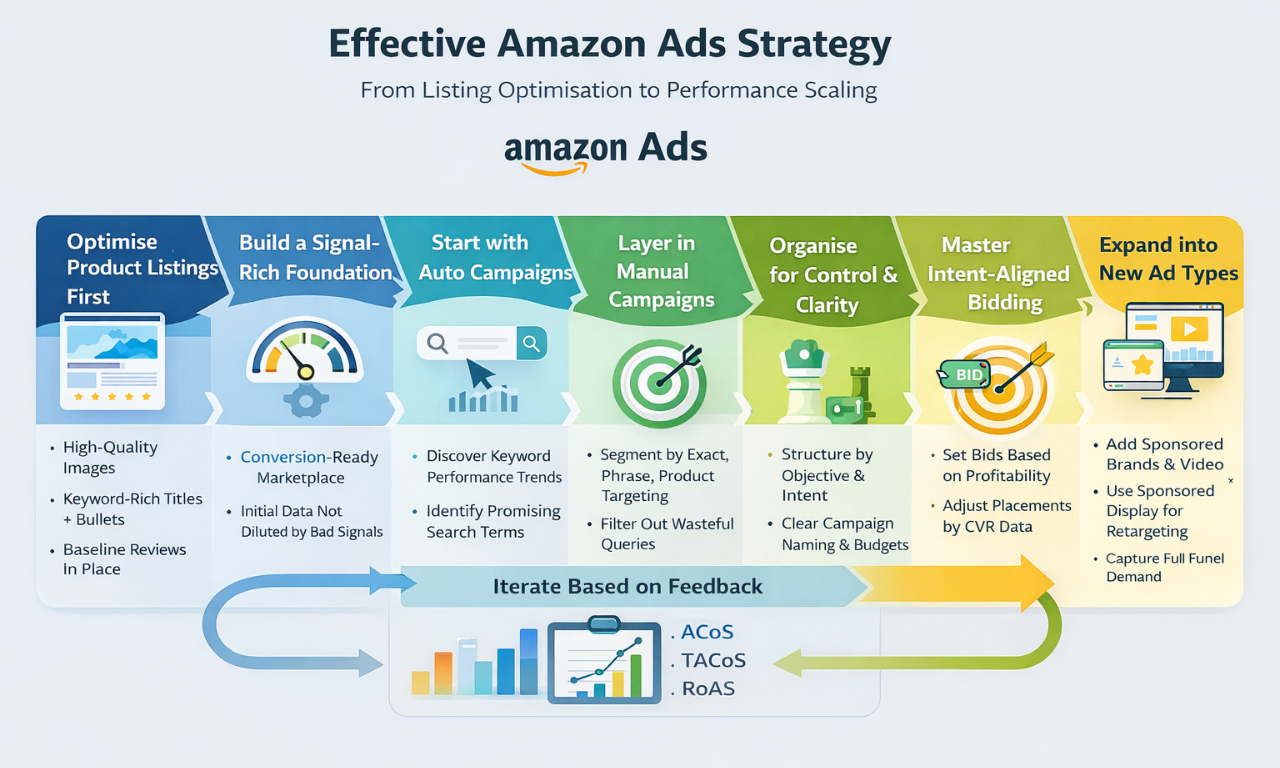
Amazon Ads are easy to launch, but most accounts never graduate from that basic stage. A strong strategy doesn’t just optimise bids or chase clicks - it addresses the core reasons why ads often underperform in real seller accounts: poor structure, weak signal-to-data feedback, and reactive optimisation habits.
Here’s how we structure Amazon Ads strategy in 2026 to correct the root causes that most sellers get wrong - with a focus on improving data signal quality, stabilising performance, and enabling predictable scale.
Optimize Your Product Listings First
Before even spending on ads, ensure your product detail pages are polished. High-quality images (including lifestyle shots), clear and keyword-rich titles, compelling bullet points, and plenty of positive reviews will improve your conversion rate. Remember, ads drive traffic, but your listing must convert that traffic into buyers.
Improving your listing's appeal can significantly boost your advertising ROI – for example, simply enhancing images and descriptions can lift conversion rate, which in turn raises your return on ad spend (RoAS) without increasing bids.
Key readiness signals include:
-
Clear product positioning and visual differentiation in search results
-
Listings structured to convert cold traffic, not just brand-aware buyers
-
Stable Buy Box ownership and inventory depth to support scale
A common mistake is launching ads to “test demand” while listings are still evolving. In practice, this produces misleading data and trains the algorithm on poor conversion signals.
Tip: Only advertise products that have the buy box (for sellers) and sufficient stock; otherwise, ad clicks are wasted on unavailable items.
Start with Auto and Manual Campaigns
If you're new, Amazon makes it easy to create your first campaign. In Seller Central, go to Advertising > Campaign Manager > Create campaign. A smart approach is to launch an Automatic Sponsored Products campaign first to let Amazon identify relevant search terms for your product (keyword harvesting).
Run this for a week or two to gather data on which search queries convert to sales. Simultaneously, set up a Manual campaign (exact or phrase match) targeting the most relevant keywords you already suspect are winners. Over time, move converting search terms from the auto campaign into your manual campaigns for more control, and add poor performers as negatives to avoid wasting spend.
Organize Campaigns for Clarity
Structure your campaigns in a logical way. Many experienced advertisers separate campaigns by goals or product categories. For example, you might organize into buckets like Brand Awareness (for Sponsored Brands), Category Targeting/Conquest (targeting competitor ASINs or category keywords), and Efficiency/Profit (exact match on high-ROI keywords).
One pro tip is to use clear naming conventions (e.g., 2026_Q1_ProductX_Exact) and group campaigns by objective or funnel stage. This makes it easier to monitor performance and scale what works.
Master Bid Management
Bids are one of the most powerful levers in Amazon PPC. Set your initial bids around Amazon's suggested mid-range as a starting point. Then monitor and adjust. Increase bids on high-converting keywords to capture more impressions, and decrease bids (or pause) on terms that spend money without sales.
Keep an eye on key metrics:
- ACoS (Advertising Cost of Sales) which is ad spend divided by sales – this should align with your profit margins
- RoAS (Return on Ad Spend) – the inverse of ACoS, indicating how many dollars in sales you get per ad dollar spent
- TACoS (Total ACoS) which factors in organic sales – a great indicator of overall business health in relation to ads
Strong bid optimization can make even aggressive campaigns profitable. Also, take advantage of Amazon's bidding features (dynamic bids, placement multipliers for top-of-search, etc.) to maximize results once you have data.
Leverage Long-Tail Keywords
Don't just chase the highest-volume generic keywords (which are extremely competitive); include long-tail keywords that are more specific. These often have lower cost-per-click and higher conversion rates because they match what niche customers are searching for.
For example, instead of just "wireless headphones," a long-tail like "wireless headphones for running sweatproof" might yield a better ROI. Use Amazon's search term report and keyword research tools to discover these gems. Balancing your campaign with a mix of broad popular terms and targeted long-tails will optimize spend and drive sustainable growth.
Expand into New Ad Types and Creatives
Many sellers stick to Sponsored Products only. While SP should indeed command the majority of your budget, don't overlook Sponsored Brands and Sponsored Display, as well as newer options like video ads. These formats can give you an edge since not all competitors use them.
Sponsored Brands Video (SBV), for instance, is relatively underused and can dramatically improve engagement by showcasing your product in action. Likewise, Sponsored Display can re-target shoppers who viewed your product or similar products, nudging them to come back and purchase. Using a richer mix of ads (including display and video) can help capture customers at every stage – from awareness (browsing) to consideration to decision.
Build a Signal-Rich Foundation
Most sellers rush into optimisation before meaningful performance data exists. This is like tuning a car engine without first ensuring there’s fuel in the tank.
Performance signals only matter if they are clean and interpretable. For that to happen:
-
Products must convert at a baseline level so that clicks produce meaningful feedback
-
Listings must align with customer intent so ads don’t pay for irrelevant traffic
-
Bids shouldn’t be tweaked before a campaign has accumulated enough statistically reliable data
Ads don’t work in isolation - they interact with listing quality and marketplace dynamics. If impressions and clicks aren’t translating into conversions, it’s often a signal quality problem, not an optimisation problem.
Focus on Conversion Rate (CVR)
A healthy conversion rate amplifies every dollar you spend on ads. If 1 out of 10 clicks converts now, improving that to 2 out of 10 means double the sales for the same ad spend. How to improve CVR? Ensure your price is competitive, your reviews are strong, and your listing answers all customer questions.
For example, one scenario showed that by optimizing a product listing (images, description, pricing) and raising conversion rate from 10% to ~17%, the RoAS jumped from 1.5 to 2.5 – greater profitability without cutting traffic. In short, don't focus only on lowering bids or ACoS; sometimes boosting conversion (through better content or even product improvements) is the more effective route to profitability.
Intent-Aligned Bidding: Not Just Competitive Bidding
Many sellers think that higher bids automatically win more relevant impressions. In reality, it often pushes ads into auctions where competitive advantage is low and conversion probability is weak - especially for newer or lower-review listings.
Strategic bidding is about intent alignment:
-
Ensuring bids are appropriate for the relative competitiveness of the term
-
Aligning bid aggressiveness with where your listing can convert
-
Using placement adjustments (Top of Search vs product pages) based on empirical conversion performance
Good bids reduce waste; great bids signal relevance to Amazon’s algorithm, improving both paid and organic placement over time.
Use Data and Analytics
Continuously monitor your campaigns through Amazon's reports or third-party tools. Identify which keywords or products are draining budget and which are winners. Consider leveraging Amazon's advanced tools like Amazon Marketing Cloud (AMC) for deeper analytics if you are a larger advertiser, or using dashboards to aggregate data if you manage many products (as seen in some case studies).
The beauty of Amazon Ads is the wealth of data available – use it to iterate. For example, analyze search term reports to find new negatives or new positives, check placement reports to decide if top-of-search is worth a bid boost, and observe competitors' moves (are they ramping up ads? launching new products? adjust accordingly).
By implementing these strategies - from solid campaign setup to constant optimization – you'll be well on your way to an efficient Amazon advertising strategy. It's an ongoing process: launch, test, measure, optimize, and scale.
Latest Trends and Updates for 2025-2026
The Amazon Ads landscape is always evolving. Here are some notable trends and changes as we head through 2025 into 2026:
Retail Media Boom
Amazon is a leader in the broader retail media trend – retailers turning their platforms into ad platforms using rich shopper data. Other retailers (Walmart, Target, etc.) are following, but Amazon's scale keeps it on top. Brands are allocating more budget to Amazon Ads as they seek higher ROI compared to Google/Facebook. This means more competition in Amazon PPC, but also more features from Amazon to attract advertisers.
Prime Video and Streaming Ads
As mentioned, Amazon began integrating ads into Prime Video in late 2024, essentially launching an ad-supported tier for its massive user base. Combined with Amazon's ownership of Twitch (gaming livestreams) and Freevee (free streaming service), Amazon is building a formidable Connected TV advertising network.
Sellers with the capacity for video production or larger brand budgets might explore OTT ads to reach audiences in a brand-building context (e.g. short commercials during streaming content). While this is more relevant for major brands than small sellers, it shows Amazon's ambition to be everywhere – from search results to the living room TV.
New Advertising Tools
Amazon regularly rolls out new tools. For example, they unified their advertising services under one console and brand (simply called Amazon Ads now). There are features like Amazon Marketing Stream (real-time data feeds for API users), budget rules (to adjust budgets for events like Prime Day), and Amazon Attribution (to track off-impact of Amazon Marketing Services on Amazon Sales). Staying informed through Amazon Ads' announcements (like their unBoxed conference updates) can give you early advantage in adopting new features.
AI and Automation
AI is playing a growing role in campaign optimization. Some sellers use machine learning tools or Amazon's suggested optimizations to manage bids and keywords at scale. For instance, one case study showed a brand using a machine learning-based platform to automate PPC adjustments (adding new keywords, optimizing bids) which yielded nearly 1,982 new conversions across many products while reducing manual workload.
Even if you don't use a dedicated AI tool, pay attention to Amazon's "dynamic bidding" options and automation suggestions which are basic forms of AI helping to maximize conversion likelihood for each auction.
Full-Funnel Focus
Amazon's newer ad products indicate a push toward full-funnel marketing on Amazon. This means beyond just capturing immediate sales, Amazon Ads can also help in upper-funnel goals like awareness and consideration.
Sponsored Brands and video ads are examples, as are Amazon Posts (social-media-like posts on Amazon) or the Amazon Influencer Program, which all aim to engage customers beyond a simple search ad. In 2025, expect Amazon to emphasize how brands can build their story on Amazon, not just move units.
Prime Day and Seasonal Strategies
Each year, Amazon's big events (Prime Day, Diwali sales in India, Black Friday/Cyber Monday, etc.) get larger. Successful sellers plan specialized ad strategies around these peaks. For example, leading up to Prime Day, many sellers increase budgets and bids on high-performing products to capitalize on surging traffic.
Ensuring inventory is in stock, using Prime-exclusive discounts or coupons, and running deal-focused Sponsored Brands ads can dramatically pay off during these events. Post-event, retargeting campaigns to convert those who clicked but didn't buy can help sustain momentum. The key is to treat major shopping events as distinct campaigns in your strategy calendar.
Keeping up with these trends will help you stay ahead of the curve. Amazon is continuously expanding where and how ads appear; savvy marketers should continuously adapt their strategies to make use of new opportunities (while also navigating rising competition).
Proven Amazon Ads Growth Across Multiple Brands
GrowthJockey has worked with multiple D2C and consumer brands to scale Amazon Ads profitably by fixing the fundamentals that most advertisers miss. Instead of chasing spend-led growth, our focus is on building a repeatable Amazon Ads engine that improves ROAS, lifts organic visibility, and sustains month-on-month scale.
Across these engagements, brands typically came to us with active Amazon Ads but inconsistent outcomes. Performance was constrained by inefficient campaign structures, weak listing conversion, poor BSR visibility, and an over-reliance on discounts to drive volume. Ads were running - but growth wasn’t compounding.
Once GrowthJockey took ownership of Amazon Ads strategy and execution, results followed quickly and sustainably.
Real outcomes achieved across multiple brands include:
-
3X to 6X improvement in ROAS through tighter campaign structuring and bid efficiency
-
30% increase in organic sales, driven by ad-led keyword and BSR improvement
-
54% overall sales growth within the active scaling window
-
Sustained month-on-month growth without discount dependency
These results were driven entirely through Amazon-native levers Sponsored Products, Sponsored Brands, listing optimisation using Amazon SEO, and continuous performance monitoring - not external traffic or artificial demand spikes.
GrowthJockey’s approach goes beyond “running ads.” We operate as an Amazon growth partner, aligning paid media with marketplace mechanics:
-
Listing optimisation tightly coupled with paid keyword strategy
-
ROAS-first scaling across Sponsored Products and Brands
-
Continuous tracking of BSR, conversion rate, and efficiency signals
-
Growth reporting through a venture-style lens, not vanity metrics
For brands struggling with unstable ROAS, plateaued Amazon Ads performance, or ads that fail to lift organic sales, GrowthJockey brings a systematic, outcome-driven approach to Amazon advertising.
This is what sustainable Amazon Ads growth looks like when execution meets strategy.
Conclusion
Amazon Ads offer one of the most powerful growth levers available to sellers today but only when executed with intent and structure. With millions of high-intent shoppers on the platform, success isn’t about running more ads; it’s about aligning listings, keywords, bidding, and formats into a system that compounds over time. Optimised listings, data-led decisions, and continuous iteration remain the foundation of profitable Amazon advertising.
As competition intensifies in 2025, brands that treat Amazon Ads as a growth engine, not a tactical expense will consistently outperform. Advertising on Amazon is not set-and-forget. It demands disciplined optimisation, clean data signals, and a clear understanding of what actually drives conversion and scale.
This is where many brands stall.
At GrowthJockey, we help turn Amazon Ads into a repeatable, scalable growth system by combining marketplace fundamentals with performance-driven execution. If you’re looking to stabilise ROAS, unlock sustainable scale, and make Amazon Ads work as part of your core revenue engine, the right strategy makes all the difference.
Apply the principles in this guide -and with the right partner - Amazon Ads can deliver durable, high-ROI growth.
FAQs
How does Amazon do advertising?
Amazon monetizes its platform by selling sponsored placements to brands and sellers. Ads appear across search results, product pages, apps, and devices like Fire TV, using shopper intent, keywords, and behavioral data. The model focuses on converting high-intent traffic into paid visibility at the point of purchase.
What are the 4 P’s of marketing Amazon?
Amazon’s marketing follows the 4 P’s: Product (massive selection across categories), Price (competitive, cost-led pricing), Place (online platforms supported by fast logistics), and Promotion (ads, Prime events, deals, affiliates, and direct marketing). Together, they support a highly customer-centric experience.
What is Amazon’s main strategy?
Amazon’s core strategy is customer-centric cost leadership. It focuses on low prices, vast selection, fast delivery, and continuous innovation, while reinvesting heavily in scale and technology. This approach helps Amazon deliver convenience better and cheaper than competitors.
How can I advertise on Amazon?
To advertise on Amazon, you need a seller, vendor, or author account. Using the Amazon Ads console, you choose an ad type (usually Sponsored Products), set a budget, select targeting, and launch campaigns on a PPC basis. Performance is then optimized through bids, keywords, and campaign structure.








Industries
Growth
Operations
Technology