
Amazon Sponsored Products Ads: Cost, CPC & How Pricing Works
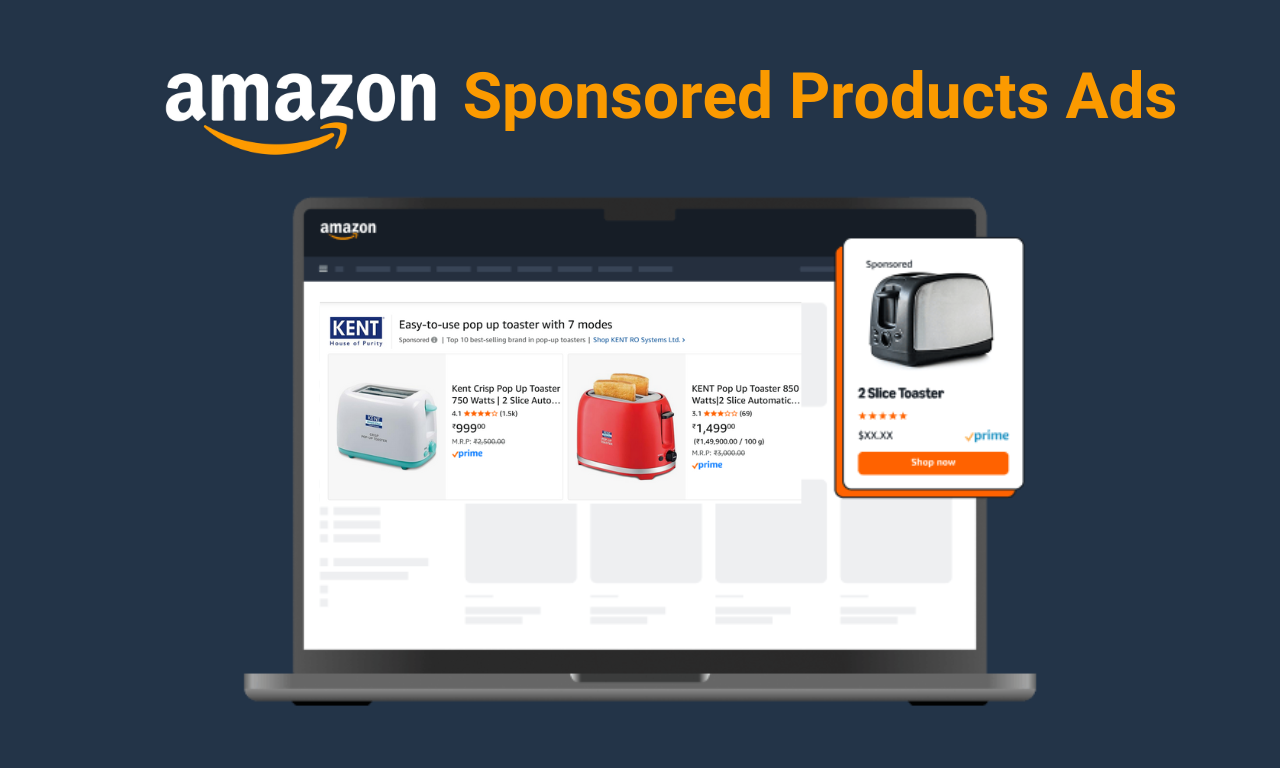
Amazon Sponsored Products are the most widely used and most commercially impactful ad format within Amazon’s advertising ecosystem. For the majority of sellers and brands, Sponsored Products account for the largest share of advertising spend and deliver the highest percentage of ad-attributed revenue. They are often the first ad format sellers experiment with, but they are also the format that sophisticated advertisers continue to rely on even at scale.
At a basic level, Amazon Sponsored Products are pay-per-click (PPC) ads that promote individual product listings directly within Amazon search results and on product detail pages. These ads closely resemble organic listings, which makes them feel native to the Amazon shopping experience. The only visible distinction is a small “Sponsored” label, but functionally, they operate within a competitive auction system driven by keywords, relevance, and performance history.
What makes Sponsored Products uniquely powerful is intent. Unlike many digital advertising channels where users are browsing or consuming content, Amazon shoppers are already in buying mode. When a seller’s product appears at the right moment for the right search query, Sponsored Products effectively shortcut the path to purchase. For founders, marketers, and PPC managers, this is why Sponsored Products are not just an awareness tool but a direct revenue lever.
What Are Amazon Sponsored Products?
Amazon Sponsored Products are auction-based ads that allow sellers to bid for visibility on Amazon’s marketplace. When a shopper searches for a keyword or views a product detail page, Amazon evaluates which Sponsored Products ads are eligible to appear. Eligibility depends on factors such as product relevance, Buy Box status, account health, and bid competitiveness.
From the advertiser’s perspective, Sponsored Products are simple to launch but complex to master. You choose which products to advertise, define how you want to target shoppers, set bids and budgets, and let Amazon deliver ads across search results and product pages. You are charged only when a shopper clicks your ad, which makes Sponsored Products inherently performance-oriented.
However, Sponsored Products are not just about visibility. Over time, they influence sales velocity, keyword relevance signals, and competitive positioning. This is why Sponsored Products are often the foundation of a broader Amazon advertising stack that includes Sponsored Brands and Sponsored Display on Amazon, each serving a different role in the funnel.
To understand how Sponsored Products compare with other ad formats, it’s useful to explore the broader ecosystem in our guide on Amazon advertising types, which explains how different formats work together rather than in isolation.
How Amazon Sponsored Products Work
Every Sponsored Products impression is the result of a real-time auction. When a shopper performs a search or opens a product detail page, Amazon instantly evaluates all Sponsored Products campaigns that are eligible for that context. Eligibility is influenced by keyword relevance, product category, historical performance, and compliance with Amazon’s advertising policies.
Once eligibility is established, Amazon runs an auction to determine which ads appear and where they appear. Importantly, the highest bid does not automatically win. Amazon also considers the likelihood that a shopper will click and convert. This means listings with strong conversion rates and relevance can often win placements at lower cost-per-click (CPC) than poorly optimised listings with higher bids.
Sponsored Products follow a cost-per-click model, meaning advertisers pay only when a shopper clicks on the ad. There are no setup fees, no monthly platform fees, and no minimum spends. When a shopper clicks the ad, they are taken directly to the product detail page, which places enormous importance on listing quality. Ads amplify whatever exists on the page; they do not compensate for weak images, unclear titles, or poor pricing.
Placements for Sponsored Products are distributed across Amazon search results and product detail pages. Top-of-search placements are the most competitive and often the most expensive, but they also tend to drive the highest conversion intent. Product detail page placements can be particularly effective for comparison shoppers, especially when targeting competitor ASINs.
Budgets are controlled through daily caps set at the campaign level. Amazon will never exceed the daily budget on a given day, but it may spend the full amount quickly if traffic demand is high. Over a month, a daily budget of ₹100 can result in spend of up to ₹3,100 in a 31-day month, assuming full utilisation.
Targeting Options in Amazon Sponsored Products
Targeting determines who sees your ads and why, and it is one of the most critical levers for profitability. Amazon Sponsored Products offer three primary targeting approaches: automatic targeting, manual keyword targeting, and product or category targeting. Each serves a distinct strategic purpose.
Automatic targeting allows Amazon to decide where your ads appear based on your product listing and historical data. This option is particularly useful for discovery, as it surfaces real shopper search terms that advertisers may not have anticipated. Automatic campaigns are often the starting point for new advertisers, but their real value lies in the data they generate rather than long-term efficiency.
Manual keyword targeting gives advertisers direct control over which search queries trigger their ads. Keywords can be matched broadly, by phrase, or exactly, depending on how tightly you want to control relevance. Over time, high-performing Sponsored Products accounts tend to concentrate spend on exact-match keywords that consistently convert within acceptable ACoS limits.
Product and category targeting allow advertisers to show ads on specific ASINs or within entire categories. This approach is particularly effective for competitor conquesting and defensive strategies. When used carefully, product targeting can capture shoppers at the comparison stage, but it requires close monitoring to ensure price parity and review strength are competitive.
A mature Sponsored Products strategy typically combines all three targeting types, using automatic campaigns for discovery, manual campaigns for efficiency, and product targeting for competitive positioning.
Setting Up a Sponsored Products Campaign
Setting up a Sponsored Products campaign is operationally simple, but strategic decisions made at this stage have long-term consequences. Advertisers begin by logging into Amazon Ads at ads.amazon.com, the platform formerly known as Amazon Marketing Services (Amazon AMS). From there, they select Sponsored Products as the campaign type and choose the products they want to advertise.
Product selection is critical. Sponsored Products perform best for listings that are Buy Box eligible, competitively priced, and supported by strong content. Sellers using Fulfillment by Amazon often see stronger results because Prime eligibility improves buyer trust and conversion rates.
After selecting products, advertisers choose their targeting method. Many experienced advertisers launch at least two campaigns per product: one automatic campaign for discovery and one manual campaign for controlled scaling. Bids are then set at the keyword or target level, and a daily budget is defined based on testing goals and risk tolerance.
Once the campaign is launched, it should not be left unattended. Sponsored Products require ongoing monitoring and optimisation, particularly in the first few weeks when Amazon is still learning how your ads perform.
For a deeper operational walkthrough, including campaign structures and optimisation workflows, our Amazon PPC guide for sellers provides a detailed execution framework.
Sponsored Products Costs & Budgets
Sponsored Products costs are driven by competition, keyword intent, and category dynamics. In India, CPCs are generally lower than in the US, but competition has intensified significantly over the last few years.
- CPC (Cost-Per-Click): Varies by category and keyword. As a benchmark, average Sponsored Products CPC is about $1.10 in the U.S. (2025) and around ₹7–₹30 in India. Highly competitive keywords cost more, while niche long-tail keywords cost less.
- Daily budgets: You control how much to spend per day. In India, many sellers start with ₹200–₹500/day. If you set ₹100/day, you could spend up to ₹3,100 in a 31-day month. Unspent budget does not roll over.
- No flat fees: There are no setup fees or monthly fees. Advertisers pay only for clicks, so overall ad spend equals total clicks × average CPC.
- Budget pacing: Amazon spends your daily budget as quickly as it finds clicks. A small budget can be used up in minutes if demand is high.
Sponsored Products Cost Benchmarks (2025)
| Market | Typical CPC Range | Strategic Insight |
|---|---|---|
| India | ₹7 – ₹30 | Long-tail keywords still offer efficiency |
| USA | ~$0.80 – $1.50 | Highly competitive, brand-driven auctions |
| High-competition niches | ₹30+ | Requires strong conversion rates |
| Branded keywords | Low to medium | Defensive, high-ROAS spend |
Budgets should be aligned with unit economics rather than arbitrary limits. Many Indian sellers start with ₹200–₹500 per day to gather data. As profitable keywords emerge, budgets can be scaled gradually. It is important to remember that Amazon does not spread budgets evenly across the month; daily caps can be exhausted quickly during peak traffic periods.
The primary efficiency metric to track is Advertising Cost of Sale (ACoS), calculated as ad spend divided by ad-attributed sales. While lower ACoS is generally desirable, context matters. Higher ACoS may be acceptable during product launches or category entry phases, especially when Sponsored Products contribute to long-term organic growth.
Best Practices & Strategy for Scaling Sponsored Products
Successful Sponsored Products campaigns are built on discipline rather than aggressive spending. One of the most important principles is ensuring that product listings are fully optimised before scaling ads. Titles, images, bullet points, and pricing directly influence conversion rates, and ads simply amplify existing performance.
Ongoing optimisation should focus on amazon keyword strategy . By reviewing which actual search queries are triggering ads and generating sales, advertisers can refine targeting, add negative keywords, and reallocate budgets toward profitable segments. This process reduces wasted spend and improves efficiency over time.
Bidding strategy should evolve as data accumulates. Initial bids should be conservative, with gradual increases applied only to keywords that demonstrate consistent profitability. Placement bid adjustments, particularly for top-of-search placements, should be used selectively and backed by performance data rather than assumptions.
Sponsored Products should not operate in isolation. Brands that scale effectively often complement Sponsored Products with Sponsored Brands for brand protection and discovery, and Sponsored Display for retargeting. A cohesive, funnel-aware plan is outlined in our Amazon advertising strategy guide, which explains how these formats work together to support growth.
Market Context: Why Sponsored Products Are More Competitive Than Ever
Amazon’s advertising business has grown into a multi-billion-dollar revenue stream, crossing $56 billion globally in 2024. Sponsored Products represent a significant portion of this revenue, which explains why competition continues to intensify. More sellers are bidding on the same keywords, driving CPCs upward and reducing the margin for error.
In this environment, simplistic strategies no longer work. Sustainable success with Sponsored Products now depends on data-driven optimisation, disciplined bidding, and integration with broader business goals. Sellers who treat Sponsored Products as a strategic system rather than a tactical experiment are far more likely to maintain profitability over time.
Conclusion
At GrowthJockey - Venture Builder, we approach Amazon Sponsored Products as a revenue system, not a standalone ad format. Our focus is on aligning Sponsored Products with unit economics, lifecycle stages, and long-term brand strategy. This includes combining Sponsored Products with Sponsored Brands and Sponsored Display, optimising listings for conversion, and continuously refining keyword and bidding strategies based on real purchase data.
For founders, marketers, and PPC managers, the objective is not just to lower ACoS, but to build a scalable, predictable Amazon advertising engine. Sponsored Products form the foundation of that engine when they are executed with structure, discipline, and strategic intent.
FAQs
Q1. What are Amazon Sponsored Products? Amazon Sponsored Products are pay-per-click ads that promote individual product listings within Amazon search results and product detail pages.
Q2. How much do Amazon Sponsored Products cost in India? CPCs typically range from ₹7 to ₹30, depending on category competition and keyword intent.
Q3. Are Sponsored Products suitable for beginners? Yes. They have no minimum spend and a low setup barrier, making them ideal for first-time advertisers.
Q4. How do Sponsored Products fit into a broader Amazon advertising strategy? They drive conversions, while formats like Sponsored Brands and Sponsored Display support brand discovery and retargeting.









Industries
Growth
Operations
Technology