
Guide to Amazon Seller Charges: FBA Fees, Ad Costs & Commisions

Selling on Amazon unlocks a huge customer base, but it's vital to understand the fees involved. Amazon's marketplace isn't free – there are commissions and service fees that can eat up 30–40% of your revenue if you're not careful. In this comprehensive guide, we break down Amazon seller charges (with a focus on India) and share tips to minimize them while growing your business. Whether you're comparing Amazon vs Flipkart for sellers or just starting out, knowing these costs will help you price and plan effectively.
Types of Amazon Seller Fees
Amazon seller fees fall into a few main categories:
- Referral Fee (Commission): A percentage cut Amazon takes on each sale.
- Closing Fee: A flat fee per unit, varying by item price and shipping method.
- Shipping/Fulfillment Fee: Charges for delivery (Easy Ship or FBA) based on weight and distance.
- FBA Service Fees: If you use Fulfillment by Amazon, extra fees for storage, packing, etc.
- Advertising Costs: Optional spending on Amazon Ads (like Amazon PPC campaigns) to boost visibility.
- Other Fees: Miscellaneous charges (high-volume listing fees, refund fees, etc.) that may apply in specific cases.
Here is a table giving you a complete breakdown of the costs associated with selling on Amazon.
| Fee Category | Description | Rate / Charge (Approx.) |
|---|---|---|
| Referral Fee | Commission charged on the total sale price; varies by product category. | 2% to 30%+ (Mobiles: ~5%, Electronics: ~8–10%, Fashion: ~15–18%, Warranties: ~30%) |
| Closing Fee | Flat fee per unit based on item price and fulfillment mode. | ₹5 to ₹65 (₹5–25 for low-priced items; ₹50+ for items above ₹1,000) |
| Weight Handling (Easy Ship) | Shipping fee based on weight and delivery distance (Local, Regional, National). | ₹30 to ₹150+ (e.g., ~₹43 for 500g Local; ~₹65 for 500g National) |
| FBA Fulfillment Fee | Combined charge for picking, packing, and shipping under FBA. | ₹40 to ₹180+ (Varies by size: Standard, Heavy, Bulky) |
| FBA Storage Fee | Monthly charge for warehouse storage space used by inventory. | ₹45–₹50 per cubic foot/month (Higher during festive peak seasons) |
| Marketplace Fee | Flat per-order fee usually shown to customers during checkout. | ₹5 (Inclusive of tax; applied to most orders) |
| Advertising (PPC) | Optional spend on Sponsored Products, Brands, or Display ads. | Variable (Controlled by seller; tracked via ACoS & TACoS) |
| Refund Admin Fee | Processing fee retained by Amazon when a refund is issued. | Lesser of ₹500 or 20% of the original referral fee |
| Removal / Disposal Fee | Fee to return unsold FBA inventory or dispose of it. | ₹10 to ₹30+ per unit (Depends on size and weight) |
| High-Volume Listing Fee | Charge for maintaining a large number of inactive listings. | ₹0.50 per dormant listing (After 12 months of no sales) |
| Long-Term Storage Fee | Additional charge for inventory stored in FBA for over 365 days. | Monthly surcharge based on volume or per-unit minimum |
| GST on Fees | Government tax applicable to all Amazon service fees. | 18% (Applied on top of all Amazon charges) |
Together, these fees typically range from 20% to 30% of each sale in total[1] – and can be higher for certain categories or heavy use of services. Below, we detail each fee type and how it impacts your bottom line.
Amazon Referral Fees (Sales Commission)
| Category | Referral Fee (if item > ₹300) | Minimum Fee |
|---|---|---|
| Mobiles, Electronics | ~5% – 8% (varies by sub-category) | ₹20 minimum |
| Books & Media | 2% (for low-price books) up to ~8% | ₹5 minimum |
| Home & Kitchen | ~15% | ₹20 minimum |
| Clothing & Accessories | ~17% (high for fashion) | ₹20 minimum |
| Beauty & Personal Care | ~15% | ₹20 minimum |
| Grocery | ~5% – 10% (food items often lower) | ₹20 minimum |
| Jewelry | ~5% – 20% (fine jewelry higher %) | ₹20 minimum |
| Automotive | ~7% – 15% (depends on part type) | ₹20 minimum |
(Table above is generalized; actual rates can have multiple price slabs. For precise fees, see Amazon's official rate card on Seller Central for your category.)
Referral fees are Amazon's commission on every sale. Amazon India charges a fixed percentage of the total item price (including shipping) for each product sold. This percentage varies by category and can be as low as 2% or as high as ~30%+ in extreme cases:
Common Range
~5% to 15% for most product categories. For example, Electronics and Books have relatively lower rates, while Fashion and Accessories often carry around 15%.
Lower-Priced Items
Many categories have tiered rates that are lower for cheaper items. For instance, books under ₹250 have just a 2% fee, rising to 12.5% for books above ₹1000. Amazon incentivizes affordability by reducing fees on low-price goods in some categories.
Highest Rates
Niche categories like jewelry or warranties carry higher fees. Gold coins have a tiny 2% fee, but general fashion jewellery can be ~22–24%, and extended warranties incur about 30% commission.
To illustrate the variation, here's a sample of Amazon.in referral fees by category:
| Category | Referral Fee |
|---|---|
| Books | 2% (item ≤ ₹250); 4% (₹251–500); 9% (₹501–1000); 12.5% (>₹1000) |
| Women's Kurtis | 15% (item ≤ ₹300); 16.5% (₹301–1000); 18% (>₹1000) |
| Mobile Phones | 5% flat |
| Fine Jewelry | 2.5% for gold coins; 5–10% for other jewelry |
| Warranty Services | 30% flat |
Table: Examples of Amazon India referral fees by category (as of 2025). Lower-priced items often have reduced rates in certain categories.
As you can see, Amazon's commission depends on what you sell and at what price. It's crucial to factor this fee into your pricing strategy. For instance, if a category's referral fee jumps above a certain price point, you might price just below that threshold to save on fees. Always consult Amazon's latest fee schedule for your category, as rates can update periodically.
Fixed Closing Fees
Amazon India's Closing Fee is a fixed charge based on the item's price band and the fulfillment channel. Here's how it works:
- For Easy Ship (Amazon arranges pickup from you and delivers to buyer) and Seller Flex, the closing fees are one rate card.
- For FBA (Fulfillment Center), closing fees are slightly different (generally a bit lower in low price ranges to incentivize FBA).
- For Self-Ship (you ship via your own courier), closing fees differ too (historically, self-ship had the highest closing fees at high price points, to encourage using Amazon logistics).
- ₹0 – ₹250 item price: ₹5 closing fee (Easy Ship), ₹7 (Self-Ship), or ₹25 (FBA)
- ₹251 – ₹500: around ₹9 (Easy Ship), ₹20 (Self-Ship), etc.
- ₹501 – ₹1000: around ₹30 (Easy Ship), ₹36 (Self-Ship), etc.
- ₹1000+: roughly ₹50–65 for higher price brackets
These fees are per unit sold and are in addition to the referral percentage. Note that FBA (Fulfillment by Amazon) closing fees can differ slightly from Easy Ship fees for the same price range. Also, certain categories like books or media in other marketplaces have their own fixed fees (e.g. Amazon US charges $1.80 closing fee on media items), but in India the price-based closing fee applies broadly.
Why does Amazon charge a closing fee? It covers transactional processing costs and is somewhat like a base charge for using the platform per sale. For sellers, this means very low-priced items still incur a minimum fee. For example, selling a ₹200 item via Easy Ship would have ₹5 closing fee – a non-trivial 2.5% of the price in addition to the referral cut. Always account for the closing fee in profitability calculations, especially if your product price is low.
Shipping & Fulfillment Fees (Easy Ship / FBA)
If Amazon is handling the delivery of your product (which is common in India through the Easy Ship program or through FBA), there will be shipping fees (weight handling charges). These are based on the weight and dimensions of the item and the delivery distance:
Easy Ship Weight Handling Fee
For sellers using Amazon's logistics to ship orders from their location, Amazon charges a fee by weight slab and shipping zone (Local, Regional, National). For example, a standard 500g package might incur about ₹30–₹50 in shipping fees locally, and higher for national delivery. An 800g package to a regional zone costs around ₹68 via Easy Ship. Heavier or bulky items have higher fees.
Self-Ship
If you handle your own shipping (self-fulfillment), Amazon doesn't charge you a shipping fee – but then you bear the courier cost directly. In that case, you'd factor your shipping cost into the item price or charge the customer.
FBA Storage Fees and Inventory Management
If you use FBA, inventory storage fees will be part of your cost structure. Amazon measures your stored inventory in cubic feet per month. As noted, currently Amazon India charges around ₹60 per cubic ft per month for standard-size items most of the year, and about ₹180+ per cubic ft per month in Q4 (festive season). Oversize items have slightly lower rates (e.g. ₹40 off-peak, ₹95 peak, per cubic ft) since bulky goods often move slower.
| Item Type | Season | Fee (₹ / cubic ft / month) | Notes |
|---|---|---|---|
| Standard-size items | Jan–Sep (Off-peak) | ~₹60 | Charged based on average daily storage |
| Standard-size items | Oct–Dec (Peak / Q4) | ₹180+ | Festive season surge pricing |
| Oversize items | Jan–Sep (Off-peak) | ~₹40 | Lower rate as bulky items move slower |
| Oversize items | Oct–Dec (Peak / Q4) | ~₹95 | Still cheaper than standard-size in Q4 |
Let's put that in practical terms. One cubic foot is about a 1'x1'x1' box. Suppose you have 100 units of a kitchen appliance and together they occupy 10 cubic ft in storage. That costs ~₹600/month Jan-Sep, and could cost ~₹1,800 for October if you still have that volume sitting. If your product has healthy turnover, you won't be paying for all 100 units' space for long – you'll sell through and Amazon only charges for the days a unit is stored (prorated daily). But if an item lingers, these fees accumulate.
Aged Inventory & Long-Term Storage Surcharges (India)
| Inventory Age | Fee Structure | Approx Cost Impact |
|---|---|---|
| 271–365 days | Aged inventory surcharge (new structure) | Additional fee on top of normal storage |
| 365+ days | Higher aged inventory surcharge | ~₹50 per cubic ft extra (approx) |
| Older structure (reference) | ₹15 per unit OR ₹15.65 per cubic ft (whichever higher) | Still useful as a baseline |
Amazon also imposes long-term storage fees (LTSF) for inventory older than 365 days. In India, LTSF is currently ₹552.5 per cubic meter (which is ₹15.65 per cubic ft) or ₹15 per unit, whichever is higher, per month for items aged >365 days. Actually, Amazon recently changed the structure: now they charge aged inventory surcharges on 271-365 days, and higher on 365+ days. The items >365 days had surcharge increased in 2024, with higher fee for products stored 365+ days. So expect roughly ₹50 per cubic foot on top of normal storage for year-old stock. This can far exceed the product's value if you're not careful.
Other Amazon Fees to Know
Beyond the core fees above, Amazon may charge a few additional fees in certain scenarios:
Amazon Marketplace Fee (₹5 per order)
As of mid-2025, Amazon.in introduced a flat ₹5 "marketplace fee" on every customer order. This is charged to the buyer as a separate line item at checkout (inclusive of tax). It's not deducted from the seller payout, but sellers should be aware of it since it effectively makes customers pay a tiny bit extra per order.
(Exceptions exist – e.g. the ₹5 fee doesn't apply to Prime Video rentals, gift cards, or certain services.)
High-Volume Listing Fee
If you have an extremely large catalog of listings that haven't sold in 12+ months, Amazon may charge a small fee (~₹0.5 or so) per dormant listing beyond a threshold. Regularly cull inactive products to avoid this.
Rental Book Service Fee
Applicable only if you rent textbooks via Amazon (₹5 per rental in the US; not common on Amazon.in).
Refund Administration Fee
When you refund a customer, Amazon returns the referral fee to you minus a small portion. Typically they keep the lesser of ₹500 or 20% of the referral fee as a processing fee on refunds.
Removal/Disposal Fees
If you use FBA and later want to remove your unsold stock from Amazon's warehouse, they charge a fee per item for removal or disposal (e.g. ₹10 per standard item for return to you).
GST
While not exactly a "fee", remember that Amazon's fees in India are subject to an 18% GST. The charges we've quoted (₹ amounts) usually exclude GST, which gets added to your seller invoice. You can claim input credit if applicable, but it's a cash flow point to note.
Most of these additional fees won't affect new or small sellers too much, but it's good to be aware as your business scales. For example, if you're selling hundreds of products, keep an eye on inventory age to avoid long-term storage or listing fees.
Advertising Costs on Amazon
Besides the fees Amazon charges per sale, many sellers also incur costs for advertising on Amazon. Using Amazon's advertising platform (Amazon Marketing Services, now the Amazon Ads console) can dramatically boost your product visibility – but it comes at a price, which you control as a budget rather than Amazon mandating it. Leveraging different types of amazon ads can help you tap in untapped revenue.
Types of Amazon Ads
Sellers can run pay-per-click campaigns such as Sponsored Products, Sponsored Brands, and even Sponsored Display Ads (visual banners). With these, you bid on keywords or audiences, similar to Google Ads. Every click on your ad costs you money, and it's deducted from your seller account balance. The cost per click (CPC) depends on how competitive the keywords are – popular product keywords can be pricey.
Advertising spend is optional, but in competitive categories it's often necessary to jumpstart sales. Many Amazon sellers aim for an ACoS (Advertising Cost of Sales) that is profitable - for example, spending 10% of your sales revenue on ads. There's also TACoS (Total Advertising Cost of Sales), which measures ad spend as a percentage of total sales (including organic sales). Keeping an eye on TACoS vs ACoS is crucial for balanced growth – ACoS tells you immediate ad efficiency, while TACoS shows if your overall business is scaling efficiently with ads.
Pro Tip: ACoS and TACoS metrics can guide your ad strategy. A rising TACoS means ad spend is growing faster than sales – possibly unsustainable. The goal is often to lower TACoS over time by boosting organic sales (through better Amazon SEO and ratings) while keeping ACoS in check. Our in-depth discussion on Amazon PPC covers how to optimize campaigns at different stages of product growth.
Budgeting for Ads
There's no fixed "fee" for advertising – you might spend ₹5,000 or ₹5,00,000 a month depending on your scale and strategy. A new seller might start with a small daily budget (say ₹500/day) to gather traction. It's important to measure results; for instance, if you spend ₹1000 on ads and it generates ₹5000 in additional sales, your ACoS is 20%. Whether that's good depends on your profit margins. Many brands also invest in display ads for brand awareness, or run lightning deals (which involve promo fees).
To minimize advertising costs, focus on relevant keywords and good targeting. The science of keywords in Google Ads similarly applies to Amazon – choosing the right keywords can prevent wasted spend on irrelevant clicks.
Also, ensure your product listings are optimized (great images, titles, descriptions), because a well-optimized listing converts better, giving you more sales per ad click. In short, ads should be seen as an investment to drive sales; use them smartly so they boost your overall profits, not just Amazon's. For more on advanced Amazon ad strategies, check out our piece on AI-optimized campaigns for Amazon & Flipkart, which explores how machine learning can improve campaign ROI.
Putting It All Together: Example of Amazon Fees
It's helpful to see how all these charges add up in a real scenario. Let's say you sell a product on Amazon.in for ₹1000. Here's a hypothetical breakdown of costs and profit:
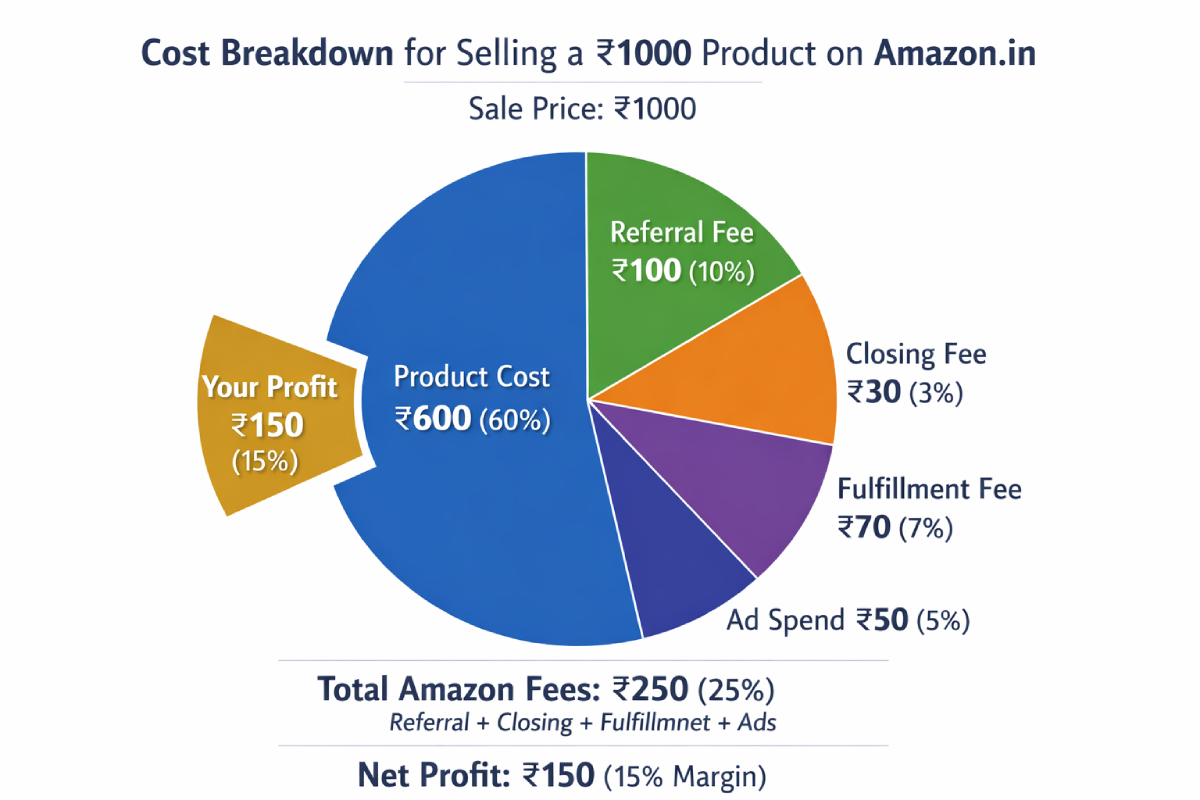
Example: You source the item for ₹600. Amazon's referral fee (assuming 10% category) is ₹100. Closing fee for ₹1000 might be ~₹30. Shipping/fulfillment fee is say ₹70 (for packing and delivering a standard package). You also spent about ₹50 on Amazon ads to sell this unit. Amazon's total cut here is ₹250 (25% of sale). After your ₹600 cost, you're left with ₹150 profit (15% margin). If ads were lower or if you self-ship to save ₹20, you could profit more; if fees were higher (e.g. heavier item), profit would shrink. This example shows why tracking all fees is critical – they directly affect your margins.
In many cases, around 1/3 of the selling price can go to Amazon when using FBA and advertising[2]. Top sellers succeed by accounting for these costs upfront and optimizing every component.
Tips to Minimize FBA Costs (2026 and Beyond)
Amazon periodically updates fees (usually annually around January and sometimes mid-year). As of 2026, here are some strategies to keep your Amazon fulfillment costs as low as possible:
-
Price Strategically: Take advantage of the ₹300 referral fee waiver. If you have multiple low-cost items, consider bundling them into a single pack so that the combined price crosses ₹300 (if you want to avoid the perception of "cheap" products) or keep items at ₹299 to pay no commission – test which approach yields better profits. Also, keep an eye on referral fee promotions Amazon announces (they sometimes reduce fees in certain categories temporarily). Advanced sellers use TACoS vs ACoS analysis to decide where ads genuinely support growth versus where they just burn margin.
-
Optimize Packaging Weight/Size: As mentioned, reduce dimensional weight. Use lightweight packaging materials. Every 100g shaved off can drop you into a cheaper FBA fee bracket. Similarly, ensure your product dimensions don't accidentally push you from "standard" to "oversize" – even a centimeter over a limit can double the fee. Designing your product and its packaging with shipping optimization in mind is a smart move in 2026.
-
Use Amazon's Free Programs: When launching new products, enroll in the FBA New Selection program if eligible – Amazon often offers free storage, free removals, and even free inbound shipping credits for new-to-FBA ASINs for a limited time. This can significantly cut cost in the first 3-6 months while you gauge product performance. Also consider Amazon's Small and Light program if your item is under a certain price/weight – in some markets, Amazon offers lower fulfillment fees for very small items, though in India the new ≤₹300 zero-referral program largely supersedes this.
-
Inventory Turnover: We can't stress this enough – avoid long-term storage charges. Plan your inventory. If something isn't selling, don't just let it sit. You can create a removal order (₹10 per item is often cheaper than paying ₹50+ in storage for another few months). Or run a promotion/advertising to move it. Using tools like AI-optimized campaigns for Amazon can help efficiently boost product visibility without overspending on ads. Sometimes a small ad spend to sell items faster can save you big on storage fees.
-
Leverage Multi-Channel Fulfillment: If you sell on your own website or other platforms, fulfill those orders from your Amazon inventory using MCF (Multi-Channel Fulfillment)](https://www.growthjockey.com/blogs/amazon-mcf-multi-channel-fulfillment). It costs slightly more than FBA (since Prime branding is not on these orders), but it's still often cheaper than holding separate stock and shipping yourself. This way, your FBA stock yields sales across multiple channels – improving overall sell-through and lowering the chance of paying long-term fees.
-
Monitor Fee Changes: Amazon's fee changes in 2024–2025 included things like introducing an Aged Inventory surcharge and raising some fulfillment fees, but also reducing off-peak storage fees and lowering small parcel rates. They even offered fee reductions for certain programs (e.g. a Low-Price FBA fee in some markets, or discounts for using Amazon's preferred shipping). Stay tuned to Amazon Seller Central announcements. Make it a habit to review your fee invoices periodically – if something looks off, investigate if a new fee was introduced. Knowledge is power; if you know fees are going up in a certain area, you can adapt your strategy (e.g. raise your prices slightly, or find cost savings elsewhere). For more strategies that improve unit economics, explore our guide on how to increase sales on Amazon.
-
Consider Alternatives for Heavy/Bulky Items: If you sell very large items (e.g. furniture, gym equipment), FBA fees will be steep (because of volumetric weight). In such cases, you might fulfill those by yourself or via Amazon's Seller Flex (where you keep inventory but Amazon treats it as Prime from your warehouse). Amazon logistics franchise options (such as their delivery partner programs) could also help you manage heavy shipments at lower cost – see our piece on the Amazon logistics franchise for insight on leveraging Amazon's network without full FBA for bulky goods. The idea is to use FBA where it makes economic sense and alternative fulfillment where it doesn't.
-
Reduce Dependency on Paid Ads with Organic Growth: Every organic sale saves you advertising costs. Investing in Amazon SEO better titles, keyword optimization, strong images, and genuine reviews helps products rank naturally.
By combining these tactics, you can significantly improve your profit margin on Amazon. Many top sellers operate on razor-thin margins but succeed through volume and cost optimization. For instance, they'll aggressively drive sales using Amazon Pay-Per-Click ads and Amazon Display Advertising to increase their Best Seller Rank (BSR), which generates organic sales (free traffic). Higher sales velocity can also earn you the Amazon Best Seller badge – which further boosts conversion (we've covered how to earn and benefit from the Best Seller badge here). All of these efforts contribute to diluting fixed costs and improving economies of scale.
How GrowthJockey Can Help
Navigating Amazon's fee structure and optimizing ads can be complex. This is where partnering with experts can give you an edge. GrowthJockey positions itself as a full-stack venture builder that not only mentors businesses but also runs performance marketing campaigns to augment a company's growth. We have built systems and AI tools to help sellers dominate on Amazon – from automating campaign optimizations to fine-tuning your product listings for maximum conversion.
In short, we act as growth partners: handling the heavy lifting of Amazon advertising, data analysis, and strategy, so you can focus on product and supply. By using techniques like AI-optimized campaigns and deep data insights, we help reduce wasted ad spend, improve organic rankings, and ultimately boost your ROI on Amazon. As a venture builder, GrowthJockey's goal is to scale ventures in a sustainable way – that means paying close attention to metrics like fees, ACoS, and margins, not just top-line sales. If Amazon's rules or costs feel overwhelming, remember you don't have to do it alone.
Frequently Asked Questions
Q1. How much does Amazon charge its sellers?
Amazon mainly charges a referral fee (commission), usually 8–15% for most categories in India, though it can range from ~2% to 30% depending on the product. Sellers also pay a closing fee per order and shipping or FBA fees based on weight and distance. If you use Amazon Ads, advertising spend is extra. Overall, sellers typically give up around 20–30% of the sale value in total fees
Q2. How much will it cost to start selling on Amazon?
Creating a seller account on Amazon.in is free. You can choose the Individual plan (no monthly fee, per-item charge) or the Professional plan (monthly subscription). Your main upfront costs are inventory, GST registration, packaging, and optional advertising. Most Amazon fees apply only after you start getting orders.
Q3. What is Amazon’s ₹5 charge?
The ₹5 charge is a marketplace fee added to customer orders on Amazon.in, not a seller fee. It is paid by the buyer at checkout and does not reduce the seller’s payout. Some categories are exempt, but for most products the fee applies. Sellers only need to be aware of it from a pricing and customer-experience perspective.
Q4. How much do Amazon FBA sellers in India typically take home as profit?
Amazon FBA sellers usually aim for 10%–20% net profit margins after all fees and advertising costs. For a ₹1,000 product, this often translates to ₹150–₹200 profit per unit. Experienced sellers may achieve higher margins, while high-volume sellers often work on thinner margins. Profitability improves as sourcing, ads, and operations are optimized.









Industries
Growth
Operations
Technology